Radunz Sonia, Benkö Tamás, Stern Sabrina, Saner Fuat H, Paul Andreas, Kaiser Gernot M
Department of General, Visceral and Transplantation Surgery, University Hospital Essen, Hufelandstr. 55, 45147, Essen, Germany.
Eur J Med Res. 2015 Mar 12;20(1):23. doi: 10.1186/s40001-015-0116-6.
One of the main reasons for organ shortage is insufficient education on organ donation. Knowledgeable medical students could share the information with friends and families resulting in a positive attitude to organ donation of the general public.
During six consecutive years (2009 to 2014), we conducted a voluntary, anonymous educational intervention study on organ donation among fourth year medical students in the course of the main surgery lecture at the University of Essen, Germany.
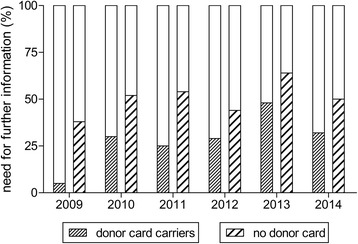
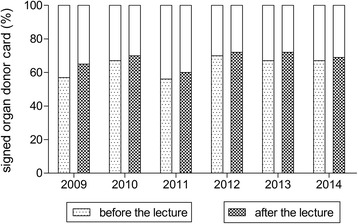
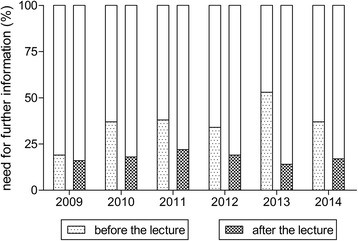
Questionnaires of 383 students were analyzed. Prior to the specific lecture on organ donation, 64% of the students carried a signed organ donor card with the intention to donate. Further information regarding organ donation was required by 37% of the students. The request for further information was statistically significantly higher among students without a donor card compared to organ donor card carriers (P < 0.0001). After the lecture, the number of students requiring further information decreased statistically significantly to 19% (P < 0.0001).
Already a 45-minute lecture for fourth year medical students significantly decreases their request for further information on organ donation and improves their attitude to organ donation. Continued training on organ donation will help medical students to become disseminators for this important topic in our society.
器官短缺的主要原因之一是器官捐献教育不足。知识丰富的医学生可以与朋友和家人分享信息,从而使公众对器官捐献持积极态度。
在连续六年(2009年至2014年)期间,我们在德国埃森大学主外科讲座课程中,对四年级医学生进行了一项关于器官捐献的自愿、匿名教育干预研究。
分析了383名学生的问卷。在关于器官捐献的特定讲座之前,64%的学生持有签署的器官捐献卡并有捐献意愿。37%的学生需要更多关于器官捐献的信息。与持有捐献卡的学生相比,没有捐献卡的学生对更多信息的需求在统计学上显著更高(P < 0.0001)。讲座后,需要更多信息的学生人数在统计学上显著降至19%(P < 0.0001)。
为四年级医学生举办一场45分钟的讲座,就能显著减少他们对器官捐献更多信息的需求,并改善他们对器官捐献的态度。持续的器官捐献培训将帮助医学生成为我们社会中这个重要话题的传播者。