Harricharan Rivona, Thaver Veneesha, Russell Vivienne A, Daniels William M U
School of Laboratory Medicine and Medical Sciences, Discipline of Human Physiology, University of KwaZulu-Natal, Westville Campus, Private Bag X 54001, Durban, 4000, South Africa.
Behav Brain Funct. 2015 Feb 7;11:3. doi: 10.1186/s12993-014-0047-3.
HIV-1 is a global catastrophe, and is exceedingly prevalent in Sub-Saharan Africa. HIV-associated neurocognitive disorder is characterized by symptoms such as motor impairments, a decline in cognition, and behavioural irregularities. The aim of this study was to provide insight into the fundamental behavioural and histopathological mechanisms underlying the development and progression of HIV-1 neuropathology.
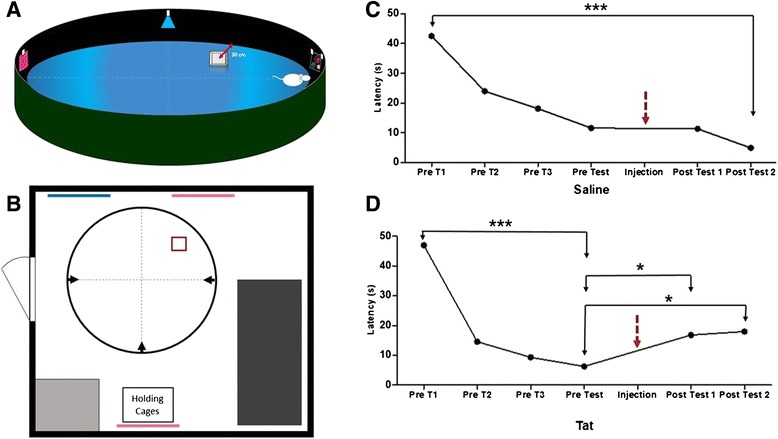
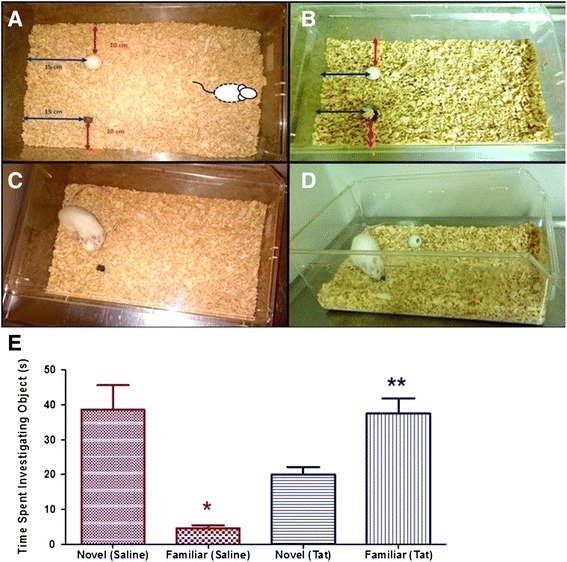
Using stereotaxic techniques, Tat protein Clade B (1 μg/μl, 10 μl) was injected bilaterally into the dorsal hippocampus of male Sprague-Dawley rats. The Morris water maze (MWM) and novel object recognition test (NORT) were used to assess spatial learning and recognition memory, respectively. Haematoxylin and eosin staining was used to identify the histopathological changes.
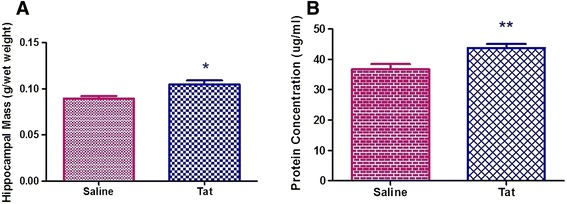
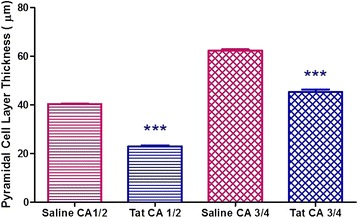
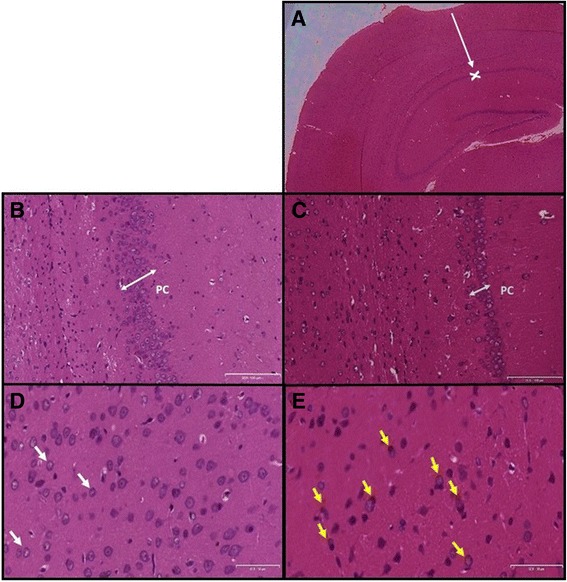
A highly significant increase in latency to reach the hidden platform in the MWM implied that noteworthy hippocampal damage had occurred. Severe behavioural deficits were also observed in the NORT where the Tat-injected group showed a greater preference for a familiar object over a novel one. This damage was confirmed by the histopathological changes (increased astrogliosis, cells becoming eosinophilic and a significant reduction in the pyramidal cell layer) observed in the hippocampus. Additionally, increases in the hippocampal mass and protein were observed, consistent with the structural alterations.
This study highlights the relationship between hippocampal-associated behavioural changes and histologic alterations following stereotaxic intra-hippocampal administration of Tat protein in rats. The implications of this study may positively impact the fields of immunology and neuroscience by encouraging future researchers to consider novel strategies to understand the complexities of the pathogenesis of HIV-associated neurocognitive disorder.
HIV-1是一场全球性灾难,在撒哈拉以南非洲极为普遍。HIV相关神经认知障碍的特征包括运动障碍、认知能力下降和行为异常等症状。本研究的目的是深入了解HIV-1神经病理学发展和进展背后的基本行为和组织病理学机制。
采用立体定位技术,将B亚型Tat蛋白(1μg/μl,10μl)双侧注射到雄性Sprague-Dawley大鼠的背侧海马体中。分别使用莫里斯水迷宫(MWM)和新物体识别测试(NORT)来评估空间学习和识别记忆。苏木精和伊红染色用于识别组织病理学变化。
在MWM中到达隐藏平台的潜伏期显著增加,这意味着海马体发生了明显损伤。在NORT中也观察到严重的行为缺陷,注射Tat蛋白的组对熟悉物体的偏好高于新物体。海马体中观察到的组织病理学变化(星形胶质细胞增生增加、细胞嗜酸性变以及锥体细胞层显著减少)证实了这种损伤。此外,观察到海马体质量和蛋白质增加,与结构改变一致。
本研究突出了大鼠海马体立体定向注射Tat蛋白后海马体相关行为变化与组织学改变之间的关系。本研究的意义可能通过鼓励未来研究人员考虑新策略来理解HIV相关神经认知障碍发病机制的复杂性,从而对免疫学和神经科学领域产生积极影响。