• 文献检索
  • 文档翻译
  • 深度研究
  • 学术资讯
  • Suppr Zotero 插件Zotero 插件
  • 邀请有礼
  • 套餐&价格
  • 历史记录
应用&插件
Suppr Zotero 插件Zotero 插件浏览器插件Mac 客户端Windows 客户端微信小程序
定价
高级版会员购买积分包购买API积分包
服务
文献检索文档翻译深度研究API 文档MCP 服务
关于我们
关于 Suppr公司介绍联系我们用户协议隐私条款
关注我们

Suppr 超能文献

核心技术专利:CN118964589B侵权必究
粤ICP备2023148730 号-1Suppr @ 2026

文献检索

告别复杂PubMed语法,用中文像聊天一样搜索,搜遍4000万医学文献。AI智能推荐,让科研检索更轻松。

立即免费搜索

文件翻译

保留排版,准确专业,支持PDF/Word/PPT等文件格式,支持 12+语言互译。

免费翻译文档

深度研究

AI帮你快速写综述,25分钟生成高质量综述,智能提取关键信息,辅助科研写作。

立即免费体验

尼日利亚产前护理利用的障碍:来自未使用者的证据及其对孕产妇健康规划的影响。

Barriers to antenatal care use in Nigeria: evidences from non-users and implications for maternal health programming.

作者信息

Fagbamigbe Adeniyi Francis, Idemudia Erhabor Sunday

机构信息

School of Research and Postgraduate Studies (SoRPS), Faculty of Human and Social Sciences, North West University, Mafikeng, South Africa.

Department of Epidemiology and Medical Statistics, Faculty of Public Health, College of Medicine, University of Ibadan, Ibadan, Nigeria.

出版信息

BMC Pregnancy Childbirth. 2015 Apr 17;15:95. doi: 10.1186/s12884-015-0527-y.

DOI:10.1186/s12884-015-0527-y
PMID:25885481
原文链接:https://pmc.ncbi.nlm.nih.gov/articles/PMC4407543/
Abstract

BACKGROUND

In Nigeria, over one third of pregnant women do not attend Antenatal Care (ANC) service during pregnancy. This study evaluated barriers to the use of ANC services in Nigeria from the perspective of non-users.

METHODS

Records of the 2199 (34.9%) respondents who did not use ANC among the 6299 women of childbearing age who had at least one child within five years preceding the 2012 National HIV/AIDS and Reproductive Health Survey (NARHS Plus II), were used for this analysis. The barriers reported for not visiting any ANC provider were assessed vis-à-vis respondents' social demographic characteristics, using multiple response data analysis techniques and Pearson chi-square test at 5% significance level.

RESULTS

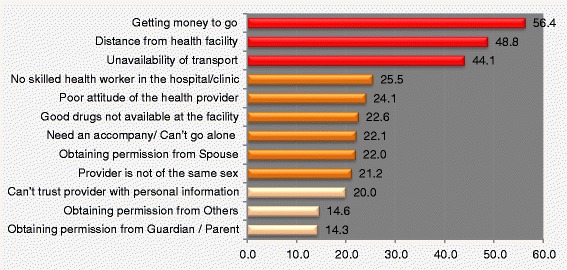
Of the mothers who did not use ANC during five years preceding the survey, rural dwellers were the majority (82.5%) and 57.3% had no formal education. Most non-users (96.5%) were employed while 93.0% were currently married. North East with 51.5% was the geographical zone with highest number of non-users compared with 14.3% from the South East. Some respondents with higher education (2.0%) and also in the wealthiest quintiles (4.2%) did not use ANC. The reasons for non-use of ANC varied significantly with respondents' wealth status, educational attainment, residence, geographical locations, age and marital status. Over half (56.4%) of the non-users reported having a problem with getting money to use ANC services while 44.1% claimed they did not attend ANC due to unavailability of transport facilities. The three leading problems: "getting money to go", "Farness of ANC service providers" and "unavailability of transport" constituted 44.3% of all barriers. Elimination of these three problems could increase ANC coverage in Nigeria by over 15%.

CONCLUSION

Non-use of ANC was commonest among the poor, rural, currently married, less educated respondents from Northern Nigeria especially the North East zone. Affordability, availability and accessibility of ANC providers are the hurdles to ANC utilization in Nigeria. Addressing financial and other barriers to ANC use, quality improvement of ANC services to increase women's satisfaction and utilization and ensuring maximal contacts among women, society, and ANC providers are surest ways to increasing ANC coverage in Nigeria.

摘要

背景

在尼日利亚,超过三分之一的孕妇在孕期未接受产前保健(ANC)服务。本研究从非使用者的角度评估了尼日利亚使用ANC服务的障碍。

方法

在2012年全国艾滋病毒/艾滋病及生殖健康调查(NARHS Plus II)前五年内至少育有一个子女的6299名育龄妇女中,2199名(34.9%)未使用ANC服务的受访者记录被用于本分析。针对未就诊于任何ANC服务提供者所报告的障碍,采用多响应数据分析技术和5%显著性水平的Pearson卡方检验,根据受访者的社会人口特征进行评估。

结果

在调查前五年内未使用ANC服务的母亲中,农村居民占多数(82.5%),57.3%未接受过正规教育。大多数非使用者(96.5%)有工作,93.0%目前已婚。东北地区非使用者数量最多,占51.5%,而东南部为14.3%。一些受过高等教育(2.0%)以及处于最富有五分位数的受访者(4.2%)也未使用ANC服务。未使用ANC服务的原因因受访者的财富状况、教育程度、居住地、地理位置、年龄和婚姻状况而有显著差异。超过一半(56.4%)的非使用者报告称使用ANC服务缺钱,44.1%称因交通不便未接受ANC服务。三个主要问题:“没钱前往”、“ANC服务提供者距离远”和“交通不便”占所有障碍的44.3%。消除这三个问题可使尼日利亚的ANC覆盖率提高超过15%。

结论

在尼日利亚,尤其是东北地区,贫困、农村、已婚、受教育程度较低的受访者中,未使用ANC服务的情况最为普遍。ANC服务提供者的可负担性、可及性和可达性是尼日利亚ANC服务利用的障碍。解决ANC服务使用的经济和其他障碍,提高ANC服务质量以增加妇女的满意度和利用率,并确保妇女、社会和ANC服务提供者之间的最大程度接触,是提高尼日利亚ANC覆盖率的最可靠方法。
https://cdn.ncbi.nlm.nih.gov/pmc/blobs/ec6b/4407543/75d5c5ece906/12884_2015_527_Fig2_HTML.jpg
https://cdn.ncbi.nlm.nih.gov/pmc/blobs/ec6b/4407543/954a76bc7d1c/12884_2015_527_Fig1_HTML.jpg
https://cdn.ncbi.nlm.nih.gov/pmc/blobs/ec6b/4407543/75d5c5ece906/12884_2015_527_Fig2_HTML.jpg
https://cdn.ncbi.nlm.nih.gov/pmc/blobs/ec6b/4407543/954a76bc7d1c/12884_2015_527_Fig1_HTML.jpg
https://cdn.ncbi.nlm.nih.gov/pmc/blobs/ec6b/4407543/75d5c5ece906/12884_2015_527_Fig2_HTML.jpg

相似文献

1
Barriers to antenatal care use in Nigeria: evidences from non-users and implications for maternal health programming.尼日利亚产前护理利用的障碍:来自未使用者的证据及其对孕产妇健康规划的影响。
BMC Pregnancy Childbirth. 2015 Apr 17;15:95. doi: 10.1186/s12884-015-0527-y.
2
Wealth and antenatal care utilization in Nigeria: Policy implications.尼日利亚的财富与产前保健利用情况:政策影响
Health Care Women Int. 2017 Jan;38(1):17-37. doi: 10.1080/07399332.2016.1225743. Epub 2016 Aug 18.
3
Utilization of maternal health care services among married adolescent women: insights from the Nigeria Demographic and Health Survey, 2008.已婚青少年女性利用妇幼保健服务的情况:来自 2008 年尼日利亚人口与健康调查的见解。
Womens Health Issues. 2012 Jul-Aug;22(4):e407-14. doi: 10.1016/j.whi.2012.05.001.
4
Geographical differentials in uptake of antenatal care services in Nigeria.尼日利亚产前护理服务利用情况的地理差异。
Health Care Women Int. 2018 Jan;39(1):34-49. doi: 10.1080/07399332.2017.1388804. Epub 2017 Nov 28.
5
Assessment of quality of antenatal care services in Nigeria: evidence from a population-based survey.尼日利亚产前护理服务质量评估:基于人群调查的证据
Reprod Health. 2015 Sep 18;12:88. doi: 10.1186/s12978-015-0081-0.
6
Antenatal care satisfaction in a developing country: a cross-sectional study from Nigeria.发展中国家的产前保健满意度:来自尼日利亚的横断面研究。
BMC Public Health. 2018 Mar 20;18(1):368. doi: 10.1186/s12889-018-5285-0.
7
Seeking evidence to support efforts to increase use of antenatal care: a cross-sectional study in two states of Nigeria.寻找支持增加产前护理使用量的证据:尼日利亚两个州的横断面研究
BMC Pregnancy Childbirth. 2014 Nov 20;14:380. doi: 10.1186/s12884-014-0380-4.
8
Barriers for pregnant women living in rural, agricultural villages to accessing antenatal care in Cambodia: A community-based cross-sectional study combined with a geographic information system.柬埔寨农村农业村庄孕妇获得产前护理的障碍:基于社区的横断面研究结合地理信息系统。
PLoS One. 2018 Mar 19;13(3):e0194103. doi: 10.1371/journal.pone.0194103. eCollection 2018.
9
Why do rural women in the most remote and poorest areas of Zambia predominantly attend only one antenatal care visit with a skilled provider? A qualitative inquiry.为什么赞比亚最偏远和最贫困地区的农村妇女主要只接受一次由专业医护人员提供的产前检查?一项定性调查。
BMC Health Serv Res. 2018 Jun 5;18(1):409. doi: 10.1186/s12913-018-3212-9.
10
Sub-national analysis and determinants of numbers of antenatal care contacts in Nigeria: assessing the compliance with the WHO recommended standard guidelines.尼日利亚省际间产前保健接触次数的分析及影响因素:评估其对世界卫生组织推荐标准指南的遵从性。
BMC Pregnancy Childbirth. 2021 May 25;21(1):402. doi: 10.1186/s12884-021-03837-y.

引用本文的文献

1
Experiences with facility delivery services within the context of a maternal neonatal health project in Gombe State, Northeast Nigeria: a qualitative study.尼日利亚东北部贡贝州一项孕产妇新生儿健康项目背景下的设施分娩服务体验:一项定性研究
Pan Afr Med J. 2025 May 14;51:16. doi: 10.11604/pamj.2025.51.16.43132. eCollection 2025.
2
Individual-level and community-level determinants of the number of antenatal care visits in emerging regions of Ethiopia: a negative binomial model.埃塞俄比亚新兴地区产前检查次数的个体层面和社区层面决定因素:负二项式模型
BMJ Open. 2025 Jul 16;15(7):e086571. doi: 10.1136/bmjopen-2024-086571.
3

本文引用的文献

1
The quality-coverage gap in antenatal care: toward better measurement of effective coverage.产前保健中的质量-覆盖差距:迈向有效覆盖的更好衡量方法。
Glob Health Sci Pract. 2014 Apr 8;2(2):173-81. doi: 10.9745/GHSP-D-13-00176. eCollection 2014 May.
2
Ending preventable maternal deaths: the time is now.终结可预防的孕产妇死亡:刻不容缓。
Lancet Glob Health. 2013 Oct;1(4):e176-7. doi: 10.1016/S2214-109X(13)70059-7. Epub 2013 Aug 19.
3
Performance based financing and uptake of maternal and child health services in yobe sate, northern Nigeria.
Adherence to Iron and Folic Acid Supplementation and its determinants among pregnant women in East Africa: Analysis of Demographic and Health Surveys data from nine East African countries.
东非孕妇对铁和叶酸补充剂的依从性及其决定因素:对来自九个东非国家的人口与健康调查数据的分析
PLoS One. 2025 Jul 16;20(7):e0327410. doi: 10.1371/journal.pone.0327410. eCollection 2025.
4
Trends and determinants of antenatal, intranatal, and postnatal care utilization among Indonesian women (2012-2017): associated factors in midwifery service utilization between midwives and other health professionals.印度尼西亚妇女产前、产时和产后护理利用情况的趋势及决定因素(2012 - 2017年):助产士与其他卫生专业人员在助产服务利用方面的相关因素
BMC Nurs. 2025 Jul 14;24(1):912. doi: 10.1186/s12912-025-03527-6.
5
Spatial disparities of antenatal care utilization among pregnant women in sub-Saharan Africa-Bayesian geo-additive modelling approach.撒哈拉以南非洲地区孕妇产前护理利用情况的空间差异——贝叶斯地理加性建模方法
Front Public Health. 2025 Jun 27;13:1517724. doi: 10.3389/fpubh.2025.1517724. eCollection 2025.
6
Antenatal care visits and associated factors in Senegal: a multilevel poisson regression analysis of the 2023 DHS survey.塞内加尔的产前检查就诊情况及相关因素:对2023年人口与健康调查的多层次泊松回归分析
Front Glob Womens Health. 2025 May 27;6:1524361. doi: 10.3389/fgwh.2025.1524361. eCollection 2025.
7
Association between the Survey-based Women's Empowerment (SWPER) index and barriers to healthcare in sub-Saharan Africa.基于调查的妇女赋权(SWPER)指数与撒哈拉以南非洲地区医疗保健障碍之间的关联。
Int Health. 2025 Sep 3;17(5):734-744. doi: 10.1093/inthealth/ihaf023.
8
Reasons for maternal near-miss in Bahir Dar city administration, northwest Ethiopia: a qualitative interview approach using socio-ecological model.埃塞俄比亚西北部巴赫达尔市辖区孕产妇险些死亡的原因:采用社会生态模型的定性访谈方法
Front Glob Womens Health. 2025 Apr 23;6:1535379. doi: 10.3389/fgwh.2025.1535379. eCollection 2025.
9
Delay in timing of first antenatal care utilisation among women of reproductive age in sub-Saharan Africa: a multilevel mixed effect analysis.撒哈拉以南非洲育龄妇女首次产前检查利用时间的延迟:多层次混合效应分析
J Health Popul Nutr. 2025 Apr 28;44(1):139. doi: 10.1186/s41043-025-00857-8.
10
Intention to use eight antenatal care model and associated factors among pregnant women who come for antenatal care in Amhara Region Referral Hospitals, Ethiopia.埃塞俄比亚阿姆哈拉地区转诊医院接受产前护理的孕妇使用八种产前护理模式的意向及相关因素。
Heliyon. 2025 Feb 11;11(4):e42633. doi: 10.1016/j.heliyon.2025.e42633. eCollection 2025 Feb 28.
基于绩效的融资与尼日利亚北部约贝州妇幼保健服务的利用情况
Glob J Health Sci. 2013 Jan 29;5(3):34-41. doi: 10.5539/gjhs.v5n3p34.
4
Pattern and determinants of antenatal booking at abakaliki southeast Nigeria.尼日利亚东南部阿巴卡利基的产前登记模式及决定因素
Ann Med Health Sci Res. 2012 Jul;2(2):169-75. doi: 10.4103/2141-9248.105666.
5
Why do women not use antenatal services in low- and middle-income countries? A meta-synthesis of qualitative studies.为什么在中低收入国家,女性不使用产前服务?一项定性研究的荟萃分析。
PLoS Med. 2013;10(1):e1001373. doi: 10.1371/journal.pmed.1001373. Epub 2013 Jan 22.
6
The influence of distance and level of service provision on antenatal care use in rural Zambia.距离和服务提供水平对赞比亚农村地区产前护理利用的影响。
PLoS One. 2012;7(10):e46475. doi: 10.1371/journal.pone.0046475. Epub 2012 Oct 4.
7
Wealth and antenatal care use: implications for maternal health care utilisation in Ghana.财富与产前保健利用:对加纳产妇保健利用的影响。
Health Econ Rev. 2012 Aug 6;2(1):14. doi: 10.1186/2191-1991-2-14.
8
Clinical audit of antenatal service provision in Nigeria.尼日利亚产前服务提供情况的临床审计
Health Care Women Int. 2011 May;32(5):441-52. doi: 10.1080/07399332.2010.517878.
9
Factors associated with underutilization of antenatal care services in Indonesia: results of Indonesia Demographic and Health Survey 2002/2003 and 2007.与印度尼西亚产前护理服务利用不足相关的因素:2002/2003 年和 2007 年印度尼西亚人口与健康调查结果。
BMC Public Health. 2010 Aug 16;10:485. doi: 10.1186/1471-2458-10-485.
10
Comparison of HIV prevalence estimates from antenatal care surveillance and population-based surveys in sub-Saharan Africa.撒哈拉以南非洲地区产前保健监测与基于人群的调查所得艾滋病毒流行率估计值的比较。
Sex Transm Infect. 2008 Aug;84 Suppl 1(Suppl_1):i78-i84. doi: 10.1136/sti.2008.030106.