Giraldo Carlos E, Álvarez María E, Carmona Jorge U
Grupo de Investigación Terapia Regenerativa, Departamento de Salud Animal, Universidad de Caldas, Manizales, Colombia.
BMC Vet Res. 2015 Mar 14;11:60. doi: 10.1186/s12917-015-0370-4.
There is a lack information on the effects of the most commonly used anticoagulants for equine platelet rich plasmas (PRPs) elaboration on cell counts and growth factor release from platelet rich gels (PRGs). The aims of this study were 1) to compare the effects of the anticoagulants sodium citrate (SC), acid citrate dextrose solution A (ACD-A) and ACD-B on platelet (PLT), leukocyte (WBC) and on some parameters associated to platelet activation including mean platelet volume (MPV) and platelet distribution width (PDW) between whole blood, pure PRP (P-PRP) and platelet-poor plasma (PPP); 2) to compare transforming growth factor beta 1 (TGF-β(1)) and platelet-derived growth factor isoform BB (PDGF-BB) concentrations in supernatants from pure PRG (P-PRG), platelet-poor gel (PPG), P-PRP lysate (positive control) and plasma (negative control); 3) to establish the possible correlations between all the studied cellular and molecular parameters.
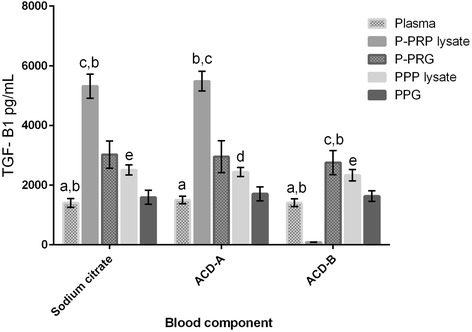
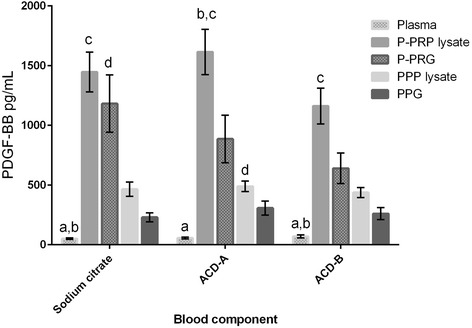
In all cases the three anticoagulants produced P-PRPs with significantly higher PLT counts compared with whole blood and PPP. The concentrations of WBCs were similar between P-PRP and whole blood, but significantly lower in PPP. The type of anticoagulant did not significantly affect the cell counts for each blood component. The anticoagulants also did not affect the MPV and PDW parameters. Independently of the anticoagulant used, all blood components presented significantly different concentrations of PDGF-BB and TGF-β(1). The highest growth factor (GF) concentrations were observed from P-PRP lysates, followed by PRG supernatants, PPP lysates, PPG supernatants and plasma. Significant correlations were observed between PLT and WBC counts (ρ = 0.80), PLT count and TGF-β(1) concentration (ρ = 0.85), PLT count and PDGF-BB concentration (ρ = 0.80) and PDGF-BB and TGF-β(1) concentrations (ρ = 0.75). The type of anticoagulant was not correlated with any of the variables evaluated.
The anticoagulants did not significantly influence cell counts or GF concentrations in equine PRP. However, ACD-B was apparently the worst anticoagulant evaluated. It is necessary to perform additional research to determine the effect of anticoagulants on the kinetics of GF elution from P-PRG.
关于制备富含血小板血浆(PRP)时最常用的抗凝剂对富含血小板凝胶(PRG)的细胞计数和生长因子释放的影响,目前缺乏相关信息。本研究的目的是:1)比较柠檬酸钠(SC)、酸性枸橼酸盐葡萄糖溶液A(ACD - A)和ACD - B这三种抗凝剂对全血、纯PRP(P - PRP)和血小板贫乏血浆(PPP)中血小板(PLT)、白细胞(WBC)以及与血小板活化相关的一些参数(包括平均血小板体积(MPV)和血小板分布宽度(PDW))的影响;2)比较纯PRG(P - PRG)、血小板贫乏凝胶(PPG)、P - PRP裂解物(阳性对照)和血浆(阴性对照)上清液中转化生长因子β1(TGF - β(1))和血小板衍生生长因子异构体BB(PDGF - BB)的浓度;3)确定所有研究的细胞和分子参数之间可能的相关性。
在所有情况下,与全血和PPP相比,三种抗凝剂制备的P - PRP的PLT计数均显著更高。P - PRP和全血中的WBC浓度相似,但PPP中的WBC浓度显著更低。抗凝剂类型对每种血液成分的细胞计数没有显著影响。抗凝剂也不影响MPV和PDW参数。无论使用何种抗凝剂,所有血液成分的PDGF - BB和TGF - β(1)浓度均存在显著差异。P - PRP裂解物中观察到的生长因子(GF)浓度最高,其次是PRG上清液、PPP裂解物、PPG上清液和血浆。在PLT与WBC计数(ρ = 0.80)、PLT计数与TGF - β(1)浓度(ρ = 0.85)、PLT计数与PDGF - BB浓度(ρ = 0.80)以及PDGF - BB与TGF - β(1)浓度(ρ = 0.75)之间观察到显著相关性。抗凝剂类型与所评估的任何变量均无相关性。
抗凝剂对马PRP中的细胞计数或GF浓度没有显著影响。然而,ACD - B显然是所评估的最差的抗凝剂。有必要进行进一步研究以确定抗凝剂对P - PRG中GF洗脱动力学的影响。