Hauschild Gregor, Geburek Florian, Gosheger Georg, Eveslage Maria, Serrano Daniela, Streitbürger Arne, Johannlükens Sara, Menzel Dirk, Mischke Reinhard
Department of Orthopedics and Tumororthopedics, University Hospital of Muenster, Albert-Schweitzer-Campus 1, 48149, Muenster, Germany.
Clinic for Horses, University of Veterinary Medicine Hannover, Foundation, Bünteweg 9, 30559, Hanover, Germany.
BMC Vet Res. 2017 Jan 5;13(1):7. doi: 10.1186/s12917-016-0920-4.
The increasing interest in platelet-rich plasma (PRP) based therapies is as yet accompanied by inconsistent information regarding nearly all aspects of handling and application. Among these storage stability of processed platelet-rich products may be the basis for a more flexible application mode. The objective of this study was (1) to estimate the storage stability of growth factors platelet derived growth factor BB (PDGF-BB) and transforming growth factor ß1 (TGF-ß1) in both, a single-step softspin centrifugation-based pure-PRP (P-PRP, ACP®), and a gravity filtration system-based leukocyte-rich-PRP (L-PRP, E-PET), over a six hours time span after preparation at room temperature and (2) to identify possible factors influencing these growth factor concentrations in an equine model.
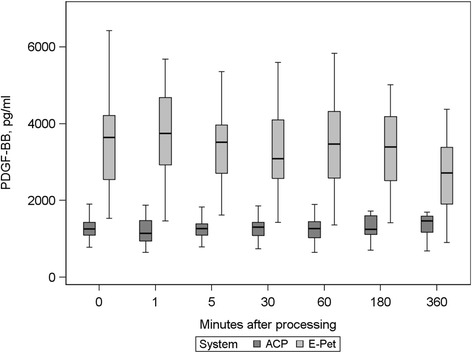
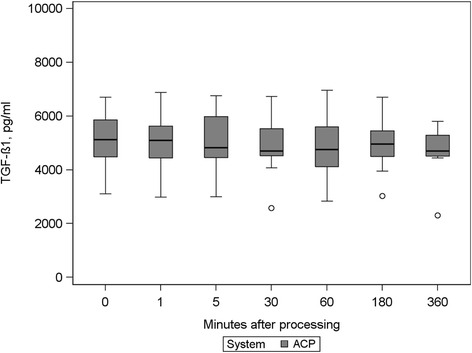
Growth factor concentrations remained stable over the entire investigation period in L-PRP as well as P-PRP preparations revealing a mean of 3569 pg/ml PDGF-BB for E-PET and means of 1276 pg/ml PDGF-BB and 5086 pg/ml TGF-ß1 for ACP®. Pearson correlations yielded no significant impact of whole blood platelet (PLT), white blood cell (WBC) and red blood cell (RBC) counts on resulting cytokine values. In case of ACP® no significant dependencies between PLT, WBC and RBC counts of the processed platelet-rich product and resulting cytokine content occurred with exception of TGF-ß1 concentrations showing a strong correlation with the WBC content. PDGF-BB content of E-PET preparations showed a strong positive correlation with PLT and a strong negative with WBC of these preparations but not with RBC.
L-PRP ad modum E-PET and P-PRP ad modum ACP® are applicable over at least a six hours time span at room temperature without loss of growth factor content. Based on the results of this study factors influencing the resulting growth factor concentrations still remain questionable. Additional studies implicating a further standardization of preparation protocols are necessary to identify consistent impact on cytokine content after PRP processing.
人们对基于富血小板血浆(PRP)的治疗方法的兴趣日益浓厚,但几乎在处理和应用的各个方面都存在不一致的信息。在这些方面中,处理后的富血小板产品的储存稳定性可能是更灵活应用模式的基础。本研究的目的是:(1)在室温下制备后,在六小时的时间跨度内,评估基于单步软旋离心的纯PRP(P-PRP,ACP®)和基于重力过滤系统的富白细胞PRP(L-PRP,E-PET)中生长因子血小板衍生生长因子BB(PDGF-BB)和转化生长因子β1(TGF-β1)的储存稳定性;(2)在马模型中确定影响这些生长因子浓度的可能因素。
在整个研究期间,L-PRP和P-PRP制剂中的生长因子浓度保持稳定,E-PET中PDGF-BB的平均浓度为3569 pg/ml,ACP®中PDGF-BB的平均浓度为1276 pg/ml,TGF-β1的平均浓度为5086 pg/ml。Pearson相关性分析表明,全血血小板(PLT)、白细胞(WBC)和红细胞(RBC)计数对所得细胞因子值没有显著影响。对于ACP®,除了TGF-β1浓度与WBC含量呈强相关性外,处理后的富血小板产品的PLT、WBC和RBC计数与所得细胞因子含量之间没有显著相关性。E-PET制剂的PDGF-BB含量与这些制剂的PLT呈强正相关,与WBC呈强负相关,但与RBC无关。
L-PRP(如E-PET)和P-PRP(如ACP®)在室温下至少六小时内均可应用,且生长因子含量不会损失。基于本研究结果,影响所得生长因子浓度的因素仍存在疑问。需要进行更多涉及制备方案进一步标准化的研究,以确定PRP处理后对细胞因子含量的一致影响。