Gruebner Oliver, Lowe Sarah R, Sampson Laura, Galea Sandro
Department of Epidemiology, Columbia University, Mailman School of Public Health, New York, NY, USA.
Department of Epidemiology, Boston University, School of Public Health, Boston, MA, USA.
Int J Health Geogr. 2015 Jun 10;14:16. doi: 10.1186/s12942-015-0008-6.
Only very few studies have investigated the geographic distribution of psychological resilience and associated mental health outcomes after natural or man made disasters. Such information is crucial for location-based interventions that aim to promote recovery in the aftermath of disasters. The purpose of this study therefore was to investigate geographic variability of (1) posttraumatic stress (PTS) and depression in a Hurricane Sandy affected population in NYC and (2) psychological vulnerability and resilience factors among affected areas in NYC boroughs.
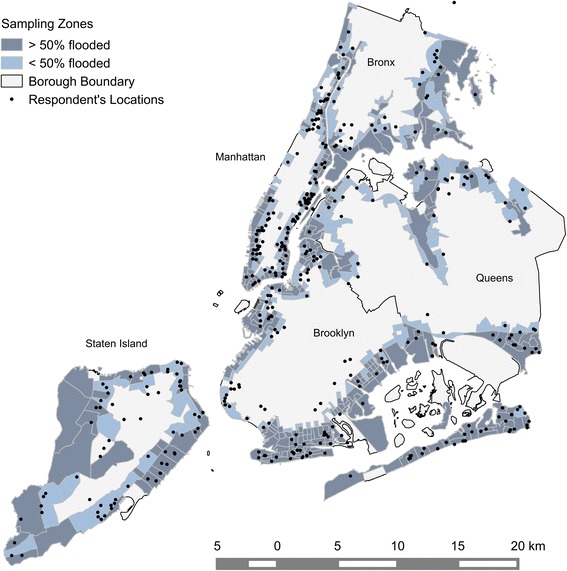
Cross-sectional telephone survey data were collected 13 to 16 months post-disaster from household residents (N = 418 adults) in NYC communities that were most heavily affected by the hurricane. The Posttraumatic Stress Checklist for DSM-5 (PCL-5) was applied for measuring posttraumatic stress and the nine-item Patient Health Questionnaire (PHQ-9) was used for measuring depression. We applied spatial autocorrelation and spatial regimes regression analyses, to test for spatial clusters of mental health outcomes and to explore whether associations between vulnerability and resilience factors and mental health differed among New York City's five boroughs.
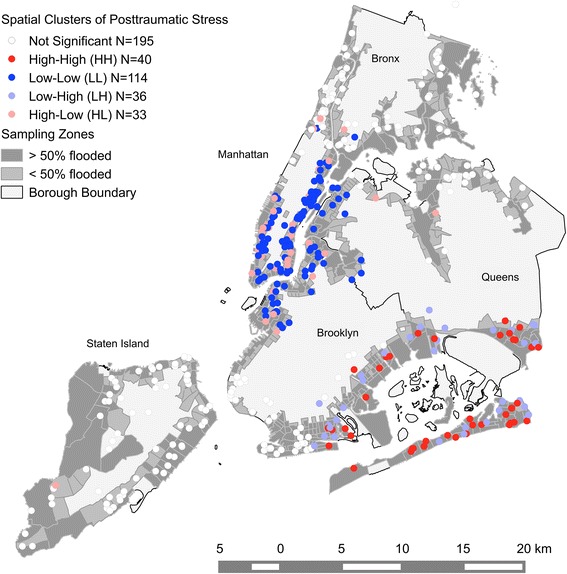
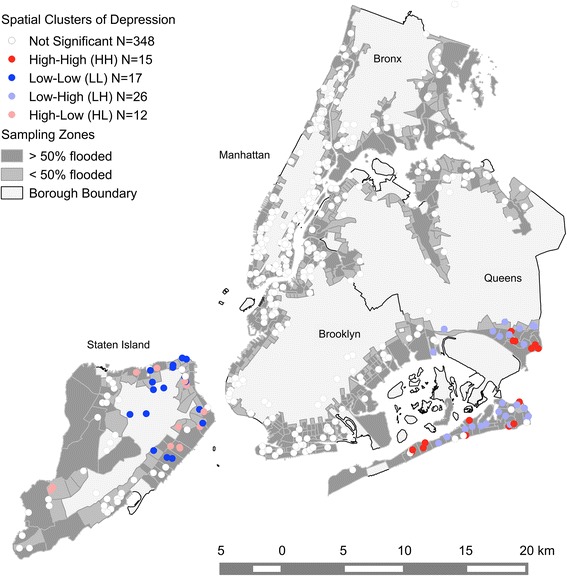
Mental health problems clustered predominantly in neighborhoods that are geographically more exposed towards the ocean indicating a spatial variation of risk within and across the boroughs. We further found significant variation in associations between vulnerability and resilience factors and mental health. Race/ethnicity (being Asian or non-Hispanic black) and disaster-related stressors were vulnerability factors for mental health symptoms in Queens, and being employed and married were resilience factors for these symptoms in Manhattan and Staten Island. In addition, parental status was a vulnerability factor in Brooklyn and a resilience factor in the Bronx.
We conclude that explanatory characteristics may manifest as psychological vulnerability and resilience factors differently across different regional contexts. Our spatial epidemiological approach is transferable to other regions around the globe and, in the light of a changing climate, could be used to strengthen the psychosocial resources of demographic groups at greatest risk of adverse outcomes pre-disaster. In the aftermath of a disaster, the approach can be used to identify survivors at greatest risk and to plan for targeted interventions to reach them.
仅有极少数研究调查了自然或人为灾害后心理韧性及相关心理健康结果的地理分布情况。此类信息对于旨在促进灾后恢复的基于地点的干预措施至关重要。因此,本研究的目的是调查纽约市受桑迪飓风影响人群中(1)创伤后应激(PTS)和抑郁的地理变异性,以及(2)纽约市行政区受灾地区的心理脆弱性和韧性因素。
在灾后13至16个月,从纽约市受飓风影响最严重社区的居民家庭(N = 418名成年人)中收集横断面电话调查数据。使用《精神疾病诊断与统计手册》第5版创伤后应激清单(PCL - 5)测量创伤后应激,使用九项患者健康问卷(PHQ - 9)测量抑郁。我们应用空间自相关和空间回归分析,以检验心理健康结果的空间聚集情况,并探讨脆弱性和韧性因素与心理健康之间的关联在纽约市五个行政区是否存在差异。
心理健康问题主要集中在地理上更靠近海洋的社区,表明各行政区内部和之间存在风险的空间差异。我们还发现脆弱性和韧性因素与心理健康之间的关联存在显著差异。种族/族裔(亚裔或非西班牙裔黑人)和与灾害相关的应激源是皇后区心理健康症状的脆弱性因素,就业和婚姻是曼哈顿和斯塔滕岛这些症状的韧性因素。此外,父母身份在布鲁克林是脆弱性因素,在布朗克斯是韧性因素。
我们得出结论,解释性特征在不同区域背景下可能表现为不同的心理脆弱性和韧性因素。我们的空间流行病学方法可应用于全球其他地区,鉴于气候变化,可用于在灾害前加强面临不良后果风险最大的人群的社会心理资源。在灾害发生后,该方法可用于识别风险最大的幸存者,并规划有针对性的干预措施以帮助他们。