• 文献检索
  • 文档翻译
  • 深度研究
  • 学术资讯
  • Suppr Zotero 插件Zotero 插件
  • 邀请有礼
  • 套餐&价格
  • 历史记录
应用&插件
Suppr Zotero 插件Zotero 插件浏览器插件Mac 客户端Windows 客户端微信小程序
定价
高级版会员购买积分包购买API积分包
服务
文献检索文档翻译深度研究API 文档MCP 服务
关于我们
关于 Suppr公司介绍联系我们用户协议隐私条款
关注我们

Suppr 超能文献

核心技术专利:CN118964589B侵权必究
粤ICP备2023148730 号-1Suppr @ 2026

文献检索

告别复杂PubMed语法,用中文像聊天一样搜索,搜遍4000万医学文献。AI智能推荐,让科研检索更轻松。

立即免费搜索

文件翻译

保留排版,准确专业,支持PDF/Word/PPT等文件格式,支持 12+语言互译。

免费翻译文档

深度研究

AI帮你快速写综述,25分钟生成高质量综述,智能提取关键信息,辅助科研写作。

立即免费体验

一种基于神经力学的助力踝关节外骨骼用于中风后步行辅助:一项可行性研究。

A neuromechanics-based powered ankle exoskeleton to assist walking post-stroke: a feasibility study.

作者信息

Takahashi Kota Z, Lewek Michael D, Sawicki Gregory S

机构信息

Joint Department of Biomedical Engineering, North Carolina State University and University of North Carolina at Chapel Hill, 911 Oval Drive, Campus Box 7115, Raleigh, NC, 27695, USA.

Division of Physical Therapy, Department of Allied Health Sciences, University of North Carolina at Chapel Hill, Bondurant Hall, 321 South Columbia St, Campus Box 7135, Chapel Hill, NC, 27599, USA.

出版信息

J Neuroeng Rehabil. 2015 Feb 25;12:23. doi: 10.1186/s12984-015-0015-7.

DOI:10.1186/s12984-015-0015-7
PMID:25889283
原文链接:https://pmc.ncbi.nlm.nih.gov/articles/PMC4367918/
Abstract

BACKGROUND

In persons post-stroke, diminished ankle joint function can contribute to inadequate gait propulsion. To target paretic ankle impairments, we developed a neuromechanics-based powered ankle exoskeleton. Specifically, this exoskeleton supplies plantarflexion assistance that is proportional to the user's paretic soleus electromyography (EMG) amplitude only during a phase of gait when the stance limb is subjected to an anteriorly directed ground reaction force (GRF). The purpose of this feasibility study was to examine the short-term effects of the powered ankle exoskeleton on the mechanics and energetics of gait.

METHODS

Five subjects with stroke walked with a powered ankle exoskeleton on the paretic limb for three 5 minute sessions. We analyzed the peak paretic ankle plantarflexion moment, paretic ankle positive work, symmetry of GRF propulsion impulse, and net metabolic power.

RESULTS

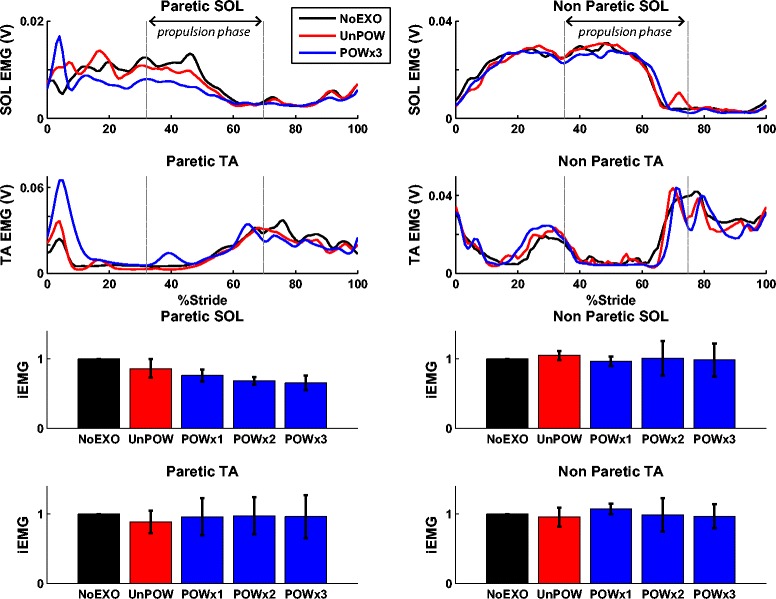
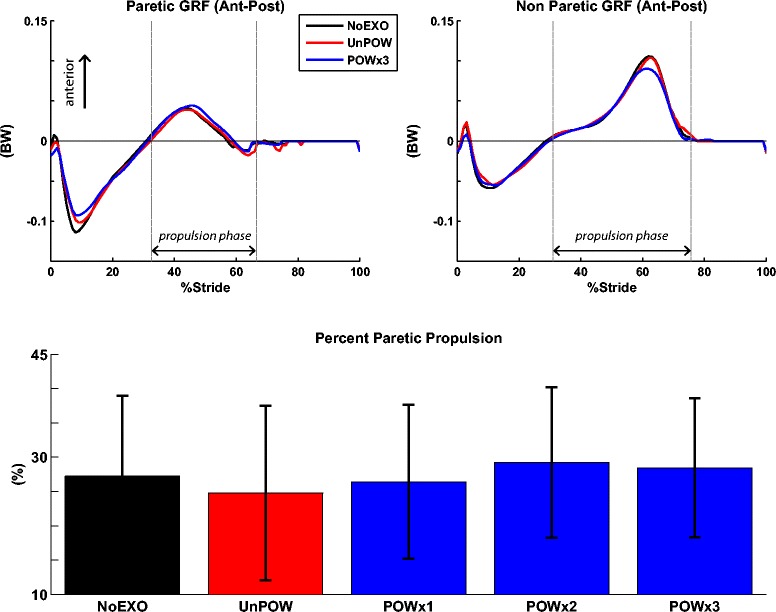
The exoskeleton increased the paretic plantarflexion moment by 16% during the powered walking trials relative to unassisted walking condition (p < .05). Despite this enhanced paretic ankle moment, there was no significant increase in paretic ankle positive work, or changes in any other mechanical variables with the powered assistance. The exoskeleton assistance appeared to reduce the net metabolic power gradually with each 5 minute repetition, though no statistical significance was found. In three of the subjects, the paretic soleus activation during the propulsion phase of stance was reduced during the powered assistance compared to unassisted walking (35% reduction in the integrated EMG amplitude during the third powered session).

CONCLUSIONS

This feasibility study demonstrated that the exoskeleton can enhance paretic ankle moment. Future studies with greater sample size and prolonged sessions are warranted to evaluate the effects of the powered ankle exoskeleton on overall gait outcomes in persons post-stroke.

摘要

背景

在中风患者中,踝关节功能减退会导致步态推进不足。为了针对患侧踝关节损伤,我们开发了一种基于神经力学的动力踝关节外骨骼。具体而言,这种外骨骼仅在步态的一个阶段提供与使用者患侧比目鱼肌肌电图(EMG)幅度成比例的跖屈辅助,此时支撑腿受到向前的地面反作用力(GRF)。这项可行性研究的目的是检验动力踝关节外骨骼对步态力学和能量学的短期影响。

方法

五名中风患者在患侧肢体上穿戴动力踝关节外骨骼行走,共进行三个5分钟的时段。我们分析了患侧踝关节最大跖屈力矩、患侧踝关节正功、GRF推进冲量的对称性以及净代谢功率。

结果

与无辅助行走状态相比,在动力行走试验期间,外骨骼使患侧跖屈力矩增加了16%(p < 0.05)。尽管患侧踝关节力矩有所增强,但患侧踝关节正功没有显著增加,并且在动力辅助下任何其他力学变量也没有变化。外骨骼辅助似乎随着每5分钟的重复逐渐降低净代谢功率,尽管未发现统计学意义。在三名受试者中,与无辅助行走相比,在动力辅助期间站立推进阶段患侧比目鱼肌的激活减少(在第三次动力时段期间,积分EMG幅度降低了35%)。

结论

这项可行性研究表明,外骨骼可以增强患侧踝关节力矩。未来有必要进行更大样本量和更长时段的研究,以评估动力踝关节外骨骼对中风患者整体步态结果的影响。

https://cdn.ncbi.nlm.nih.gov/pmc/blobs/930c/4367918/853ef502cde4/12984_2015_15_Fig7_HTML.jpg
https://cdn.ncbi.nlm.nih.gov/pmc/blobs/930c/4367918/2f661bd89098/12984_2015_15_Fig1_HTML.jpg
https://cdn.ncbi.nlm.nih.gov/pmc/blobs/930c/4367918/12961973b4e3/12984_2015_15_Fig2_HTML.jpg
https://cdn.ncbi.nlm.nih.gov/pmc/blobs/930c/4367918/4fd85fd4ab6c/12984_2015_15_Fig3_HTML.jpg
https://cdn.ncbi.nlm.nih.gov/pmc/blobs/930c/4367918/7317970eceb1/12984_2015_15_Fig4_HTML.jpg
https://cdn.ncbi.nlm.nih.gov/pmc/blobs/930c/4367918/bd5efe2e6589/12984_2015_15_Fig5_HTML.jpg
https://cdn.ncbi.nlm.nih.gov/pmc/blobs/930c/4367918/6431a9e95404/12984_2015_15_Fig6_HTML.jpg
https://cdn.ncbi.nlm.nih.gov/pmc/blobs/930c/4367918/853ef502cde4/12984_2015_15_Fig7_HTML.jpg
https://cdn.ncbi.nlm.nih.gov/pmc/blobs/930c/4367918/2f661bd89098/12984_2015_15_Fig1_HTML.jpg
https://cdn.ncbi.nlm.nih.gov/pmc/blobs/930c/4367918/12961973b4e3/12984_2015_15_Fig2_HTML.jpg
https://cdn.ncbi.nlm.nih.gov/pmc/blobs/930c/4367918/4fd85fd4ab6c/12984_2015_15_Fig3_HTML.jpg
https://cdn.ncbi.nlm.nih.gov/pmc/blobs/930c/4367918/7317970eceb1/12984_2015_15_Fig4_HTML.jpg
https://cdn.ncbi.nlm.nih.gov/pmc/blobs/930c/4367918/bd5efe2e6589/12984_2015_15_Fig5_HTML.jpg
https://cdn.ncbi.nlm.nih.gov/pmc/blobs/930c/4367918/6431a9e95404/12984_2015_15_Fig6_HTML.jpg
https://cdn.ncbi.nlm.nih.gov/pmc/blobs/930c/4367918/853ef502cde4/12984_2015_15_Fig7_HTML.jpg

相似文献

1
A neuromechanics-based powered ankle exoskeleton to assist walking post-stroke: a feasibility study.一种基于神经力学的助力踝关节外骨骼用于中风后步行辅助:一项可行性研究。
J Neuroeng Rehabil. 2015 Feb 25;12:23. doi: 10.1186/s12984-015-0015-7.
2
Mechanics and energetics of post-stroke walking aided by a powered ankle exoskeleton with speed-adaptive myoelectric control.脑卒中后使用具有速度自适应肌电控制的动力踝外骨骼辅助行走的力学和能量学。
J Neuroeng Rehabil. 2019 May 15;16(1):57. doi: 10.1186/s12984-019-0523-y.
3
Biomechanical mechanisms underlying exosuit-induced improvements in walking economy after stroke.中风后外骨骼套装改善步行经济性的生物力学机制。
J Exp Biol. 2018 Mar 7;221(Pt 5):jeb168815. doi: 10.1242/jeb.168815.
4
Reducing the metabolic cost of walking with an ankle exoskeleton: interaction between actuation timing and power.使用脚踝外骨骼降低步行的代谢成本:驱动时机与功率之间的相互作用
J Neuroeng Rehabil. 2017 Apr 27;14(1):35. doi: 10.1186/s12984-017-0235-0.
5
Learning to walk with an adaptive gain proportional myoelectric controller for a robotic ankle exoskeleton.使用自适应增益比例肌电控制器学习通过机器人脚踝外骨骼行走。
J Neuroeng Rehabil. 2015 Nov 4;12:97. doi: 10.1186/s12984-015-0086-5.
6
Short-term locomotor adaptation to a robotic ankle exoskeleton does not alter soleus Hoffmann reflex amplitude.短期适应机器人踝部外骨骼并不会改变比目鱼肌Hoffmann 反射幅度。
J Neuroeng Rehabil. 2010 Jul 26;7:33. doi: 10.1186/1743-0003-7-33.
7
Articulated ankle-foot-orthosis improves inter-limb propulsion symmetry during walking adaptability task post-stroke.踝足矫形器改善了卒中后行走适应任务中的肢体间推进对称性。
Clin Biomech (Bristol). 2024 Jun;116:106268. doi: 10.1016/j.clinbiomech.2024.106268. Epub 2024 May 18.
8
Motor modules during adaptation to walking in a powered ankle exoskeleton.在动力踝部外骨骼中适应行走时的运动模块。
J Neuroeng Rehabil. 2018 Jan 3;15(1):2. doi: 10.1186/s12984-017-0343-x.
9
Proportional Joint-Moment Control for Instantaneously Adaptive Ankle Exoskeleton Assistance.比例关节力矩控制的即时自适应踝部外骨骼辅助。
IEEE Trans Neural Syst Rehabil Eng. 2019 Apr;27(4):751-759. doi: 10.1109/TNSRE.2019.2905979. Epub 2019 Mar 19.
10
Mechanics and energetics of level walking with powered ankle exoskeletons.使用动力踝关节外骨骼进行水平行走的力学与能量学
J Exp Biol. 2008 May;211(Pt 9):1402-13. doi: 10.1242/jeb.009241.

引用本文的文献

1
Powered knee exoskeleton improves sit-to-stand transitions in stroke patients using electromyographic control.电动膝关节外骨骼通过肌电图控制改善中风患者从坐立转换的能力。
Commun Eng. 2025 Jun 7;4(1):104. doi: 10.1038/s44172-025-00440-3.
2
Movement Recognition and Muscle Force Estimation of Wrist Based on Electromyographic Signals of Forearm.基于前臂肌电信号的手腕运动识别与肌肉力量估计
Biosensors (Basel). 2025 Apr 17;15(4):259. doi: 10.3390/bios15040259.
3
A wearable ankle-assisted robot for improving gait function and pattern in stroke patients.

本文引用的文献

1
Stroke Survivors' Gait Adaptations to a Powered Ankle Foot Orthosis.中风幸存者对动力踝足矫形器的步态适应性
Adv Robot. 2011 Jan 1;25(15):1879-1901. doi: 10.1163/016918611X588907.
2
Impaired limb shortening following stroke: what's in a name?中风后肢体缩短受损:名称意味着什么?
PLoS One. 2014 Oct 16;9(10):e110140. doi: 10.1371/journal.pone.0110140. eCollection 2014.
3
Targeting paretic propulsion to improve poststroke walking function: a preliminary study.针对偏瘫推进功能以改善中风后步行功能:一项初步研究。
一种用于改善中风患者步态功能和模式的可穿戴脚踝辅助机器人。
J Neuroeng Rehabil. 2025 Apr 22;22(1):89. doi: 10.1186/s12984-025-01624-w.
4
Autonomous Powered Ankle Exoskeleton Improves Foot Clearance and Knee Hyperextension After Stroke: A Case Study.自主动力脚踝外骨骼改善中风后足背屈和膝关节过度伸展:一项病例研究。
IEEE Trans Med Robot Bionics. 2025 Feb;7(1):51-58. doi: 10.1109/tmrb.2024.3503893. Epub 2024 Nov 21.
5
Therapeutic and orthotic effects of an adaptive functional electrical stimulation system on gait biomechanics in participants with stroke.适应性功能性电刺激系统对中风患者步态生物力学的治疗和矫正作用
J Neuroeng Rehabil. 2025 Mar 18;22(1):62. doi: 10.1186/s12984-025-01577-0.
6
A Propulsion Neuroprosthesis Improves Overground Walking in Community-Dwelling Individuals After Stroke.一种推进式神经假体可改善中风后社区居住个体的地面行走能力。
IEEE Open J Eng Med Biol. 2024 Jul 4;5:563-572. doi: 10.1109/OJEMB.2024.3416028. eCollection 2024.
7
DE-AFO: A Robotic Ankle Foot Orthosis for Children with Cerebral Palsy Powered by Dielectric Elastomer Artificial Muscle.DE-AFO:一种由介电弹性体人工肌肉驱动的用于脑瘫儿童的机器人踝足矫形器。
Sensors (Basel). 2024 Jun 11;24(12):3787. doi: 10.3390/s24123787.
8
Gait signature changes with walking speed are similar among able-bodied young adults despite persistent individual-specific differences.尽管存在个体特异性差异,但在身体健全的年轻人中,步态特征随步行速度的变化是相似的。
bioRxiv. 2024 May 3:2024.05.01.591976. doi: 10.1101/2024.05.01.591976.
9
Exo Supportive Devices: Summary of Technical Aspects.外骨骼辅助设备:技术方面总结
Bioengineering (Basel). 2023 Nov 17;10(11):1328. doi: 10.3390/bioengineering10111328.
10
A portable AFO solution for pneumatic actuator with cable tendon mechanism to assist ankle dorsiflexion.一种用于带有缆线腱机构的气动执行器的便携式踝足矫形器解决方案,以辅助踝关节背屈。
Front Bioeng Biotechnol. 2023 Oct 19;11:1227327. doi: 10.3389/fbioe.2023.1227327. eCollection 2023.
Arch Phys Med Rehabil. 2014 May;95(5):840-8. doi: 10.1016/j.apmr.2013.12.012. Epub 2013 Dec 28.
4
A universal ankle-foot prosthesis emulator for human locomotion experiments.一种用于人体运动实验的通用踝足假肢模拟器。
J Biomech Eng. 2014 Mar;136(3):035002. doi: 10.1115/1.4026225.
5
Real-time feedback enhances forward propulsion during walking in old adults.实时反馈可增强老年人行走时的向前推进力。
Clin Biomech (Bristol). 2014 Jan;29(1):68-74. doi: 10.1016/j.clinbiomech.2013.10.018. Epub 2013 Oct 30.
6
Inducing self-selected human engagement in robotic locomotion training.在机器人运动训练中诱导自我选择的人类参与。
IEEE Int Conf Rehabil Robot. 2013 Jun;2013:6650488. doi: 10.1109/ICORR.2013.6650488.
7
Proportional EMG control of ankle plantar flexion in a powered transtibial prosthesis.动力型经胫假肢中踝关节跖屈的肌电图比例控制
IEEE Int Conf Rehabil Robot. 2013 Jun;2013:6650391. doi: 10.1109/ICORR.2013.6650391.
8
Pilot study of locomotion improvement using hybrid assistive limb in chronic stroke patients.混合辅助肢体改善慢性中风患者运动功能的初步研究。
BMC Neurol. 2013 Oct 7;13:141. doi: 10.1186/1471-2377-13-141.
9
Changes in metabolic cost of transport following locomotor training poststroke.脑卒中后运动训练对代谢转运成本的影响。
Top Stroke Rehabil. 2013 Mar-Apr;20(2):161-70. doi: 10.1310/tsr2002-161.
10
Adaptation to walking with an exoskeleton that assists ankle extension.适应辅助踝关节伸展的外骨骼行走。
Gait Posture. 2013 Jul;38(3):495-9. doi: 10.1016/j.gaitpost.2013.01.029. Epub 2013 Mar 5.