• 文献检索
  • 文档翻译
  • 深度研究
  • 学术资讯
  • Suppr Zotero 插件Zotero 插件
  • 邀请有礼
  • 套餐&价格
  • 历史记录
应用&插件
Suppr Zotero 插件Zotero 插件浏览器插件Mac 客户端Windows 客户端微信小程序
定价
高级版会员购买积分包购买API积分包
服务
文献检索文档翻译深度研究API 文档MCP 服务
关于我们
关于 Suppr公司介绍联系我们用户协议隐私条款
关注我们

Suppr 超能文献

核心技术专利:CN118964589B侵权必究
粤ICP备2023148730 号-1Suppr @ 2026

文献检索

告别复杂PubMed语法,用中文像聊天一样搜索,搜遍4000万医学文献。AI智能推荐,让科研检索更轻松。

立即免费搜索

文件翻译

保留排版,准确专业,支持PDF/Word/PPT等文件格式,支持 12+语言互译。

免费翻译文档

深度研究

AI帮你快速写综述,25分钟生成高质量综述,智能提取关键信息,辅助科研写作。

立即免费体验

脑卒中后使用具有速度自适应肌电控制的动力踝外骨骼辅助行走的力学和能量学。

Mechanics and energetics of post-stroke walking aided by a powered ankle exoskeleton with speed-adaptive myoelectric control.

机构信息

North Carolina State University, 911 Oval Drive, Raleigh, NC, 27606, USA.

School of Biomedical Sciences, University of Queensland, St. Lucia, QLD, Australia.

出版信息

J Neuroeng Rehabil. 2019 May 15;16(1):57. doi: 10.1186/s12984-019-0523-y.

DOI:10.1186/s12984-019-0523-y
PMID:31092269
原文链接:https://pmc.ncbi.nlm.nih.gov/articles/PMC6521500/
Abstract

BACKGROUND

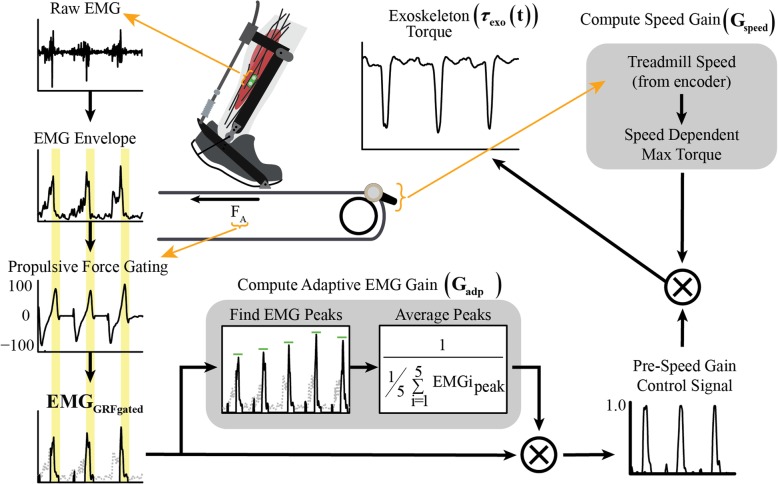
Ankle exoskeletons offer a promising opportunity to offset mechanical deficits after stroke by applying the needed torque at the paretic ankle. Because joint torque is related to gait speed, it is important to consider the user's gait speed when determining the magnitude of assistive joint torque. We developed and tested a novel exoskeleton controller for delivering propulsive assistance which modulates exoskeleton torque magnitude based on both soleus muscle activity and walking speed. The purpose of this research is to assess the impact of the resulting exoskeleton assistance on post-stroke walking performance across a range of walking speeds.

METHODS

Six participants with stroke walked with and without assistance applied to a powered ankle exoskeleton on the paretic limb. Walking speed started at 60% of their comfortable overground speed and was increased each minute (n00, n01, n02, etc.). We measured lower limb joint and limb powers, metabolic cost of transport, paretic and non-paretic limb propulsion, and trailing limb angle.

RESULTS

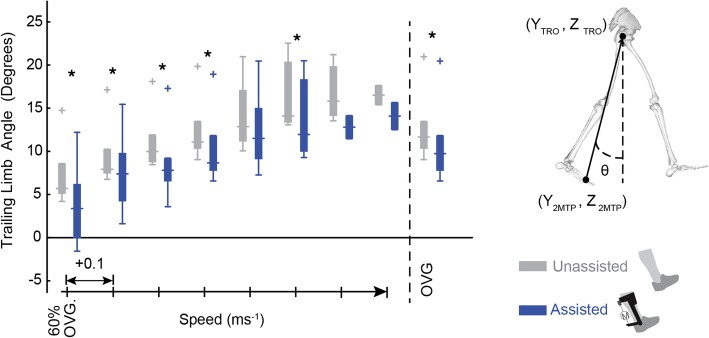
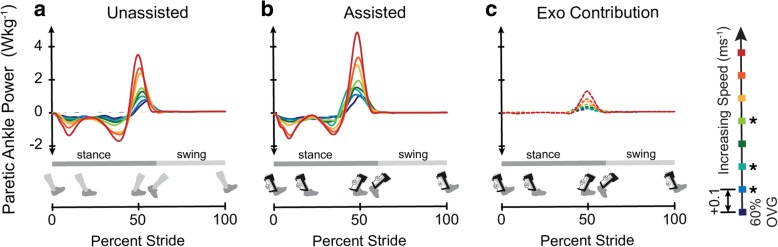
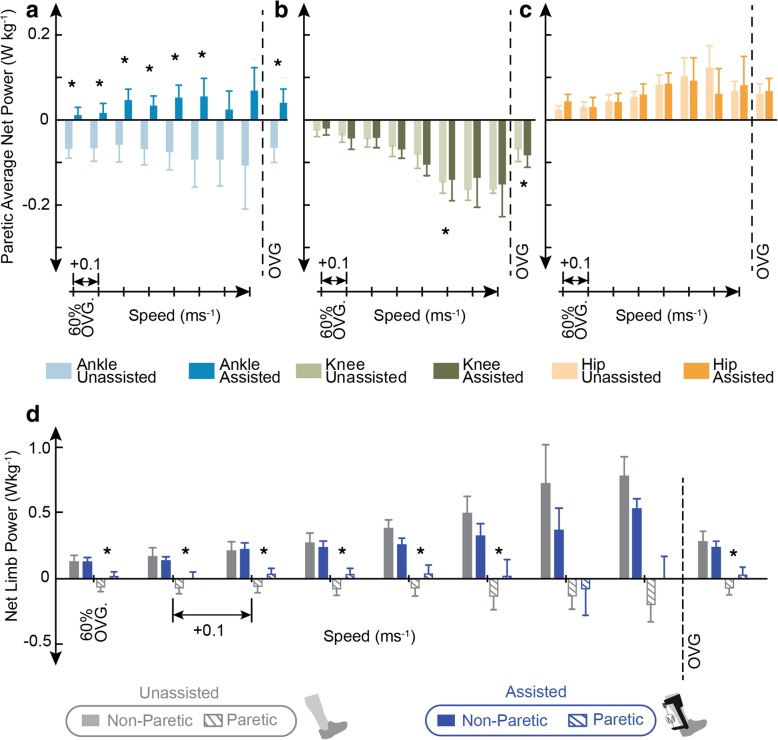
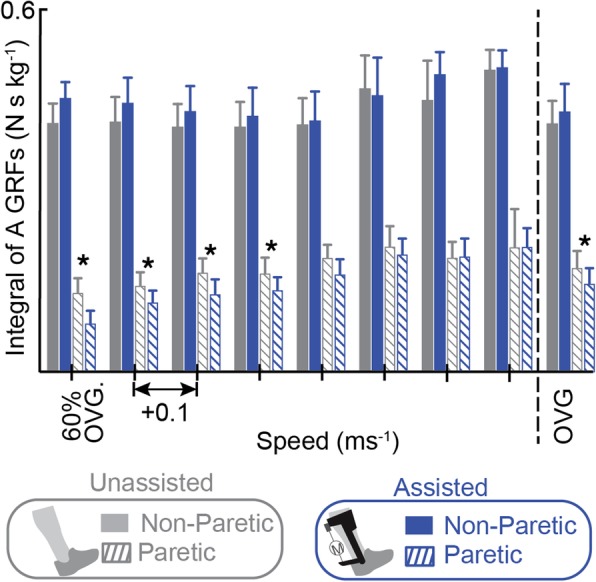
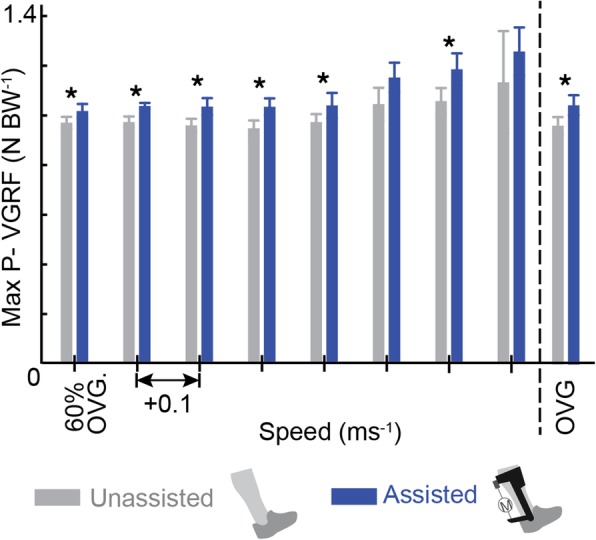
Exoskeleton assistance increased with walking speed, verifying the speed-adaptive nature of the controller. Both paretic ankle joint power and total limb power increased significantly with exoskeleton assistance at six walking speeds (n00, n01, n02, n03, n04, n05). Despite these joint- and limb-level benefits associated with exoskeleton assistance, no subject averaged metabolic benefits were evident when compared to the unassisted condition. Both paretic trailing limb angle and integrated anterior paretic ground reaction forces were reduced with assistance applied as compared to no assistance at four speeds (n00, n01, n02, n03).

CONCLUSIONS

Our results suggest that despite appropriate scaling of ankle assistance by the exoskeleton controller, suboptimal limb posture limited the conversion of exoskeleton assistance into forward propulsion. Future studies could include biofeedback or verbal cues to guide users into limb configurations that encourage the conversion of mechanical power at the ankle to forward propulsion.

TRIAL REGISTRATION

N/A.

摘要

背景

踝关节外骨骼通过在患侧踝关节施加所需的扭矩,为中风后弥补机械缺陷提供了一个很有前景的机会。由于关节扭矩与步态速度有关,因此在确定辅助关节扭矩的大小时,考虑用户的步态速度非常重要。我们开发并测试了一种新的外骨骼控制器,用于提供推进辅助,该控制器根据比目鱼肌活动和行走速度来调节外骨骼扭矩的大小。本研究的目的是评估在一系列行走速度下,由此产生的外骨骼辅助对中风后行走表现的影响。

方法

6 名患有中风的参与者在患侧肢体上使用动力踝关节外骨骼进行行走,同时使用和不使用辅助。行走速度从他们舒适的地面速度的 60%开始,每分钟增加一次(n00、n01、n02 等)。我们测量了下肢关节和肢体的功率、运输代谢成本、患侧和非患侧肢体的推进以及拖曳肢体角度。

结果

外骨骼辅助随行走速度而增加,验证了控制器的速度自适应特性。在六种行走速度(n00、n01、n02、n03、n04、n05)下,外骨骼辅助显著增加了患侧踝关节关节功率和总肢体功率。尽管外骨骼辅助带来了这些关节和肢体水平的益处,但与未辅助的情况相比,没有一个受试者的代谢益处明显。与无辅助相比,在四种速度(n00、n01、n02、n03)下,辅助应用时患侧拖曳肢体角度和整合的患侧地面反作用力前向分量都减小了。

结论

我们的研究结果表明,尽管外骨骼控制器通过适当的方式对踝关节辅助进行了缩放,但次优的肢体姿势限制了将外骨骼辅助转化为向前推进。未来的研究可以包括生物反馈或口头提示,以指导用户采用鼓励将踝关节的机械功率转化为向前推进的肢体配置。

试验注册

无。

https://cdn.ncbi.nlm.nih.gov/pmc/blobs/a4c5/6521500/4d3515463f3d/12984_2019_523_Fig6_HTML.jpg
https://cdn.ncbi.nlm.nih.gov/pmc/blobs/a4c5/6521500/66a7f8ef31a5/12984_2019_523_Fig1_HTML.jpg
https://cdn.ncbi.nlm.nih.gov/pmc/blobs/a4c5/6521500/fee3e62c39a3/12984_2019_523_Fig2_HTML.jpg
https://cdn.ncbi.nlm.nih.gov/pmc/blobs/a4c5/6521500/0a14f953f643/12984_2019_523_Fig3_HTML.jpg
https://cdn.ncbi.nlm.nih.gov/pmc/blobs/a4c5/6521500/3418c78ed7ea/12984_2019_523_Fig4_HTML.jpg
https://cdn.ncbi.nlm.nih.gov/pmc/blobs/a4c5/6521500/abf34d1a8a11/12984_2019_523_Fig5_HTML.jpg
https://cdn.ncbi.nlm.nih.gov/pmc/blobs/a4c5/6521500/4d3515463f3d/12984_2019_523_Fig6_HTML.jpg
https://cdn.ncbi.nlm.nih.gov/pmc/blobs/a4c5/6521500/66a7f8ef31a5/12984_2019_523_Fig1_HTML.jpg
https://cdn.ncbi.nlm.nih.gov/pmc/blobs/a4c5/6521500/fee3e62c39a3/12984_2019_523_Fig2_HTML.jpg
https://cdn.ncbi.nlm.nih.gov/pmc/blobs/a4c5/6521500/0a14f953f643/12984_2019_523_Fig3_HTML.jpg
https://cdn.ncbi.nlm.nih.gov/pmc/blobs/a4c5/6521500/3418c78ed7ea/12984_2019_523_Fig4_HTML.jpg
https://cdn.ncbi.nlm.nih.gov/pmc/blobs/a4c5/6521500/abf34d1a8a11/12984_2019_523_Fig5_HTML.jpg
https://cdn.ncbi.nlm.nih.gov/pmc/blobs/a4c5/6521500/4d3515463f3d/12984_2019_523_Fig6_HTML.jpg

相似文献

1
Mechanics and energetics of post-stroke walking aided by a powered ankle exoskeleton with speed-adaptive myoelectric control.脑卒中后使用具有速度自适应肌电控制的动力踝外骨骼辅助行走的力学和能量学。
J Neuroeng Rehabil. 2019 May 15;16(1):57. doi: 10.1186/s12984-019-0523-y.
2
A neuromechanics-based powered ankle exoskeleton to assist walking post-stroke: a feasibility study.一种基于神经力学的助力踝关节外骨骼用于中风后步行辅助:一项可行性研究。
J Neuroeng Rehabil. 2015 Feb 25;12:23. doi: 10.1186/s12984-015-0015-7.
3
Learning to walk with an adaptive gain proportional myoelectric controller for a robotic ankle exoskeleton.使用自适应增益比例肌电控制器学习通过机器人脚踝外骨骼行走。
J Neuroeng Rehabil. 2015 Nov 4;12:97. doi: 10.1186/s12984-015-0086-5.
4
Impact of elastic ankle exoskeleton stiffness on neuromechanics and energetics of human walking across multiple speeds.弹性踝部外骨骼刚度对人体在多种速度下行走的神经力学和能量学的影响。
J Neuroeng Rehabil. 2020 Jun 15;17(1):75. doi: 10.1186/s12984-020-00703-4.
5
Optimized hip-knee-ankle exoskeleton assistance at a range of walking speeds.在多种步行速度下优化髋膝踝外骨骼辅助。
J Neuroeng Rehabil. 2021 Oct 18;18(1):152. doi: 10.1186/s12984-021-00943-y.
6
[Effects of ankle exoskeleton assistance during human walking on lower limb muscle contractions and coordination patterns].[人体行走过程中踝关节外骨骼辅助对下肢肌肉收缩及协调模式的影响]
Sheng Wu Yi Xue Gong Cheng Xue Za Zhi. 2022 Feb 25;39(1):75-83. doi: 10.7507/1001-5515.202107040.
7
Biomechanics and energetics of walking in powered ankle exoskeletons using myoelectric control versus mechanically intrinsic control.使用肌电控制与机械固有控制的动力踝外骨骼行走的生物力学和能量学。
J Neuroeng Rehabil. 2018 May 25;15(1):42. doi: 10.1186/s12984-018-0379-6.
8
Biomechanical mechanisms underlying exosuit-induced improvements in walking economy after stroke.中风后外骨骼套装改善步行经济性的生物力学机制。
J Exp Biol. 2018 Mar 7;221(Pt 5):jeb168815. doi: 10.1242/jeb.168815.
9
Proportional Joint-Moment Control for Instantaneously Adaptive Ankle Exoskeleton Assistance.比例关节力矩控制的即时自适应踝部外骨骼辅助。
IEEE Trans Neural Syst Rehabil Eng. 2019 Apr;27(4):751-759. doi: 10.1109/TNSRE.2019.2905979. Epub 2019 Mar 19.
10
An experimental comparison of the relative benefits of work and torque assistance in ankle exoskeletons.踝关节外骨骼中工作辅助和扭矩辅助相对益处的实验比较。
J Appl Physiol (1985). 2015 Sep 1;119(5):541-57. doi: 10.1152/japplphysiol.01133.2014. Epub 2015 Jul 9.

引用本文的文献

1
Multi-Modal Sensing for Propulsion Estimation in People Post-Stroke Across Speeds.用于中风后人群不同速度下推进力估计的多模态传感
IEEE Trans Neural Syst Rehabil Eng. 2025;33:2273-2285. doi: 10.1109/TNSRE.2025.3577961.
2
Autonomous Powered Ankle Exoskeleton Improves Foot Clearance and Knee Hyperextension After Stroke: A Case Study.自主动力脚踝外骨骼改善中风后足背屈和膝关节过度伸展:一项病例研究。
IEEE Trans Med Robot Bionics. 2025 Feb;7(1):51-58. doi: 10.1109/tmrb.2024.3503893. Epub 2024 Nov 21.
3
Comparing the mechanical energetics of walking among individuals with unilateral transfemoral limb loss using socket and osseointegrated prosthetic interfaces.

本文引用的文献

1
A soft robotic exosuit improves walking in patients after stroke.软性机器人外骨骼可改善中风后患者的行走能力。
Sci Transl Med. 2017 Jul 26;9(400). doi: 10.1126/scitranslmed.aai9084.
2
Control of lateral weight transfer is associated with walking speed in individuals post-stroke.中风后个体的横向体重转移控制与步行速度相关。
J Biomech. 2017 Jul 26;60:72-78. doi: 10.1016/j.jbiomech.2017.06.021. Epub 2017 Jun 23.
3
Reducing the metabolic cost of walking with an ankle exoskeleton: interaction between actuation timing and power.
比较使用接受腔和骨整合假体界面的单侧经股骨肢体缺失个体之间行走的机械能学。
Sci Rep. 2025 Mar 21;15(1):9755. doi: 10.1038/s41598-025-93211-1.
4
Bilateral hip exoskeleton assistance enables faster walking in individuals with chronic stroke-related gait impairments.双侧髋关节外骨骼辅助可使患有慢性中风相关步态障碍的个体行走速度更快。
Sci Rep. 2025 Jan 15;15(1):2017. doi: 10.1038/s41598-025-86343-x.
5
Insights into muscle metabolic energetics: Modelling muscle-tendon mechanics and metabolic rates during walking across speeds.肌肉代谢能量学研究进展:行走速度范围内模拟肌肉-肌腱力学和代谢率。
PLoS Comput Biol. 2024 Sep 13;20(9):e1012411. doi: 10.1371/journal.pcbi.1012411. eCollection 2024 Sep.
6
Gait signature changes with walking speed are similar among able-bodied young adults despite persistent individual-specific differences.尽管存在个体特异性差异,但在身体健全的年轻人中,步态特征随步行速度的变化是相似的。
bioRxiv. 2024 May 3:2024.05.01.591976. doi: 10.1101/2024.05.01.591976.
7
Exercising with a robotic exoskeleton can improve memory and gait in people with Parkinson's disease by facilitating progressive exercise intensity.使用机器人外骨骼进行锻炼可以通过促进逐渐增加的运动强度来改善帕金森病患者的记忆力和步态。
Sci Rep. 2024 Feb 22;14(1):4417. doi: 10.1038/s41598-024-54200-y.
8
Gait quality in prosthesis users is reflected by force-based metrics when learning to walk on a new research-grade powered prosthesis.在学习使用新型研究级动力假肢行走时,假肢使用者的步态质量可通过基于力的指标来反映。
Front Rehabil Sci. 2024 Feb 2;5:1339856. doi: 10.3389/fresc.2024.1339856. eCollection 2024.
9
Quantifying changes in individual-specific template-based representations of center-of-mass dynamics during walking with ankle exoskeletons using Hybrid-SINDy.使用 Hybrid-SINDy 量化踝关节外骨骼行走过程中质心动力学个体特定基于模板的表示的变化。
Sci Rep. 2024 Jan 10;14(1):1031. doi: 10.1038/s41598-023-50999-0.
10
Simple within-stride changes in treadmill speed can drive selective changes in human gait symmetry.在跑步机上简单的步伐内速度变化可以驱动人类步态对称性的选择性变化。
PLoS One. 2023 Oct 26;18(10):e0287568. doi: 10.1371/journal.pone.0287568. eCollection 2023.
使用脚踝外骨骼降低步行的代谢成本:驱动时机与功率之间的相互作用
J Neuroeng Rehabil. 2017 Apr 27;14(1):35. doi: 10.1186/s12984-017-0235-0.
4
Individual joint contribution to body weight support in the affected lower limb during walking in post-stroke hemiplegia.中风后偏瘫患者行走时患侧下肢各关节对体重支撑的个体贡献。
Top Stroke Rehabil. 2017 Apr;24(3):170-176. doi: 10.1080/10749357.2016.1219128. Epub 2016 Aug 12.
5
Identifying candidates for targeted gait rehabilitation after stroke: better prediction through biomechanics-informed characterization.识别中风后针对性步态康复的候选者:通过生物力学信息表征实现更好的预测
J Neuroeng Rehabil. 2016 Sep 23;13(1):84. doi: 10.1186/s12984-016-0188-8.
6
Task-specific ankle robotics gait training after stroke: a randomized pilot study.中风后特定任务的踝关节机器人步态训练:一项随机试点研究。
J Neuroeng Rehabil. 2016 Jun 2;13(1):51. doi: 10.1186/s12984-016-0158-1.
7
Learning to walk with an adaptive gain proportional myoelectric controller for a robotic ankle exoskeleton.使用自适应增益比例肌电控制器学习通过机器人脚踝外骨骼行走。
J Neuroeng Rehabil. 2015 Nov 4;12:97. doi: 10.1186/s12984-015-0086-5.
8
Mechanisms to increase propulsive force for individuals poststroke.增加中风后个体推进力的机制。
J Neuroeng Rehabil. 2015 Apr 18;12:40. doi: 10.1186/s12984-015-0030-8.
9
A neuromechanics-based powered ankle exoskeleton to assist walking post-stroke: a feasibility study.一种基于神经力学的助力踝关节外骨骼用于中风后步行辅助:一项可行性研究。
J Neuroeng Rehabil. 2015 Feb 25;12:23. doi: 10.1186/s12984-015-0015-7.
10
Revisiting the mechanics and energetics of walking in individuals with chronic hemiparesis following stroke: from individual limbs to lower limb joints.重新审视中风后慢性偏瘫患者的行走力学与能量学:从单个肢体到下肢关节
J Neuroeng Rehabil. 2015 Feb 27;12:24. doi: 10.1186/s12984-015-0012-x.