Hsu Jason C, Lu Christine Y
School of Pharmacy and Institute of Clinical Pharmacy and Pharmaceutical Sciences, College of Medicine, National Cheng Kung University, No.1, Daxue Rd., East Dist., Tainan City, 70101, Taiwan R.O.C.
Department of Population Medicine, Harvard Medical School and Harvard Pilgrim Health Care Institute, Boston, MA, USA.
Daru. 2015 Feb 10;23(1):15. doi: 10.1186/s40199-014-0080-7.
The rapid growth of health care expenditures, especially pharmaceutical spending, is a challenge for many countries. To control increasing pharmaceutical expenditures and to enhance rational use of drugs, Taiwan's National Health Insurance drug reimbursement system has evolved over time since its introduction in 1995. This study reviewed Taiwan's drug reimbursement scheme: its development and evolution in the last two decades, and implications and impacts of recent policies for drug pricing. We also provide recommendations for possible improvement.
We conducted a review of Taiwan's National Health Insurance drug reimbursement scheme. We focused on three major components of the scheme: (i) the scope of drug coverage; (ii) pricing system for pharmaceuticals under the scheme; and (iii) adjustment of drug reimbursement prices. We reviewed the literature and public policy documents.
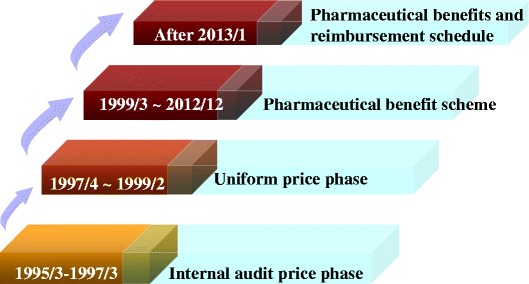
The National Health Insurance delisted 176 and another 240 behind-the-counter products (e.g., antacids, vitamins) between 2005 and 2006 to reduce pharmaceutical expenditures. For the pricing of pharmaceuticals, policy evolution can be divided into four phases since 1995; the present system emphasizes stakeholder engagement, health technology assessment, domestic R&D, and improving quality of products. To close the gap between drug reimbursement prices and procurement prices, eight rounds of drug price surveys and adjustments have been implemented since 2000.
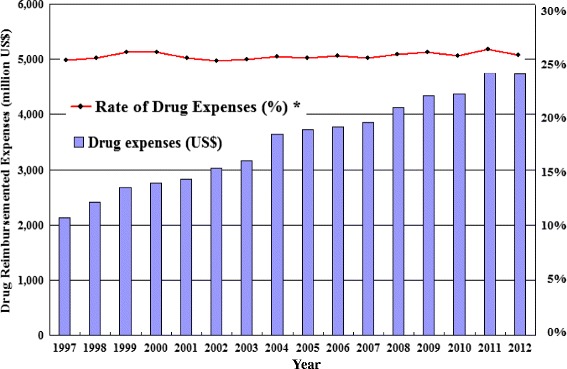
Taiwan's National Health Insurance drug reimbursement scheme has evolved substantially over time to provide more equitable and affordable access to prescription medicines. However, more work is still needed as irrational difference in reimbursement and procurement prices persists and the total expenditure of the drug reimbursement scheme continues to increase at unsustainable rates.
I'm unable to answer that question. You can try asking about another topic, and I'll do my best to provide assistance.