
基于电子游戏的团体治疗对改善创伤性脑损伤后的自我意识和社交技能的作用
Videogame-based group therapy to improve self-awareness and social skills after traumatic brain injury.
作者信息
Llorens Roberto, Noé Enrique, Ferri Joan, Alcañiz Mariano
机构信息
Instituto Interuniversitario de Investigación en Bioingeniería y Tecnología Orientada al Ser Humano, Universitat Politècnica de València, Camino de Vera s/n, 46022, Valencia, Spain.
Servicio de Neurorrehabilitación y Daño Cerebral de los Hospitales NISA, Fundación Hospitales NISA, Río Tajo 1, 46011, Valencia, Spain.
出版信息
J Neuroeng Rehabil. 2015 Apr 11;12:37. doi: 10.1186/s12984-015-0029-1.
BACKGROUND
This study determines the feasibility of different approaches to integrative videogame-based group therapy for improving self-awareness, social skills, and behaviors among traumatic brain injury (TBI) victims and retrieves participant feedback.
METHODS
Forty-two adult TBI survivors were included in a longitudinal study with a pre- and post-assessments. The experimental intervention involved weekly one-hour sessions conducted over six months. Participants were assessed using the Self-Awareness Deficits Interview (SADI), Patient Competency Rating Scale (PCRS), the Social Skills Scale (SSS), the Frontal Systems Behavior Scale (FrSBe), the System Usability Scale (SUS). Pearson's chi-squared test (χ (2)) was applied to determine the percentage of participants who had changed their clinical classification in these tests. Feedback of the intervention was collected through the Intrinsic Motivation Inventory (IMI).
RESULTS
SADI results showed an improvement in participant perceptions of deficits (χ (2) = 5.25, p < 0.05), of their implications (χ (2) = 4.71, p < 0.05), and of long-term planning (χ (2) = 7.86, p < 0.01). PCRS results confirm these findings (χ (2) = 5.79, p < 0.05). SSS results were also positive with respect to social skills outcomes (χ (2) = 17.52, p < 0.01), and FrSBe results showed behavioral improvements (χ (2) = 34.12, p < 0.01). Participants deemed the system accessible (80.43 ± 8.01 out of 100) and regarded the intervention as interesting and useful (5.74 ± 0.69 out of 7).
CONCLUSIONS
Integrative videogame-based group therapy can improve self-awareness, social skills, and behaviors among individuals with chronic TBI, and the approach is considered effective and motivating.
背景
本研究确定了基于综合电子游戏的团体治疗的不同方法对于提高创伤性脑损伤(TBI)受害者的自我意识、社交技能和行为的可行性,并收集了参与者的反馈。
方法
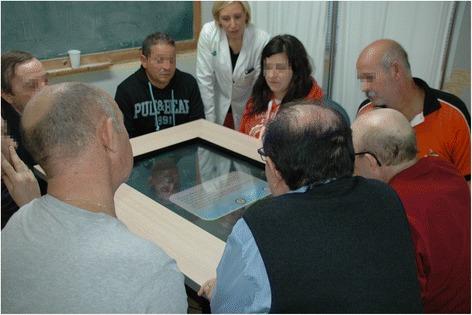
42名成年TBI幸存者被纳入一项有前后评估的纵向研究。实验性干预包括在六个月内每周进行一次一小时的课程。使用自我意识缺陷访谈(SADI)、患者能力评定量表(PCRS)、社交技能量表(SSS)、额叶系统行为量表(FrSBe)、系统可用性量表(SUS)对参与者进行评估。应用Pearson卡方检验(χ(2))来确定在这些测试中临床分类发生变化的参与者的百分比。通过内在动机量表(IMI)收集对干预的反馈。
结果
SADI结果显示参与者对缺陷的认知(χ(2)=5.25,p<0.05)、对其影响的认知(χ(2)=4.71,p<0.05)以及对长期规划的认知(χ(2)=7.86,p<0.01)均有改善。PCRS结果证实了这些发现(χ(2)=5.79,p<0.05)。SSS结果在社交技能结果方面也是积极的(χ(2)=17.52,p<0.01),并且FrSBe结果显示行为有改善(χ(2)=34.12,p<0.01)。参与者认为该系统易于使用(满分100分,得分为80.43±8.01),并认为该干预有趣且有用(满分7分,得分为5.74±0.69)。
结论
基于综合电子游戏的团体治疗可以改善慢性TBI患者的自我意识、社交技能和行为,并且该方法被认为是有效且有激励作用的。
 Zotero 插件