Fransisca Liony, Kusnanto Josef Hari, Satoto Tri Baskoro T, Sebayang Boni, Andriyan Eko, Bangs Michael J
Public Health & Malaria Control, International SOS, PT. Freeport Indonesia, Kuala Kencana, Papua, Indonesia.
Center for Tropical Medicine, Faculty of Medicine, Gadjah Mada University, Yogyakarta, Indonesia.
Malar J. 2015 Mar 5;14:103. doi: 10.1186/s12936-015-0615-5.
The World Health Organization recommends malaria be diagnosed by standard microscopy or rapid diagnostic test (RDT) before treatment. RDTs have been used with greater frequency in the absence of matching blood slide confirmation in the majority of RDT reported cases in Mimika Regency, Papua Province, Indonesia. Given the importance of RDT in current health system as point-of-care tool, careful validation of RDT product performance for providing accurate malaria diagnosis is critical.
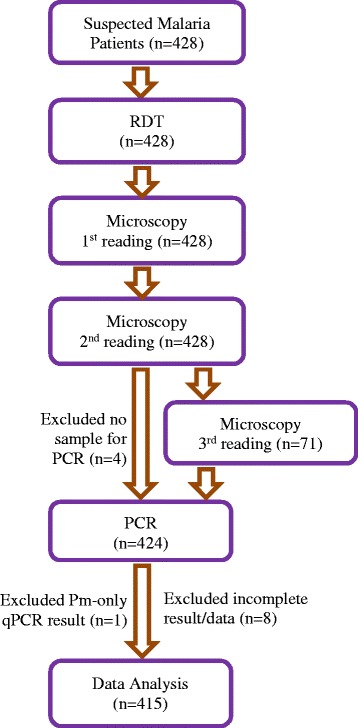
Plasmotec Malaria-3 (XW-P07) performance was evaluated by comparing it with paired blood film microscopy and quantitative real-time PCR (qPCR). Consecutive whole blood samples were derived from one clinic in Mimika as part of routine passive malaria case detection. RDT results were read by two trained technicians and interpreted by consensus. Expert microscopic examination of blood slides was cross-checked by observer-blinded second reader and a third examiner if discordant between examinations. qPCR was used as the 'gold standard', followed by microscopy for the outcome/disease variable. Comparison analysis included sensitivity (Sn), specificity (Sp), positive and negative predictive values (PPV & NPV), and other diagnostic screening performance measures for detecting Plasmodium falciparum and Plasmodium vivax infections.
Overall malaria positive samples from qPCR was 42.2% (175/415 samples); and from matching blood slides 40.5% (168/415) of which those infections with relatively low parasite densities ≤100/μl blood was 5.7% of P. falciparum and 16.5% of P. vivax samples examined. Overall RDT performance when compared with microscopy for detecting P. falciparum was Sn:92%, Sp:96.6%, PPV:88%, NPV:97.8%, Kappa:0.87; and for P. vivax Sn:72.9%, Sp:99.1%, PPV:95.4%, NPV:93.4%, Kappa:0.79. Overall RDT performance when compared with qPCR for detecting P. falciparum was Sn:92%, Sp:96.6%, PPV:88%, NPV:97.8%, Kappa:0.87; and for P. vivax Sn:66%, Sp:99.1%, PPV:95.4%, NPV:90.9%, Kappa:0.73.
Plasmotec Malaria-3 test showed good overall performance scores in precision for detecting P. falciparum, but lower values regarding sensitivity and negative likelihood ratio for detecting P. vivax, a finding partly associated with greater frequency of lower density P. vivax infections compared to P. falciparum in this study. In particular, the negative likelihood ratio (>0.1) for P. vivax detection indicates RDT lacked sufficient discriminating exclusion power falling below general acceptance criteria.
世界卫生组织建议在治疗前通过标准显微镜检查或快速诊断检测(RDT)来诊断疟疾。在印度尼西亚巴布亚省米米卡县报告的大多数RDT病例中,在没有匹配血涂片确认的情况下,RDT的使用频率更高。鉴于RDT作为即时护理工具在当前卫生系统中的重要性,仔细验证RDT产品性能以提供准确的疟疾诊断至关重要。
通过将Plasmotec Malaria-3(XW-P07)与配对血涂片显微镜检查和定量实时PCR(qPCR)进行比较,评估其性能。作为常规被动疟疾病例检测的一部分,连续全血样本取自米米卡的一家诊所。由两名经过培训的技术人员读取RDT结果,并通过共识进行解释。如果检查结果不一致,由不知情的第二名读者和第三名检查人员对血涂片进行专家显微镜检查并进行交叉核对。qPCR用作“金标准”,随后进行显微镜检查以确定结果/疾病变量。比较分析包括检测恶性疟原虫和间日疟原虫感染的敏感性(Sn)、特异性(Sp)、阳性和阴性预测值(PPV和NPV)以及其他诊断筛查性能指标。
qPCR检测出的总体疟疾阳性样本为42.2%(175/415个样本);匹配血涂片检测出的阳性样本为40.5%(168/415),其中寄生虫密度相对较低(≤100/μl血液)的感染样本在检测的恶性疟原虫样本中占5.7%,在间日疟原虫样本中占16.5%。与显微镜检查相比,RDT检测恶性疟原虫的总体性能为:Sn:92%,Sp:96.6%,PPV:88%,NPV:97.8%,Kappa:0.87;检测间日疟原虫的性能为:Sn:72.9%,Sp:99.1%,PPV:95.4%,NPV:93.4%,Kappa:0.79。与qPCR相比,RDT检测恶性疟原虫的总体性能为:Sn:92%,Sp:96.6%,PPV:88%,NPV:97.8%,Kappa:0.87;检测间日疟原虫的性能为:Sn:66%,Sp:99.1%,PPV:95.4%,NPV:90.9%,Kappa:0.73。
Plasmotec Malaria-3检测在检测恶性疟原虫的准确性方面总体表现良好,但在检测间日疟原虫的敏感性和阴性似然比方面数值较低,这一发现部分与本研究中间日疟原虫低密度感染频率高于恶性疟原虫有关。特别是,检测间日疟原虫的阴性似然比(>0.1)表明RDT缺乏足够的鉴别排除能力,低于一般接受标准。