Littnerova Simona, Kala Petr, Jarkovsky Jiri, Kubkova Lenka, Prymusova Krystyna, Kubena Petr, Tesak Martin, Toman Ondrej, Poloczek Martin, Spinar Jindrich, Dusek Ladislav, Parenica Jiri
Institute of Biostatistics and Analyses, Masaryk University, Brno, Czech Republic.
Department of Cardiology, University Hospital Brno, Brno, Czech Republic; Faculty of Medicine, Masaryk University, Brno, Czech Republic.
PLoS One. 2015 Apr 20;10(4):e0123215. doi: 10.1371/journal.pone.0123215. eCollection 2015.
To compare the prognostic accuracy of six scoring models for up to three-year mortality and rates of hospitalisation due to acute decompensated heart failure (ADHF) in STEMI patients.
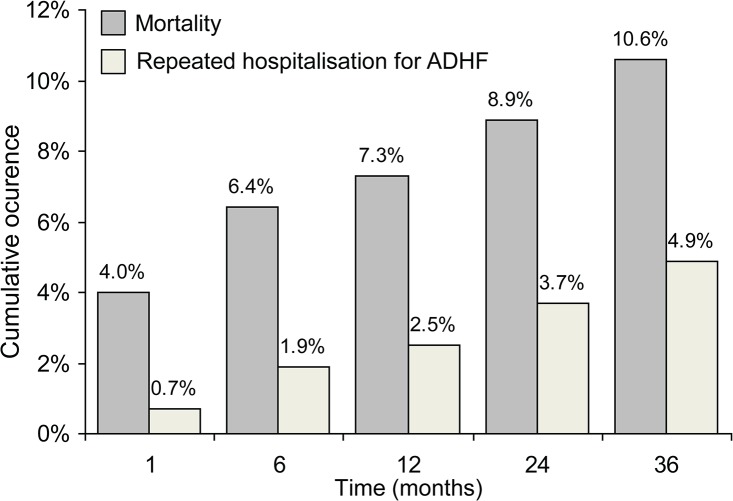
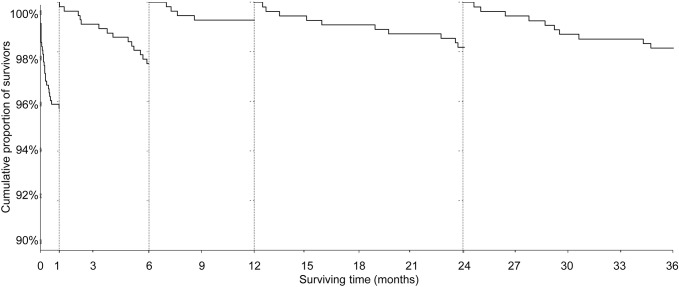
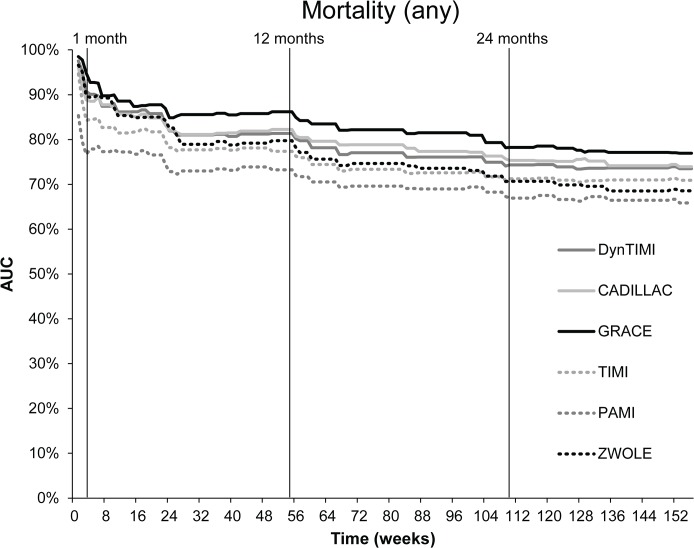
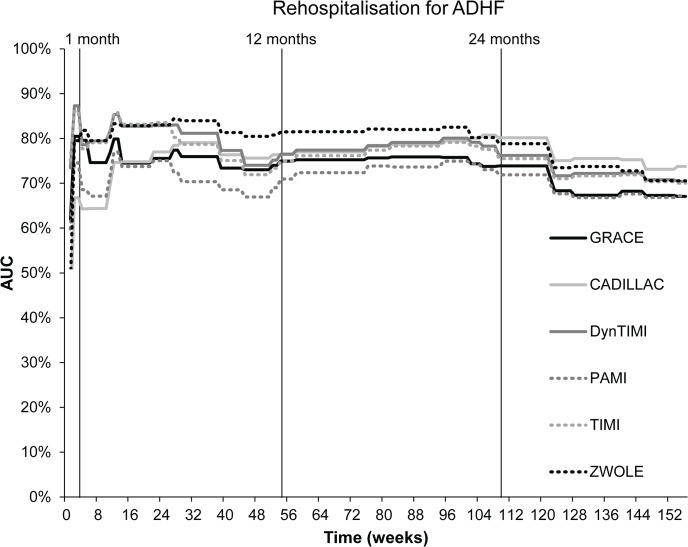
A total of 593 patients treated with primary PCI were evaluated. Prospective follow-up of patients was ≥3 years. Thirty-day, one-year, two-year, and three-year mortality rates were 4.0%, 7.3%, 8.9%, and 10.6%, respectively. Six risk scores--the TIMI score and derived dynamic TIMI, CADILLAC, PAMI, Zwolle, and GRACE--showed a high predictive accuracy for six- and 12-month mortality with area under the receiver operating characteristic curve (AUC) values of 0.73-0.85. The best predictive values for long-term mortality were obtained by GRACE. The next best-performing scores were CADILLAC, Zwolle, and Dynamic TIMI. All risk scores had a lower prediction accuracy for repeat hospitalisation due to ADHF, except Zwolle with the discriminatory capacity for hospitalisation up to two years (AUC, 0.80-0.83).
All tested models showed a high predictive value for the estimation of one-year mortality, but GRACE appears to be the most suitable for the prediction for a longer follow-up period. The tested models exhibited an ability to predict the risk of ADHF, especially the Zwolle model.
比较六种评分模型对ST段抬高型心肌梗死(STEMI)患者长达三年的死亡率及急性失代偿性心力衰竭(ADHF)住院率的预测准确性。
共评估了593例行直接经皮冠状动脉介入治疗(PCI)的患者。对患者进行了≥3年的前瞻性随访。30天、1年、2年和3年的死亡率分别为4.0%、7.3%、8.9%和10.6%。六种风险评分——心肌梗死溶栓治疗(TIMI)评分及其衍生的动态TIMI评分、CADILLAC评分、心肌梗死溶栓治疗后心肌梗死分级(PAMI)评分、兹沃勒(Zwolle)评分和全球急性冠状动脉事件注册(GRACE)评分——对6个月和12个月死亡率显示出较高的预测准确性,受试者工作特征曲线(AUC)下面积值为0.73 - 0.85。GRACE评分对长期死亡率的预测值最佳。其次表现最佳的评分是CADILLAC评分、Zwolle评分和动态TIMI评分。除Zwolle评分对长达两年的住院具有鉴别能力(AUC,0.80 - 0.83)外,所有风险评分对因ADHF再次住院的预测准确性均较低。
所有测试模型对1年死亡率的估计均显示出较高的预测价值,但GRACE评分似乎最适合较长随访期的预测。测试模型表现出预测ADHF风险的能力,尤其是Zwolle模型。