
超人工智能基因组学:基于超声影像组学和基因组学特征融合的人工智能心血管疾病风险评估用于预防、个性化和精准医学:一篇综述
UltraAIGenomics: Artificial Intelligence-Based Cardiovascular Disease Risk Assessment by Fusion of Ultrasound-Based Radiomics and Genomics Features for Preventive, Personalized and Precision Medicine: A Narrative Review.
作者信息
Saba Luca, Maindarkar Mahesh, Johri Amer M, Mantella Laura, Laird John R, Khanna Narendra N, Paraskevas Kosmas I, Ruzsa Zoltan, Kalra Manudeep K, Fernandes Jose Fernandes E, Chaturvedi Seemant, Nicolaides Andrew, Rathore Vijay, Singh Narpinder, Isenovic Esma R, Viswanathan Vijay, Fouda Mostafa M, Suri Jasjit S
机构信息
Department of Radiology, Azienda Ospedaliero Universitaria, 40138 Cagliari, Italy.
School of Bioengineering Sciences and Research, MIT Art, Design and Technology University, 412021 Pune, India.
出版信息
Rev Cardiovasc Med. 2024 May 22;25(5):184. doi: 10.31083/j.rcm2505184. eCollection 2024 May.
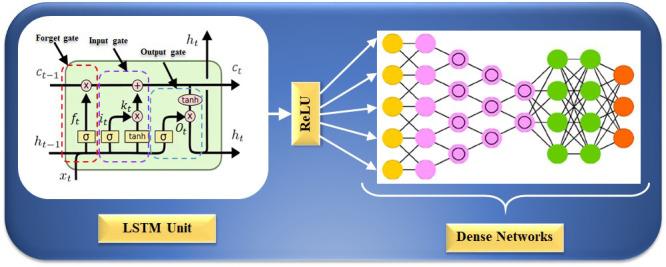
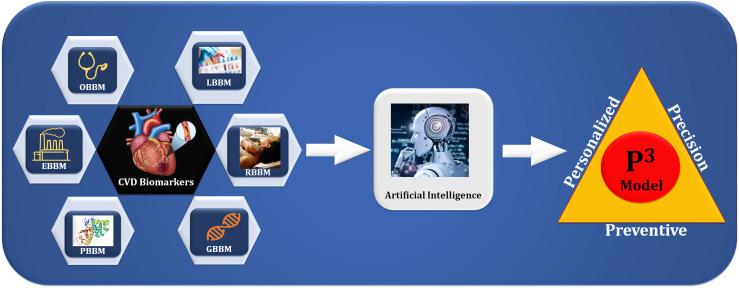
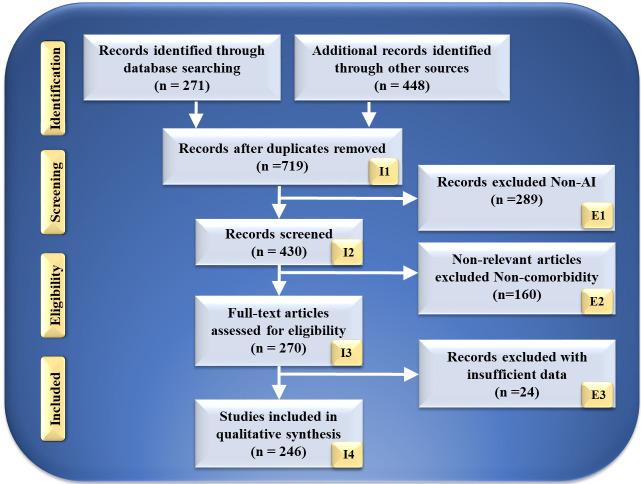
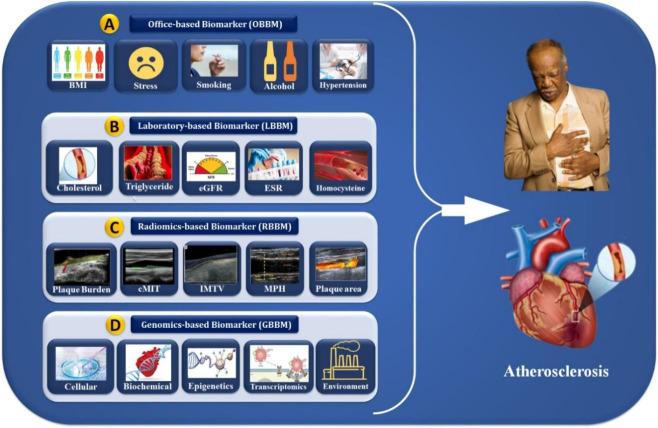
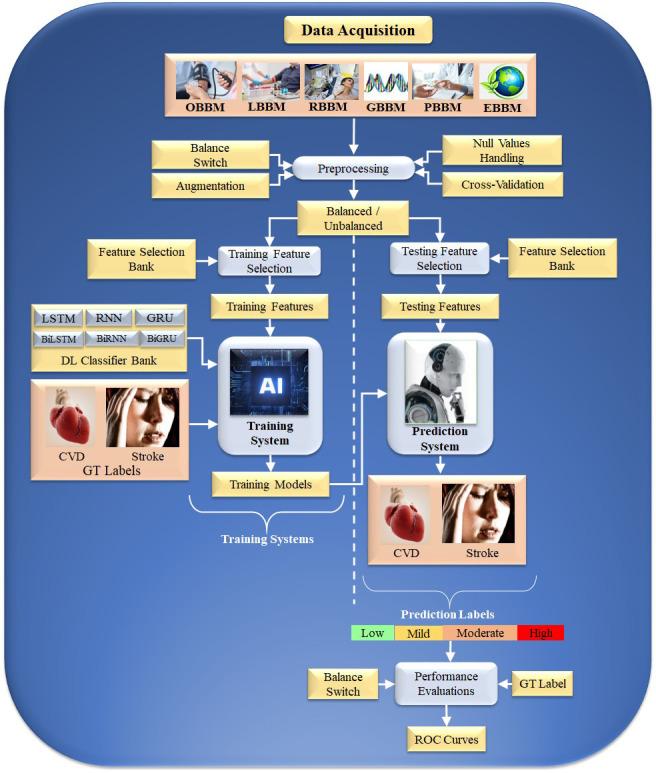
Cardiovascular disease (CVD) diagnosis and treatment are challenging since symptoms appear late in the disease's progression. Despite clinical risk scores, cardiac event prediction is inadequate, and many at-risk patients are not adequately categorised by conventional risk factors alone. Integrating genomic-based biomarkers (GBBM), specifically those found in plasma and/or serum samples, along with novel non-invasive radiomic-based biomarkers (RBBM) such as plaque area and plaque burden can improve the overall specificity of CVD risk. This review proposes two hypotheses: (i) RBBM and GBBM biomarkers have a strong correlation and can be used to detect the severity of CVD and stroke precisely, and (ii) introduces a proposed artificial intelligence (AI)-based preventive, precision, and personalized ( ) CVD/Stroke risk model. The PRISMA search selected 246 studies for the CVD/Stroke risk. It showed that using the RBBM and GBBM biomarkers, deep learning (DL) modelscould be used for CVD/Stroke risk stratification in the framework. Furthermore, we present a concise overview of platelet function, complete blood count (CBC), and diagnostic methods. As part of the AI paradigm, we discuss explainability, pruning, bias, and benchmarking against previous studies and their potential impacts. The review proposes the integration of RBBM and GBBM, an innovative solution streamlined in the DL paradigm for predicting CVD/Stroke risk in the framework. The combination of RBBM and GBBM introduces a powerful CVD/Stroke risk assessment paradigm. model signifies a promising advancement in CVD/Stroke risk assessment.
心血管疾病(CVD)的诊断和治疗具有挑战性,因为症状在疾病进展后期才会出现。尽管有临床风险评分,但心脏事件预测仍不充分,仅靠传统风险因素无法充分对许多高危患者进行分类。将基于基因组的生物标志物(GBBM),特别是在血浆和/或血清样本中发现的那些,与新型非侵入性基于放射组学的生物标志物(RBBM)如斑块面积和斑块负荷相结合,可以提高CVD风险的总体特异性。本综述提出两个假设:(i)RBBM和GBBM生物标志物具有很强的相关性,可用于精确检测CVD和中风的严重程度;(ii)引入一种基于人工智能(AI)的预防性、精准性和个性化的( )CVD/中风风险模型。PRISMA检索筛选了246项关于CVD/中风风险的研究。结果表明,在 框架下,利用RBBM和GBBM生物标志物,深度学习(DL)模型可用于CVD/中风风险分层。此外,我们简要概述了血小板功能、全血细胞计数(CBC)和诊断方法。作为AI范式的一部分,我们讨论了可解释性、剪枝、偏差以及与先前研究的基准比较及其潜在影响。本综述提出将RBBM和GBBM整合,这是一种在DL范式中简化的创新解决方案,用于在 框架下预测CVD/中风风险。RBBM和GBBM的结合引入了一种强大的CVD/中风风险评估范式。 模型标志着CVD/中风风险评估方面有前景的进展。
 Zotero 插件