Benzina Sami, Pitaval Amandine, Lemercier Claudie, Lustremant Celine, Frouin Vincent, Wu Ning, Papine Alexandre, Soussaline Françoise, Romeo Paul-Henri, Gidrol Xavier
CEA, IRTSV, Biologie à Grande Echelle, 17 rue des Martyrs, 38054, Grenoble Cedex, France,
Cell Mol Life Sci. 2015 Sep;72(18):3559-73. doi: 10.1007/s00018-015-1901-7. Epub 2015 Apr 18.
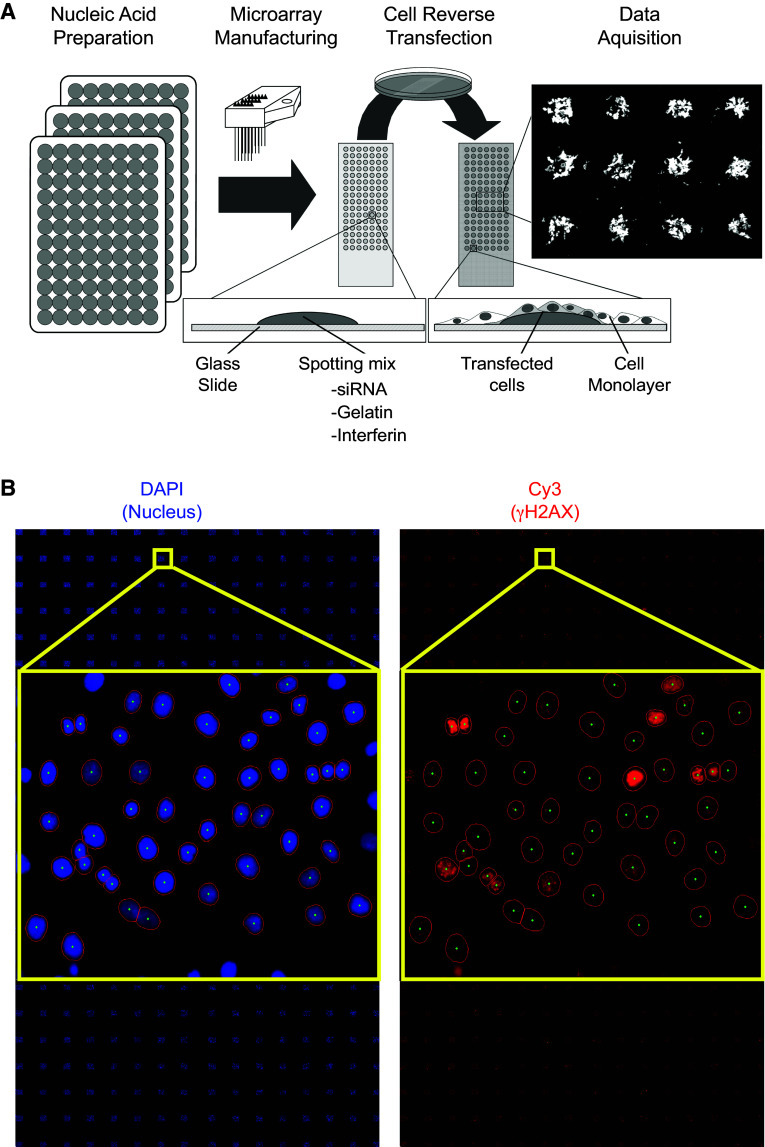
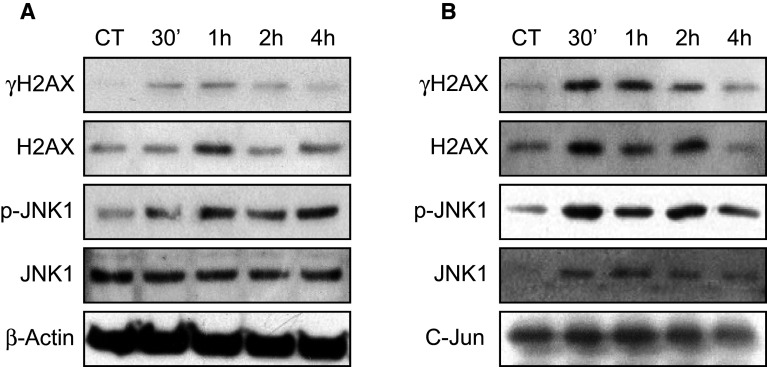
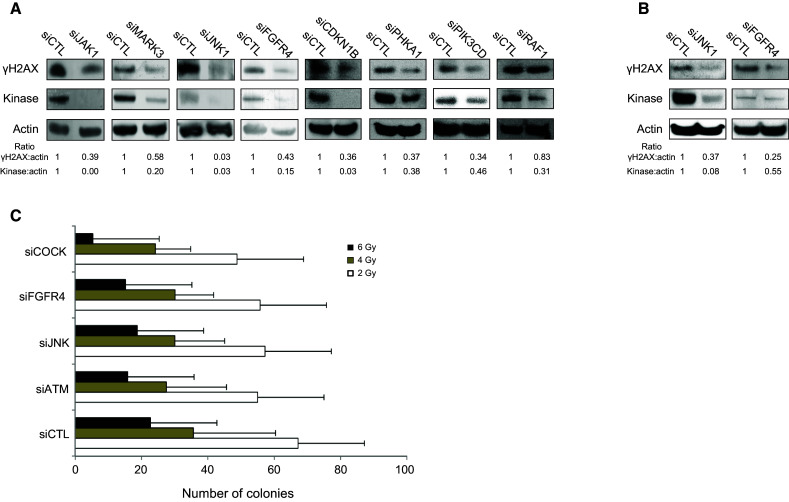
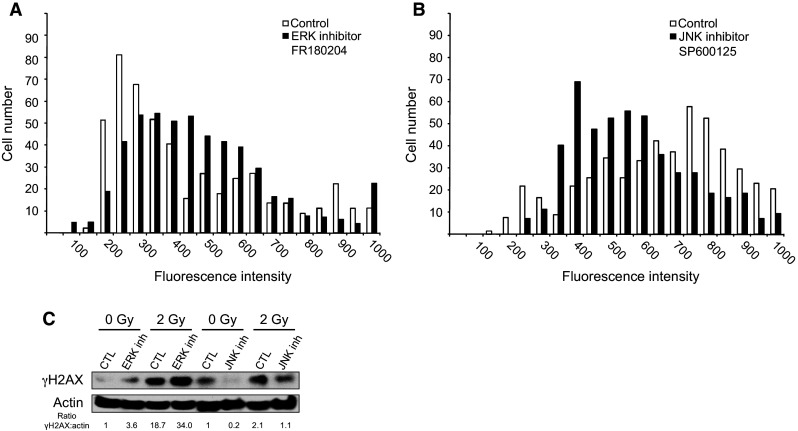
A general radioprotective effect by fibroblast growth factor (FGF) has been extensively described since the early 1990s; however, the molecular mechanisms involved remain largely unknown. Radiation-induced DNA double-strand breaks (DSBs) lead to a complex set of responses in eukaryotic cells. One of the earliest consequences is phosphorylation of histone H2AX to form nuclear foci of the phosphorylated form of H2AX (γH2AX) in the chromatin adjacent to sites of DSBs and to initiate the recruitment of DNA-repair molecules. Upon a DSB event, a rapid signaling network is activated to coordinate DNA repair with the induction of cell-cycle checkpoints. To date, three kinases (ATM, ATR, and DNA-PK) have been shown to phosphorylate histone H2AX in response to irradiation. Here, we report a kinome-targeted small interfering RNA (siRNA) screen to characterize human kinases involved in H2AX phosphorylation. By analyzing γH2AX foci at a single-nucleus level, we identified 46 kinases involved either directly or indirectly in H2AX phosphorylation in response to irradiation in human keratinocytes. Furthermore, we demonstrate that in response to irradiation, the FGFR4 signaling cascade promotes JNK1 activation and direct H2AX phosphorylation leading, in turn, to more efficient DNA repair. This can explain, at least partially, the radioprotective effect of FGF.
自20世纪90年代初以来,成纤维细胞生长因子(FGF)的一般辐射防护作用已被广泛描述;然而,其中涉及的分子机制在很大程度上仍然未知。辐射诱导的DNA双链断裂(DSB)会在真核细胞中引发一系列复杂的反应。最早的后果之一是组蛋白H2AX磷酸化,在与DSB位点相邻的染色质中形成磷酸化形式的H2AX(γH2AX)核灶,并启动DNA修复分子的募集。在发生DSB事件时,一个快速的信号网络被激活,以协调DNA修复与细胞周期检查点的诱导。迄今为止,已证明三种激酶(ATM、ATR和DNA-PK)在受到辐射时会使组蛋白H2AX磷酸化。在此,我们报告了一项针对激酶组的小干扰RNA(siRNA)筛选,以鉴定参与H2AX磷酸化的人类激酶。通过在单核水平分析γH2AX灶,我们确定了46种直接或间接参与人类角质形成细胞辐射诱导的H2AX磷酸化的激酶。此外,我们证明,在受到辐射时,FGFR4信号级联促进JNK1激活和直接的H2AX磷酸化,进而导致更有效的DNA修复。这至少可以部分解释FGF的辐射防护作用。