Andreoletti Gaia, Ashton James J, Coelho Tracy, Willis Claire, Haggarty Rachel, Gibson Jane, Holloway John, Batra Akshay, Afzal Nadeem A, Beattie Robert Mark, Ennis Sarah
*Human Genetics and Genomic Medicine, University of Southampton, Southampton General Hospital, Southampton, United Kingdom; †Department of Paediatric Gastroenterology, University Hospital Southampton NHS Foundation Trust, Southampton General Hospital, Southampton, United Kingdom; ‡NIHR Nutrition Biomedical Research Centre, Southampton Centre for Biomedical Research, University Hospital Southampton NHS Foundation Trust, Southampton General Hospital, Southampton, United Kingdom; and §Centre for Biological Sciences, Faculty of Natural and Environmental Studies, University of Southampton, Southampton, United Kingdom.
Inflamm Bowel Dis. 2015 Jun;21(6):1229-36. doi: 10.1097/MIB.0000000000000381.
Pediatric Inflammatory Bowel Disease (PIBD) is a chronic condition seen in genetically predisposed individuals. Genome-wide association studies have implicated >160 genomic loci in IBD with many genes coding for proteins in key immune pathways. This study looks at autoimmune disease burden in patients diagnosed with PIBD and interrogates exome data of a subset of patients.
Patients were recruited from the Southampton Genetics of PIBD cohort. Clinical diagnosis of autoimmune disease in these individuals was ascertained from medical records. For a subset of patients with PIBD and concurrent asthma, exome data was interrogated to ascertain the burden of pathogenic variants within genes implicated in asthma. Association testing was conducted between cases and population controls using the SKAT-O test.
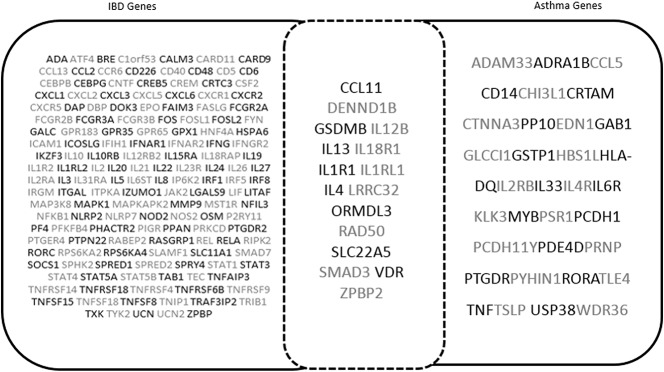
Forty-nine (28.3%) PIBD children (18.49% CD, 8.6% UC, and 21.15% IBDU patients) had a concurrent clinical diagnosis of at least one other autoimmune disorder; asthma was the most prevalent, affecting 16.2% of the PIBD cohort. Rare and common variant association testing revealed 6 significant genes (P < 0.05) before Bonferroni adjustment. Three of these genes were previously implicated in both asthma and IBD (ZPBP2 IL1R1, and IL18R1) and 3 in asthma only (PYHIN1, IL2RB, and GSTP1).
One-third of our cohort had a concurrent autoimmune condition. We observed higher incidence of asthma compared with the overall pediatric prevalence. Despite a small sample size, SKAT-O evaluated a significant burden of rare and common mutations in 6 genes. Variant burden suggests that a systemic immune dysregulation rather than organ-specific could underpin immune dysfunction for a subset of patients.
儿童炎症性肠病(PIBD)是一种在具有遗传易感性个体中出现的慢性疾病。全基因组关联研究已表明,超过160个基因组位点与炎症性肠病有关,许多基因编码关键免疫途径中的蛋白质。本研究着眼于被诊断为PIBD患者的自身免疫性疾病负担,并对部分患者的外显子组数据进行分析。
患者从南安普敦PIBD遗传学队列中招募。通过病历确定这些个体自身免疫性疾病的临床诊断。对于一部分患有PIBD并发哮喘的患者,分析其外显子组数据,以确定与哮喘相关基因中致病变异的负担。使用SKAT-O检验在病例组和人群对照组之间进行关联测试。
49名(28.3%)PIBD儿童(18.49%为克罗恩病患者,8.6%为溃疡性结肠炎患者,21.15%为未定型炎症性肠病患者)同时被临床诊断患有至少一种其他自身免疫性疾病;哮喘最为常见,影响了16.2%的PIBD队列患者。罕见和常见变异关联测试在Bonferroni校正前发现了6个显著基因(P < 0.05)。其中3个基因先前已被证明与哮喘和炎症性肠病均有关(ZPBP2、IL1R1和IL18R1),另外3个仅与哮喘有关(PYHIN1、IL2RB和GSTP1)。
我们队列中有三分之一的患者同时患有自身免疫性疾病。我们观察到哮喘的发病率高于总体儿童患病率。尽管样本量较小,但SKAT-O评估了6个基因中罕见和常见突变的显著负担。变异负担表明,对于一部分患者来说,系统性免疫失调而非器官特异性免疫失调可能是免疫功能障碍的基础。