Gagliardi Anna R, Alhabib Samia
Toronto General Research Institute, University Health Network, Toronto, Canada.
Department of Family & Community Medicine, King Abdullah University Hospital, Riyadh, Saudi Arabia.
Implement Sci. 2015 Apr 21;10:54. doi: 10.1186/s13012-015-0247-8.
There is currently no reliable way to choose strategies that are appropriate for implementing guidelines facing different barriers. This study examined trends in guideline implementation by topic over a 10-year period to explore whether and how strategies may be suitable for addressing differing barriers.
A scoping systematic review was performed. MEDLINE and EMBASE were searched from 2004 to 2013 for studies that evaluated the implementation of guidelines on arthritis, diabetes, colorectal cancer and heart failure. Data on study characteristics, reason for implementation (new guideline or quality improvement), implementation strategy used, rationale for selecting that strategy and reported impact were extracted and summarized. Interventions were mapped against a published taxonomy of guideline implementation strategies.
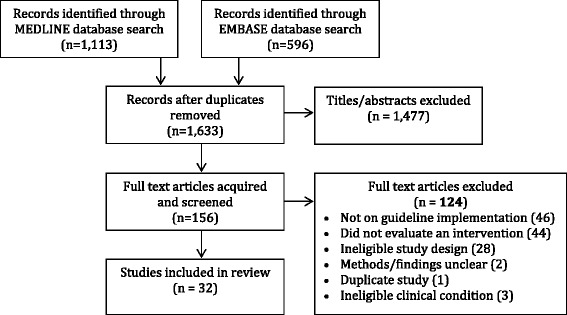
The search resulted in 1,709 articles; 156 were retrieved and 127 were excluded largely because they did not evaluate guideline implementation, leaving 32 eligible for review (4 arthritis, 3 colorectal cancer, 21 diabetes, 4 heart failure). Six of 7 randomized trials and 8 of 25 observational studies had a low risk of bias. Most studies promoted guideline use for quality improvement (78.0%). Few studies rationalized strategy choice (18.8%). Most employed multiple approaches and strategies, most often educational meetings and print material for professionals or patients. Few studies employed organizational, financial or regulatory approaches. Strategies employed that were unique to the published taxonomy included professional (print material, tailoring guidelines, self-audit training or material) and patient strategies (education, counselling, group interaction, print material, reminders). Most studies achieved positive impact (87.5%). This did not appear to be associated with guideline topic, use of theory or barrier assessment, or number or type of implementation approaches and strategies.
While few studies were eligible, limiting insight on how to choose implementation strategies that address guideline-specific barriers, this review identified other important findings. Education for professionals or patients and print material were the most commonly employed strategies for translating guidelines to practice. Mapping of strategies onto the published taxonomy identified gaps in guideline implementation that represent opportunities for future research and expanded the taxonomy.
目前尚无可靠方法来选择适合在面对不同障碍时实施指南的策略。本研究调查了10年间按主题划分的指南实施趋势,以探讨策略是否以及如何适合应对不同的障碍。
进行了一项范围界定的系统综述。检索了2004年至2013年期间MEDLINE和EMBASE数据库中评估关节炎、糖尿病、结直肠癌和心力衰竭指南实施情况的研究。提取并总结了有关研究特征、实施原因(新指南或质量改进)、所采用的实施策略、选择该策略的理由以及报告的影响的数据。根据已发表的指南实施策略分类法对干预措施进行了映射分析。
检索结果为1709篇文章;筛选出156篇,其中大部分(127篇)被排除,主要原因是它们未评估指南实施情况,最终留下32篇符合综述要求(4篇关于关节炎,3篇关于结直肠癌,21篇关于糖尿病,4篇关于心力衰竭)。7项随机试验中的6项以及25项观察性研究中的8项存在低偏倚风险。大多数研究旨在促进指南用于质量改进(78.0%)。很少有研究对策略选择进行合理性论证(18.8%)。大多数研究采用了多种方法和策略,最常用的是针对专业人员或患者的教育会议和印刷材料。很少有研究采用组织、财务或监管方法。所采用的策略中,已发表分类法特有的包括专业策略(印刷材料、调整指南、自我审核培训或材料)和患者策略(教育、咨询、小组互动、印刷材料、提醒)。大多数研究取得了积极影响(87.5%)。这似乎与指南主题、理论应用或障碍评估无关,也与实施方法和策略的数量或类型无关。
虽然符合条件的研究较少,限制了对如何选择应对特定指南障碍的实施策略的深入了解,但本综述确定了其他重要发现。对专业人员或患者的教育以及印刷材料是将指南转化为实践最常用的策略。将策略映射到已发表的分类法上,发现了指南实施中的差距,这为未来研究提供了机会,并扩展了分类法。