
一个针对西班牙裔人群的关于活体肾捐赠与移植的交互式双语文化定向网站:开发与形成性评估。
An interactive, bilingual, culturally targeted website about living kidney donation and transplantation for hispanics: development and formative evaluation.
作者信息
Gordon Elisa J, Feinglass Joe, Carney Paula, Ramirez Daney, Olivero Maria, O'Connor Kate, MacLean Jessica, Brucker James, Caicedo Juan Carlos
机构信息
Center for Healthcare Studies and Comprehensive Transplant Center, Institute for Public Health and Medicine, Northwestern University Feinberg School of Medicine, Chicago, IL, United States.
出版信息
JMIR Res Protoc. 2015 Apr 20;4(2):e42. doi: 10.2196/resprot.3838.
BACKGROUND
As the kidney shortage continues to grow, patients on the waitlist are increasingly turning to live kidney donors for transplantation. Despite having a disproportionately higher prevalence of end-stage kidney disease (ESKD), fewer waitlisted Hispanic patients received living donor kidney transplants (LDKTs) than non-Hispanic whites in 2014. Although lack of knowledge has been identified as a barrier to living kidney donation (LKD) among Hispanics, little is known about information needs, and few bilingual educational resources provide transplant-related information addressing Hispanics' specific concerns.
OBJECTIVE
This paper describes the process of developing a bilingual website targeted to the Hispanic community. The website was designed to increase knowledge about LKD among Hispanic patients with ESKD, their families, and the public, and was inspired by educational sessions targeted to Hispanic transplant patients provided by Northwestern University's Hispanic Kidney Transplant Program.
METHODS
Northwestern faculty partnered with the National Kidney Foundation of Illinois for expertise in ESKD and Hispanic community partners across the Chicago area. We established a Community Advisory Board (CAB) of 10 Chicago-area Hispanic community leaders to provide insight into cultural concerns and community and patients' needs. Website content development was informed by 9 focus groups with 76 adult Hispanic kidney transplant recipients, living kidney donors, dialysis patients, and the general Hispanic public. The website development effort was guided by community input on images, telenovela scripts, and messages. After initial development, formal usability testing was conducted with 18 adult Hispanic kidney transplant recipients, dialysis patients, and living kidney donors to identify ways to improve navigability, design, content, comprehension, and cultural sensitivity. Usability testing revealed consistently high ratings as "easy to navigate", "informative", and "culturally appropriate". Bandura's Social Cognitive Theory and Gagne's Conditions of Learning Theory guided website design to facilitate adult learning.
RESULTS
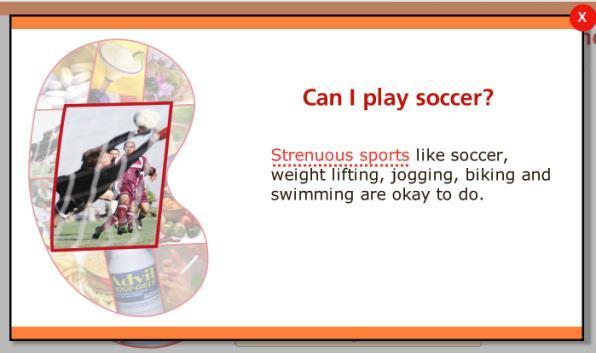
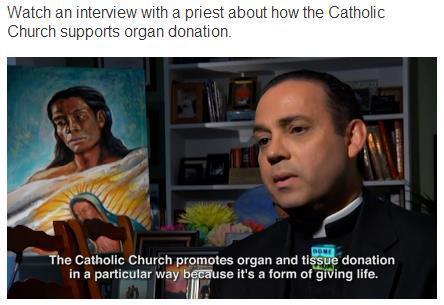
The website, "Infórmate: Living Kidney Donation for Hispanics/Latinos" (Infórmate Acerca de la Donación de Riñón en Vida), includes six sections: Treatment Options, Donation: Step-by-Step, Benefits and Risks, Financial Issues, Immigrant Issues, and Cultural Beliefs and Myths. Sections host 5-10 interactive messages that summarize important points and link to detailed explanations for users interested in learning more about specific issues. The website hosts interactive videos, multimedia testimonials, telenovelas, games, and quizzes. Photographs and videos of Hispanic living donors are shown to promote pride and ownership.
CONCLUSIONS
Our success in developing a website was driven by a development team with expertise in transplantation, social science, evaluation, instructional design, and Hispanic perspectives, and by a patient-centered approach toward content and design. Based on feedback from usability testing and our CAB, the website is sensitive to Hispanic cultural sensibilities. We have nearly completed a formal evaluation of the website's impact on increasing Hispanics' knowledge about LKD and will disseminate the website thereafter.
背景
随着肾脏短缺问题持续加剧,等待名单上的患者越来越多地寻求活体肾脏捐赠者进行移植。尽管终末期肾病(ESKD)在西班牙裔人群中的患病率高得不成比例,但2014年等待名单上接受活体捐赠肾脏移植(LDKT)的西班牙裔患者比非西班牙裔白人少。虽然知识匮乏已被确定为西班牙裔人群活体肾脏捐赠(LKD)的障碍,但对于信息需求知之甚少,而且很少有双语教育资源提供针对西班牙裔人群具体关切的移植相关信息。
目的
本文描述了一个针对西班牙裔社区的双语网站的开发过程。该网站旨在增加患有ESKD的西班牙裔患者及其家人和公众对LKD的了解,其灵感来自西北大学西班牙裔肾脏移植项目为西班牙裔移植患者提供的教育课程。
方法
西北大学的教职员工与伊利诺伊州肾脏基金会合作,获取ESKD方面的专业知识,并与芝加哥地区的西班牙裔社区合作伙伴合作。我们成立了一个由10名芝加哥地区西班牙裔社区领袖组成的社区咨询委员会(CAB),以深入了解文化关切以及社区和患者的需求。网站内容的开发参考了9个焦点小组的意见,这些小组由76名成年西班牙裔肾脏移植受者、活体肾脏捐赠者、透析患者和西班牙裔普通公众组成。网站开发工作在图像、肥皂剧脚本和信息方面接受了社区的意见指导。初步开发完成后,对18名成年西班牙裔肾脏移植受者、透析患者和活体肾脏捐赠者进行了正式的可用性测试,以确定改进导航性、设计、内容、理解性和文化敏感性的方法。可用性测试显示,该网站在“易于导航”、“信息丰富”和“文化适宜性”方面的评分一直很高。班杜拉的社会认知理论和加涅的学习条件理论指导了网站设计,以促进成人学习。
结果
该网站“Infórmate:西班牙裔/拉丁裔的活体肾脏捐赠”(Infórmate Acerca de la Donación de Riñón en Vida)包括六个部分:治疗选择、捐赠:一步一步来、益处和风险、财务问题、移民问题以及文化信仰和误解。每个部分包含5 - 10条互动信息,总结要点,并为有兴趣深入了解特定问题的用户提供详细解释的链接。该网站还设有互动视频、多媒体推荐、肥皂剧、游戏和测验。展示了西班牙裔活体捐赠者的照片和视频,以增强自豪感和归属感。
结论
我们在开发网站方面的成功得益于一个由移植、社会科学、评估、教学设计以及西班牙裔视角等方面专家组成的开发团队,以及以患者为中心的内容和设计方法。根据可用性测试和我们的CAB的反馈,该网站对西班牙裔文化敏感性很关注。我们几乎完成了对该网站增加西班牙裔对LKD了解的影响的正式评估,并将在之后推广该网站。


 Zotero 插件