Chan-On Waraporn, Huyen Nguyen Thi Bich, Songtawee Napat, Suwanjang Wilasinee, Prachayasittikul Supaluk, Prachayasittikul Virapong
Center for Research and Innovation, Mahidol University, Bangkok, Thailand.
Department of Clinical Microbiology and Applied Technology, Mahidol University, Bangkok, Thailand.
Drug Des Devel Ther. 2015 Apr 8;9:2033-47. doi: 10.2147/DDDT.S79313. eCollection 2015.
Fork head box M1 (FoxM1) is an oncogenic transcription factor frequently elevated in numerous cancers, including cholangiocarcinoma (CCA). A growing body of evidence documents its diverse functions contributing to tumorigenesis and cancer progression. As such, discovery of agents that can target FoxM1 would be valuable for the treatment of CCA. The quinoline-based compounds, namely clioquinol (CQ) and nitroxoline (NQ), represent a new class of anticancer drug. However, their efficacy and underlying mechanisms have not been elucidated in CCA. In this study, anticancer activities and inhibitory effects of CQ and NQ on FoxM1 signaling were explored using CCA cells.
The effects of CQ and NQ on cell viability and proliferation were evaluated using the colorimetric 3-(4,5-dimethylthiazol-2yl)-5-(3-carboxymethoxyphenyl)-(4-sulfophenyl)-2H-tetrazolium (MTS assay). Colony formation and cell migration affected by CQ and NQ were investigated using a clonogenic and a wound healing assay, respectively. To demonstrate the agents' effects on FoxM1 signaling, expression levels of the target genes were quantitatively determined using real-time polymerase chain reaction.
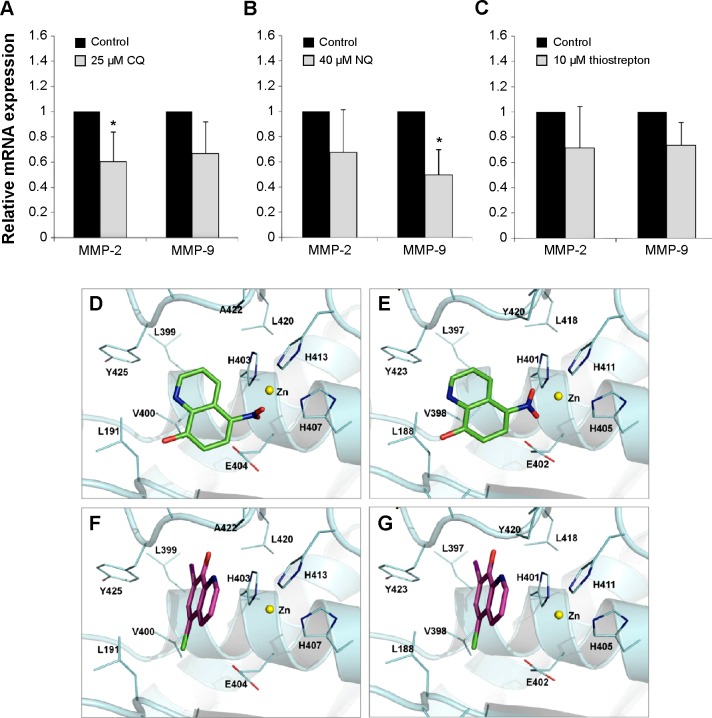
CQ and NQ significantly inhibited cell survival of HuCCT1 and Huh28 in a dose- and a time-dependent fashion. Further investigations using the rapidly proliferating HuCCT1 cells revealed significant suppression of cell proliferation and colony formation induced by low doses of the compounds. Treatment of CQ and NQ repressed expression of cyclin D1 but enhanced expression of p21. Most importantly, upon CQ and NQ treatment, expression of oncogenic FoxM1 was markedly decreased concomitant with downregulation of various FoxM1's downstream targets including cdc25b, CENP-B, and survivin. In addition, the compounds distinctly impaired HuCCT1 migration as well as inhibited expression of matrix metalloproteinase (MMP)-2 and MMP-9.
Collectively, this study reports for the first time the anticancer effects of CQ and NQ against CCA cells, and highlights new insights into the mechanism of actions of the quinoline-based compounds to disrupt FoxM1 signaling.
叉头框蛋白M1(FoxM1)是一种致癌转录因子,在包括胆管癌(CCA)在内的多种癌症中经常上调。越来越多的证据表明其在肿瘤发生和癌症进展中具有多种功能。因此,发现能够靶向FoxM1的药物对CCA的治疗具有重要价值。喹啉类化合物,即氯碘羟喹(CQ)和硝碘酚腈(NQ),代表了一类新型抗癌药物。然而,它们在CCA中的疗效及潜在机制尚未阐明。在本研究中,使用CCA细胞探索了CQ和NQ的抗癌活性及其对FoxM1信号通路的抑制作用。
使用比色法3-(4,5-二甲基噻唑-2-基)-5-(3-羧甲氧基苯基)-(4-磺基苯基)-2H-四唑(MTS法)评估CQ和NQ对细胞活力和增殖的影响。分别使用克隆形成实验和伤口愈合实验研究CQ和NQ对集落形成和细胞迁移的影响。为了证明这些药物对FoxM1信号通路的作用,使用实时聚合酶链反应定量测定靶基因的表达水平。
CQ和NQ以剂量和时间依赖性方式显著抑制HuCCT1和Huh28细胞的存活。使用快速增殖的HuCCT1细胞进行的进一步研究表明,低剂量的这些化合物可显著抑制细胞增殖和集落形成。CQ和NQ处理可抑制细胞周期蛋白D1的表达,但增强p21的表达。最重要的是,经CQ和NQ处理后,致癌性FoxM1的表达明显降低,同时包括细胞周期蛋白依赖性激酶25B(cdc25b)、着丝粒蛋白B(CENP-B)和生存素在内的多种FoxM1下游靶点的表达下调。此外,这些化合物明显损害HuCCT1细胞的迁移,并抑制基质金属蛋白酶(MMP)-2和MMP-9的表达。
总体而言,本研究首次报道了CQ和NQ对CCA细胞的抗癌作用,并突出了喹啉类化合物破坏FoxM1信号通路作用机制的新见解。