Arner Peter, Henjes Frauke, Schwenk Jochen M, Darmanis Spyros, Dahlman Ingrid, Iresjö Britt-Marie, Naredi Peter, Agustsson Thorhallur, Lundholm Kent, Nilsson Peter, Rydén Mikael
Department of Medicine (H7), Karolinska Institutet, Karolinska University Hospital, Huddinge, 141 86, Stockholm, Sweden.
Affinity Proteomics, Science for Life Laboratory, School of Biotechnology, Royal Institute of Technology, Box 1031, 171 21, Solna, Sweden.
PLoS One. 2015 Apr 21;10(4):e0123566. doi: 10.1371/journal.pone.0123566. eCollection 2015.
Cancer cachexia (CC) is linked to poor prognosis. Although the mechanisms promoting this condition are not known, several circulating proteins have been proposed to contribute. We analyzed the plasma proteome in cancer subjects in order to identify factors associated with cachexia.
DESIGN/SUBJECTS: Plasma was obtained from a screening cohort of 59 patients, newly diagnosed with suspected gastrointestinal cancer, with (n = 32) or without (n = 27) cachexia. Samples were subjected to proteomic profiling using 760 antibodies (targeting 698 individual proteins) from the Human Protein Atlas project. The main findings were validated in a cohort of 93 patients with verified and advanced pancreas cancer.
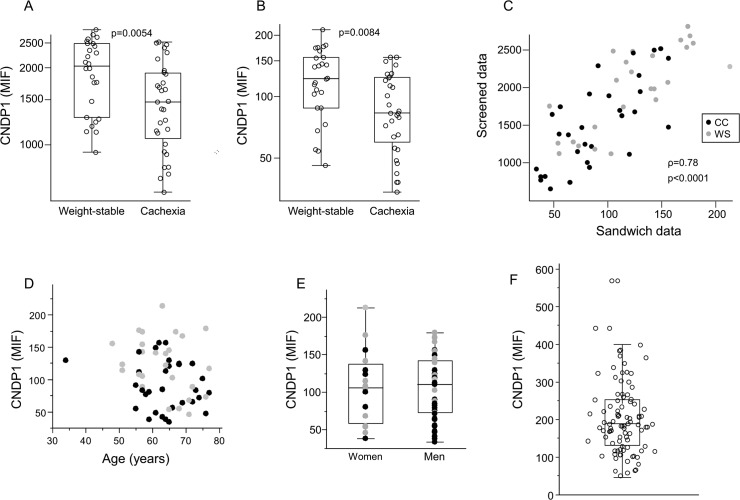
Only six proteins displayed differential plasma levels in the screening cohort. Among these, Carnosine Dipeptidase 1 (CNDP1) was confirmed by sandwich immunoassay to be lower in CC (p = 0.008). In both cohorts, low CNDP1 levels were associated with markers of poor prognosis including weight loss, malnutrition, lipid breakdown, low circulating albumin/IGF1 levels and poor quality of life. Eleven of the subjects in the discovery cohort were finally diagnosed with non-malignant disease but omitting these subjects from the analyses did not have any major influence on the results.
In gastrointestinal cancer, reduced plasma levels of CNDP1 associate with signs of catabolism and poor outcome. These results, together with recently published data demonstrating lower circulating CNDP1 in subjects with glioblastoma and metastatic prostate cancer, suggest that CNDP1 may constitute a marker of aggressive cancer and CC.
癌症恶病质(CC)与预后不良相关。尽管促进这种状况的机制尚不清楚,但有几种循环蛋白被认为与之有关。我们分析了癌症患者的血浆蛋白质组,以确定与恶病质相关的因素。
设计/研究对象:从59例新诊断为疑似胃肠道癌的患者筛查队列中获取血浆,其中有恶病质的患者32例,无恶病质的患者27例。使用来自人类蛋白质图谱项目的760种抗体(针对698种个体蛋白质)对样本进行蛋白质组分析。主要发现结果在93例经证实的晚期胰腺癌患者队列中得到验证。
在筛查队列中,只有6种蛋白质的血浆水平存在差异。其中,通过夹心免疫测定法证实,肌肽二肽酶1(CNDP1)在恶病质患者中水平较低(p = 0.008)。在两个队列中,低CNDP1水平均与预后不良的指标相关,包括体重减轻、营养不良、脂质分解、循环白蛋白/胰岛素样生长因子1水平低以及生活质量差。发现队列中的11名受试者最终被诊断为非恶性疾病,但在分析中剔除这些受试者对结果没有任何重大影响。
在胃肠道癌中,血浆CNDP1水平降低与分解代谢迹象和不良预后相关。这些结果,连同最近发表的数据表明胶质母细胞瘤和转移性前列腺癌患者循环CNDP1水平较低,提示CNDP1可能构成侵袭性癌症和癌症恶病质的一个标志物。