Agharbaoui Zahra, Leclercq Mickael, Remita Mohamed Amine, Badawi Mohamed A, Lord Etienne, Houde Mario, Danyluk Jean, Diallo Abdoulaye Baniré, Sarhan Fathey
Department of Biological Sciences, University of Quebec in Montreal, Montreal, Canada.
Department of Computer Sciences, University of Quebec in Montreal, Montreal, Canada.
BMC Genomics. 2015 Apr 24;16(1):339. doi: 10.1186/s12864-015-1490-8.
Wheat is a major staple crop with broad adaptability to a wide range of environmental conditions. This adaptability involves several stress and developmentally responsive genes, in which microRNAs (miRNAs) have emerged as important regulatory factors. However, the currently used approaches to identify miRNAs in this polyploid complex system focus on conserved and highly expressed miRNAs avoiding regularly those that are often lineage-specific, condition-specific, or appeared recently in evolution. In addition, many environmental and biological factors affecting miRNA expression were not yet considered, resulting still in an incomplete repertoire of wheat miRNAs.
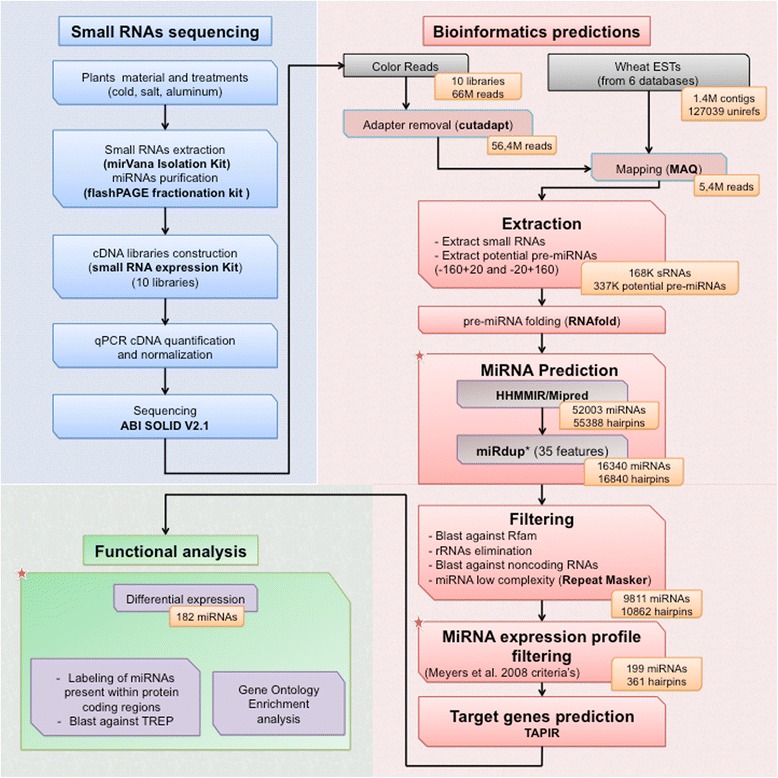
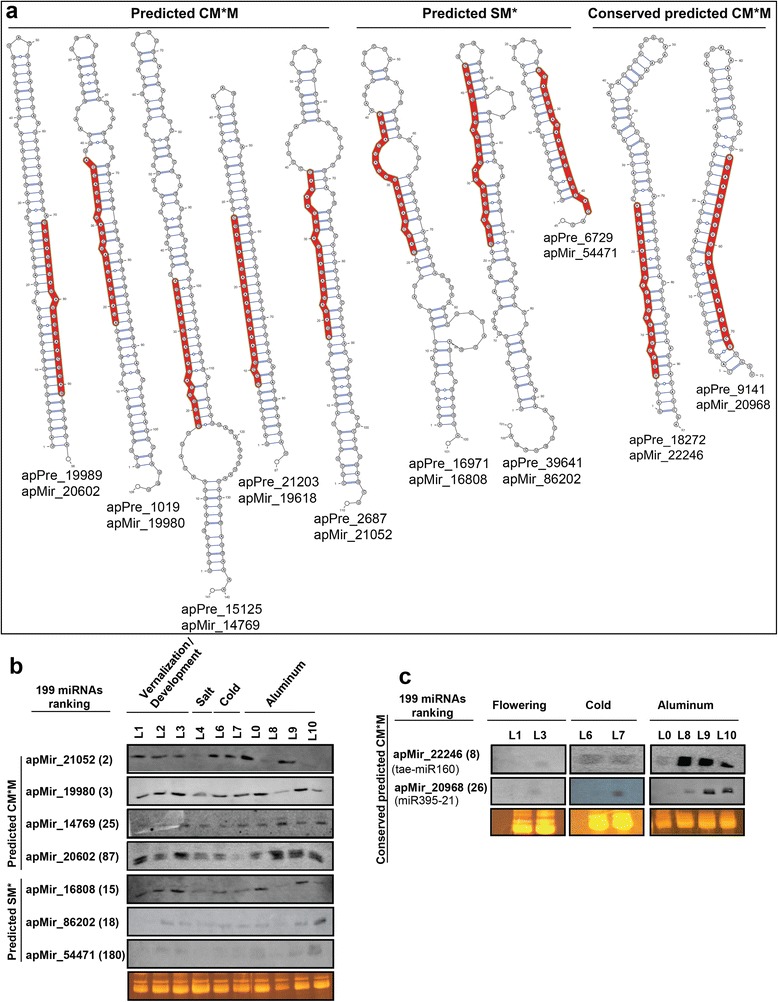
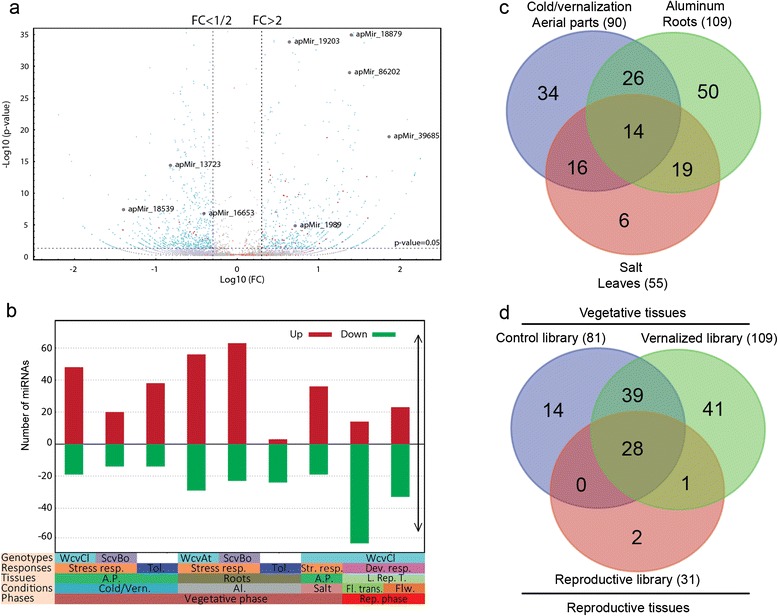
We developed a conservation-independent technique based on an integrative approach that combines machine learning, bioinformatic tools, biological insights of known miRNA expression profiles and universal criteria of plant miRNAs to identify miRNAs with more confidence. The developed pipeline can potentially identify novel wheat miRNAs that share features common to several species or that are species specific or clade specific. It allowed the discovery of 199 miRNA candidates associated with different abiotic stresses and development stages. We also highlight from the raw data 267 miRNAs conserved with 43 miRBase families. The predicted miRNAs are highly associated with abiotic stress responses, tolerance and development. GO enrichment analysis showed that they may play biological and physiological roles associated with cold, salt and aluminum (Al) through auxin signaling pathways, regulation of gene expression, ubiquitination, transport, carbohydrates, gibberellins, lipid, glutathione and secondary metabolism, photosynthesis, as well as floral transition and flowering.
This approach provides a broad repertoire of hexaploid wheat miRNAs associated with abiotic stress responses, tolerance and development. These valuable resources of expressed wheat miRNAs will help in elucidating the regulatory mechanisms involved in freezing and Al responses and tolerance mechanisms as well as for development and flowering. In the long term, it may help in breeding stress tolerant plants.
小麦是一种主要的主食作物,对广泛的环境条件具有广泛的适应性。这种适应性涉及多个应激和发育响应基因,其中微小RNA(miRNA)已成为重要的调控因子。然而,目前在这个多倍体复杂系统中鉴定miRNA的方法主要集中在保守且高表达的miRNA上,常常忽略那些通常是谱系特异性、条件特异性或在进化中近期出现的miRNA。此外,许多影响miRNA表达的环境和生物因素尚未被考虑,导致小麦miRNA的库仍然不完整。
我们基于一种综合方法开发了一种不依赖保守性的技术,该方法结合了机器学习、生物信息学工具、已知miRNA表达谱的生物学见解以及植物miRNA的通用标准,以更可靠地鉴定miRNA。所开发的流程有可能鉴定出与多个物种具有共同特征或物种特异性或进化枝特异性的新型小麦miRNA。它发现了199个与不同非生物胁迫和发育阶段相关的miRNA候选物。我们还从原始数据中突出显示了与43个miRBase家族保守的267个miRNA。预测的miRNA与非生物胁迫响应、耐受性和发育高度相关。基因本体(GO)富集分析表明,它们可能通过生长素信号通路、基因表达调控、泛素化、转运、碳水化合物、赤霉素、脂质、谷胱甘肽和次生代谢、光合作用以及花期转变和开花,发挥与寒冷、盐和铝(Al)相关的生物学和生理学作用。
这种方法提供了与非生物胁迫响应、耐受性和发育相关的六倍体小麦miRNA的广泛库。这些表达的小麦miRNA的宝贵资源将有助于阐明参与冷冻和Al响应及耐受机制以及发育和开花的调控机制。从长远来看,它可能有助于培育耐胁迫植物。