Tejedor J Ramón, Tilgner Hagen, Iannone Camilla, Guigó Roderic, Valcárcel Juan
Centre de Regulació Genòmica, 08003 Barcelona, Spain Universitat Pompeu Fabra, 08003 Barcelona, Spain.
Centre de Regulació Genòmica, 08003 Barcelona, Spain Universitat Pompeu Fabra, 08003 Barcelona, Spain Institució Catalana de Recerca i Estudis Avançats, 08020 Barcelona, Spain.
RNA. 2015 Jun;21(6):1187-202. doi: 10.1261/rna.049890.115. Epub 2015 Apr 22.
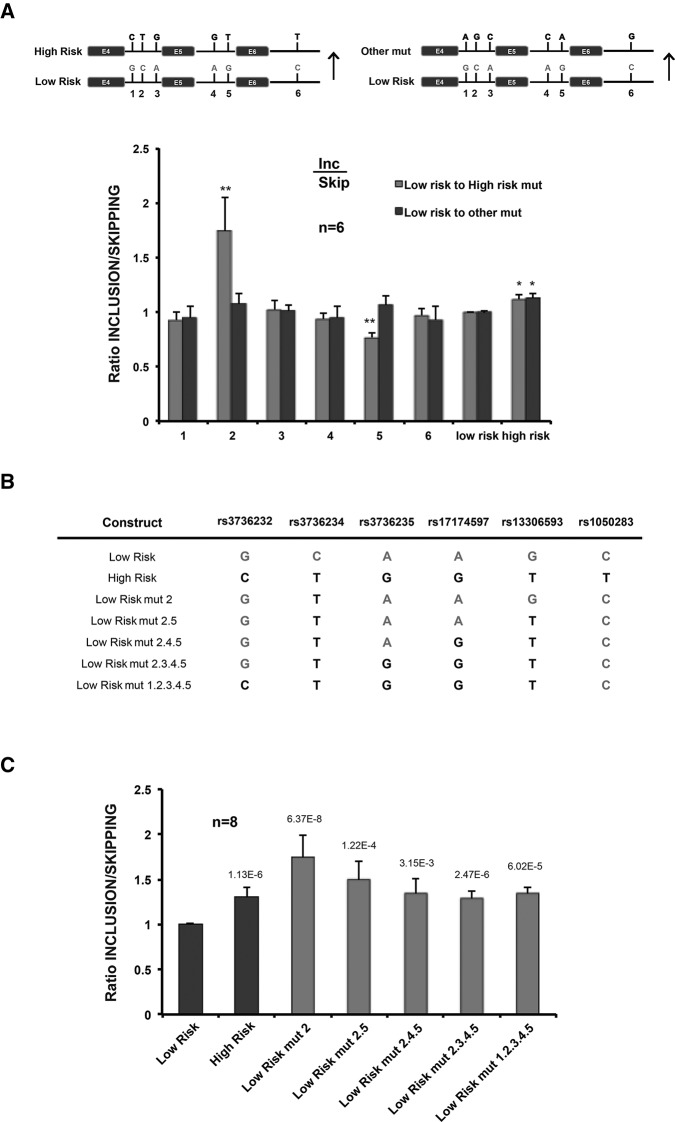
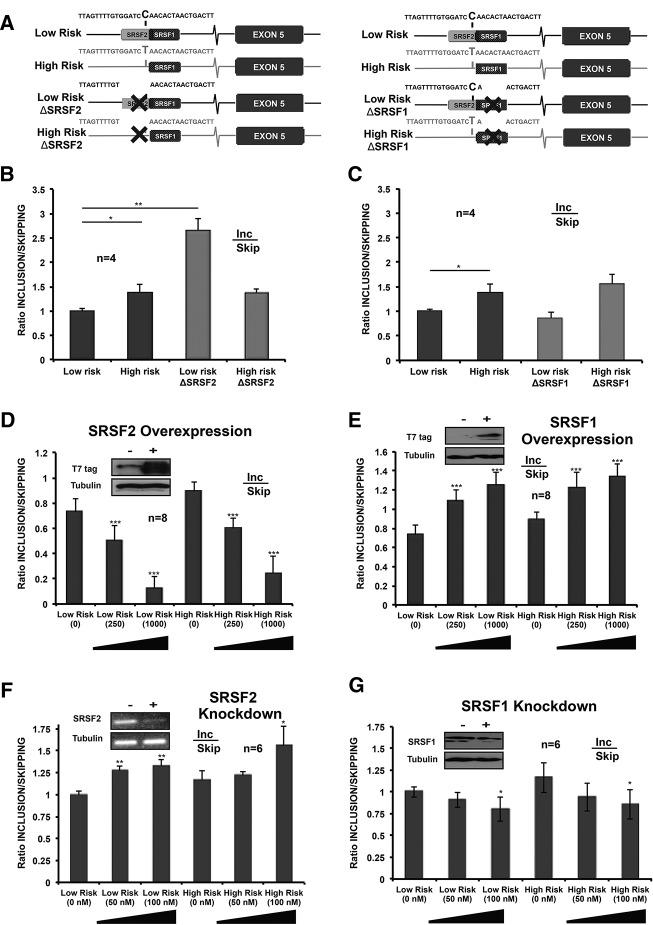
The OLR1 gene encodes the oxidized low-density lipoprotein receptor (LOX-1), which is responsible for the cellular uptake of oxidized LDL (Ox-LDL), foam cell formation in atheroma plaques and atherosclerotic plaque rupture. Alternative splicing (AS) of OLR1 exon 5 generates two protein isoforms with antagonistic functions in Ox-LDL uptake. Previous work identified six single nucleotide polymorphisms (SNPs) in linkage disequilibrium that influence the inclusion levels of OLR1 exon 5 and correlate with the risk of cardiovascular disease. Here we use minigenes to recapitulate the effects of two allelic series (Low- and High-Risk) on OLR1 AS and identify one SNP in intron 4 (rs3736234) as the main contributor to the differences in exon 5 inclusion, while the other SNPs in the allelic series attenuate the drastic effects of this key SNP. Bioinformatic, proteomic, mutational and functional high-throughput analyses allowed us to define regulatory sequence motifs and identify SR protein family members (SRSF1, SRSF2) and HMGA1 as factors involved in the regulation of OLR1 AS. Our results suggest that antagonism between SRSF1 and SRSF2/HMGA1, and differential recognition of their regulatory motifs depending on the identity of the rs3736234 polymorphism, influence OLR1 exon 5 inclusion and the efficiency of Ox-LDL uptake, with potential implications for atherosclerosis and coronary disease.
OLR1基因编码氧化型低密度脂蛋白受体(LOX-1),该受体负责细胞对氧化型低密度脂蛋白(Ox-LDL)的摄取、动脉粥样硬化斑块中泡沫细胞的形成以及动脉粥样硬化斑块破裂。OLR1外显子5的可变剪接(AS)产生两种在Ox-LDL摄取中具有拮抗功能的蛋白质异构体。先前的研究确定了处于连锁不平衡状态的六个单核苷酸多态性(SNP),这些多态性影响OLR1外显子5的包含水平,并与心血管疾病风险相关。在这里,我们使用微型基因来重现两个等位基因系列(低风险和高风险)对OLR1可变剪接的影响,并确定内含子4中的一个SNP(rs3736234)是外显子5包含差异的主要贡献者,而等位基因系列中的其他SNP减弱了这个关键SNP的显著影响。生物信息学、蛋白质组学、突变和功能高通量分析使我们能够定义调控序列基序,并确定SR蛋白家族成员(SRSF1、SRSF2)和HMGA1是参与OLR1可变剪接调控的因子。我们的结果表明,SRSF1与SRSF2/HMGA1之间的拮抗作用,以及根据rs3736234多态性的身份对其调控基序的差异识别,影响OLR1外显子5的包含和Ox-LDL摄取效率,对动脉粥样硬化和冠状动脉疾病具有潜在影响。