Tanno Luciana Kase, Calderon Moises A, Goldberg Bruce J, Akdis Cezmi A, Papadopoulos Nikolaos G, Demoly Pascal
Hospital Sírio Libanês, São Paulo, Brazil.
Section of Allergy and Clinical Immunology, Imperial College London, National Heart and Lung Institute, Royal Brompton Hospital, London, UK.
Clin Transl Allergy. 2014 Nov 28;4:42. doi: 10.1186/2045-7022-4-42. eCollection 2014.
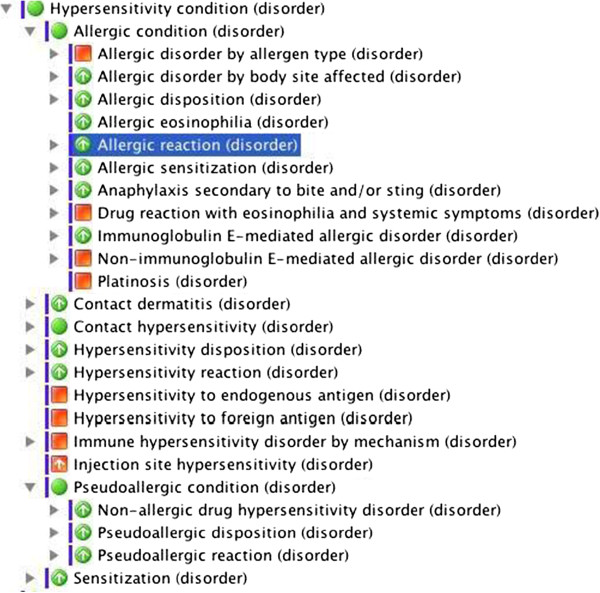
Although efforts to improve the classification of hypersensitivity/allergic diseases have been made, they have not been considered a top-level category in the International Classification of Diseases (ICD)-10 and still are not in the ICD-11 beta phase linearization. ICD-10 is the most used classification system by the allergy community worldwide but it is not considered as appropriate for clinical practice. The Systematized Nomenclature of Medicine Clinical Terms (SNOMED CT) on the other hand contains a tightly integrated classification of hypersensitivity/allergic disorders based on the EAACI/WAO nomenclature and the World Health Organization (WHO) may plan to align ICD-11 with SNOMED CT so that they share a common ontological basis.
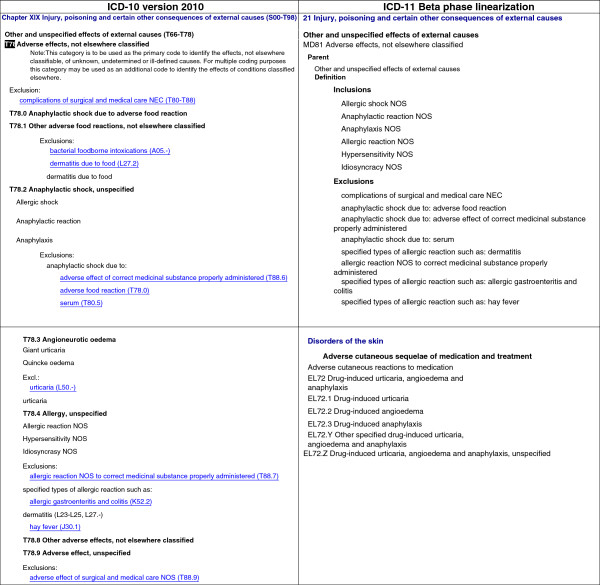
With the aim of actively supporting the ongoing ICD-11 revision and the optimal practice of Allergology, we performed a careful comparison of ICD-10 and 11 beta phase linearization codes to identify gaps, areas of regression in allergy coding and possibly reach solutions, in collaboration with committees in charge of the ICD-11 revision.
We have found a significant degree of misclassification of terms in the allergy-related hierarchies. This stems not only from unclear definitions of these conditions but also the use of common names that falsely imply allergy. The lack of understanding of the immune mechanisms underlying some of the conditions contributes to the difficulty in classification.
More than providing data to support specific changes into the ongoing linearization, these results highlight the need for either a new chapter entitled Hypersensitivity/Allergic Disorders as in SNOMED CT or a high level structure in the Immunology chapter in order to make classification more appropriate and usable.
尽管人们已努力改进超敏反应/过敏性疾病的分类,但在《国际疾病分类》(ICD)-10中它们未被视为一个顶级类别,在ICD-11测试版线性化版本中依然如此。ICD-10是全球过敏学界使用最广泛的分类系统,但它被认为不适用于临床实践。另一方面,医学临床术语系统化命名法(SNOMED CT)包含了基于欧洲变态反应和临床免疫学会(EAACI)/世界变态反应组织(WAO)命名法的紧密整合的超敏反应/过敏性疾病分类,世界卫生组织(WHO)可能计划使ICD-11与SNOMED CT保持一致,以便它们共享一个共同的本体论基础。
为了积极支持正在进行的ICD-11修订以及变态反应学的最佳实践,我们与负责ICD-11修订的委员会合作,仔细比较了ICD-10和11测试版线性化编码,以识别差距、过敏编码中的回归领域并可能找到解决方案。
我们发现在过敏相关层次结构中存在大量术语错误分类的情况。这不仅源于这些病症定义不明确,还源于使用了错误暗示过敏的通用名称。对某些病症潜在免疫机制缺乏了解也导致了分类困难。
这些结果不仅为正在进行的线性化中的具体变化提供了支持数据,更突出了需要像SNOMED CT中那样设立一个名为“超敏反应/过敏性疾病”的新篇章,或者在免疫学章节中设立一个高级结构,以使分类更恰当且实用。