Ribeiro Rita, Wilson Anthony J, Nunes Telmo, Ramilo David W, Amador Rita, Madeira Sara, Baptista Filipa M, Harrup Lara E, Lucientes Javier, Boinas Fernando
Centre for Interdisciplinary Research in Animal Health (CIISA), Faculty of Veterinary Medicine, University of Lisbon, Lisbon, Portugal.
Integrative Entomology Group, The Pirbright Institute, Pirbright, Woking, Surrey, United Kingdom.
PLoS One. 2015 Apr 23;10(4):e0124019. doi: 10.1371/journal.pone.0124019. eCollection 2015.
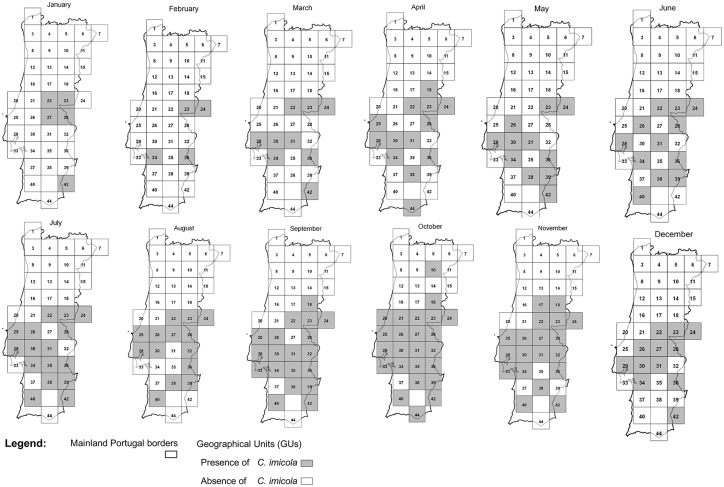
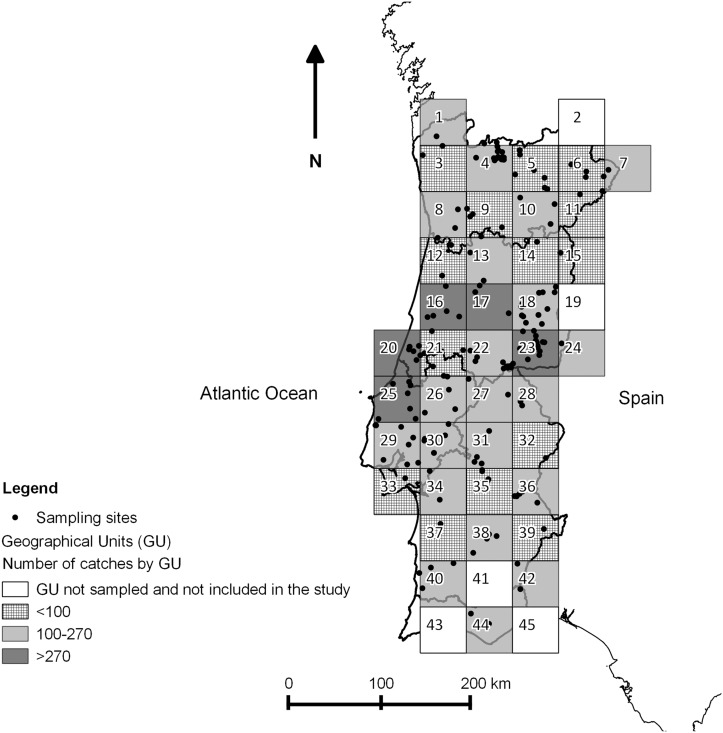
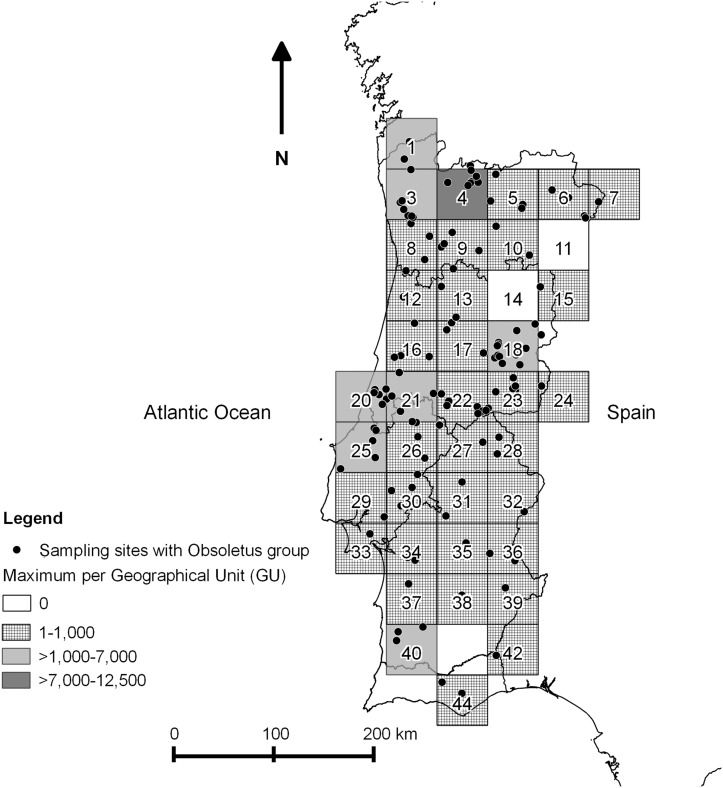
Bluetongue virus (BTV) is transmitted by Culicoides biting midges and causes an infectious, non-contagious disease of ruminants. It has been rapidly emerging in southern Europe since 1998. In mainland Portugal, strains of BTV belonging to three serotypes have been detected: BTV-10 (1956-1960), BTV-4 (2004-2006 and 2013) and BTV-1 (2007-2012). This paper describes the design, implementation and results of the Entomological Surveillance Programme covering mainland Portugal, between 2005 and 2010, including 5,650 caches. Culicoides imicola Kieffer was mostly found in central and southern regions of Portugal, although it was sporadically detected in northern latitudes. Its peak activity occurred in the autumn and it was active during the winter months in limited areas of the country. Obsoletus group was present at the highest densities in the north although they were found throughout the country in substantial numbers. Culicoides activity occurred all year round but peaked in the spring. A generalized linear mixed model was developed for the analysis of the environmental factors associated with activity of the species of Culicoides suspected vectors of BTV in the country. For C. imicola Kieffer, the most important variables were month, diurnal temperature range (DTR), the number of frost days (FRS) and median monthly temperature (TMP). For the Obsoletus group, the most important factors were month, diurnal temperature range (DTR), and linear and quadratic terms for median monthly temperature (TMP). The results reported can improve our understanding of climatic factors in Culicoides activity influencing their distribution and seasonal pattern.
蓝舌病病毒(BTV)通过库蠓叮咬传播,可引发反刍动物的一种传染性、非接触性疾病。自1998年以来,该病毒在南欧迅速传播。在葡萄牙大陆,已检测到属于三种血清型的BTV毒株:BTV - 10(1956 - 1960年)、BTV - 4(2004 - 2006年和2013年)以及BTV - 1(2007 - 2012年)。本文描述了2005年至2010年间覆盖葡萄牙大陆的昆虫学监测计划的设计、实施及结果,其中包括5650个监测点。在葡萄牙,虽然在北纬地区偶尔能检测到,但库蠓主要分布在中部和南部地区。其活动高峰期出现在秋季,并且在该国部分有限地区的冬季也有活动。在北部,残斑库蠓种群密度最高,不过在全国范围内都有大量发现。库蠓全年都有活动,但在春季达到高峰。为分析与该国疑似BTV传播媒介的库蠓种类活动相关的环境因素,建立了一个广义线性混合模型。对于库蠓,最重要的变量是月份、日温度范围(DTR)、霜冻天数(FRS)和月平均温度(TMP)。对于残斑库蠓种群,最重要的因素是月份、日温度范围(DTR)以及月平均温度(TMP)的线性和二次项。所报告的结果可以增进我们对影响库蠓分布和季节模式的气候因素的理解。