Cozzolino Domenico, Grandone Anna, Cittadini Antonio, Palmiero Giuseppe, Esposito Giovanni, De Bellis Annamaria, Furlan Raffaello, Perrotta Silverio, Perrone Laura, Torella Daniele, Miraglia Del Giudice Emanuele
Department of Internal Medicine, Second University of Naples, Naples, Italy.
Department of Women, Child and General and Specialized Surgery, Second University of Naples, Naples, Italy.
PLoS One. 2015 Apr 23;10(4):e0123916. doi: 10.1371/journal.pone.0123916. eCollection 2015.
The prevalence of obesity is increasing among children/adolescents. Subtle cardiovascular abnormalities, responsible for a higher mortality later in life, have been reported in obese children/adolescents. The aims of the study were to evaluate cardiovascular autonomic regulation, by means of spectrum analysis of R-R interval variability, and myocardial function, by means of standard and tissue Doppler echocardiography, in a group of non-hypertensive asymptomatic obese children and adolescents; furthermore, the influence of insulin resistance was tested.
R-R interval variability was analyzed during both the 70° head-up tilt and 24-hour electrocardiographic holter monitoring. Spectrum analysis of R-R interval variability provided the indices of sympathetic (low frequency [LFRR]) and vagal (high frequency [HFRR]) modulation of the sinoatrial node. Homeostasis model assessment of insulin resistance (HOMA-IR) was used to classify obese children/adolescents (n=72) as insulin resistant (n=37) and non-insulin resistant (n=35).
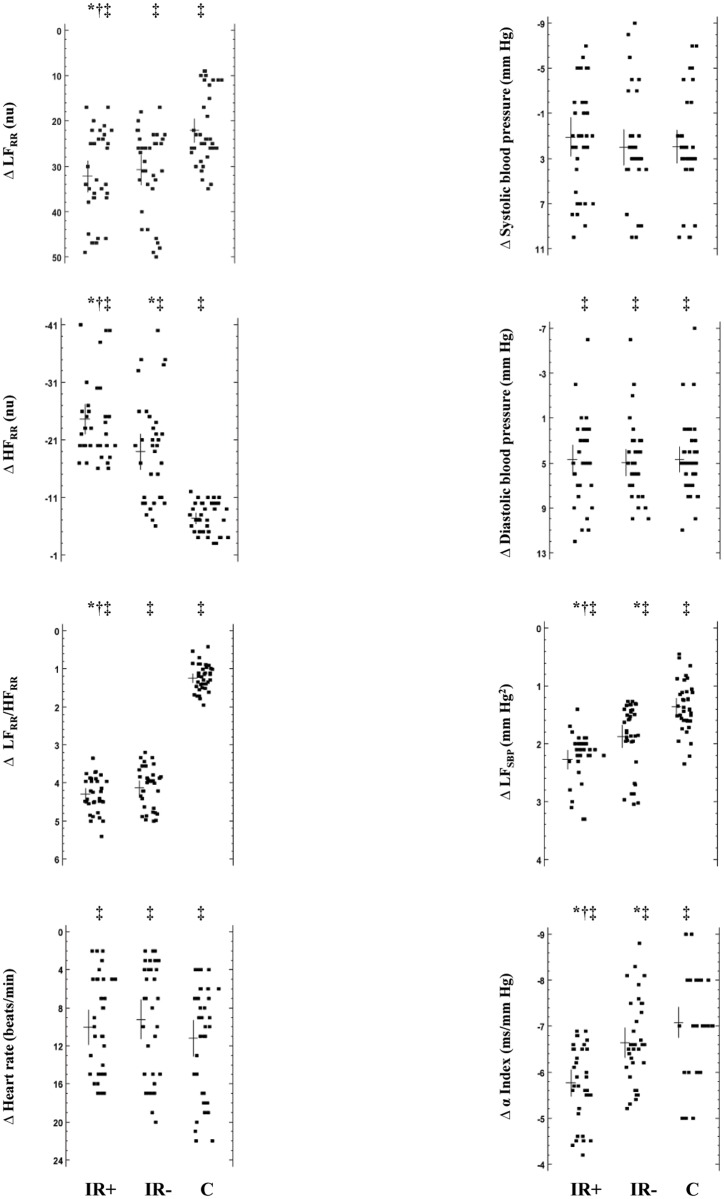
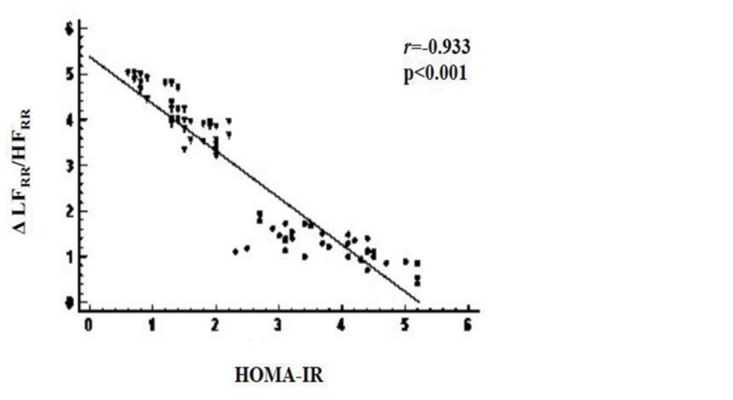
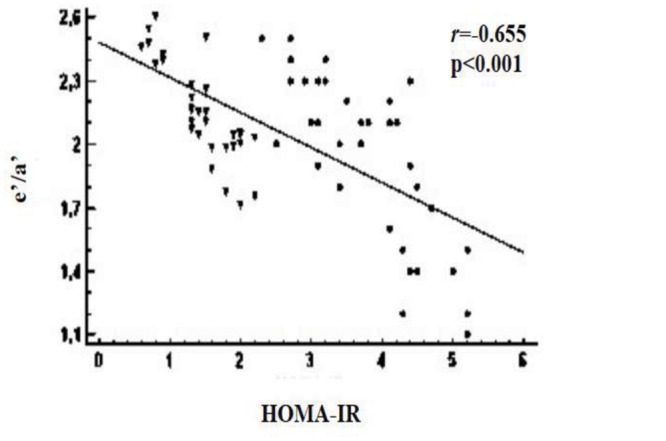
In obese subjects: a) left ventricular mass was significantly (p<0.05) increased, whereas both the e/a ratio and the e'/a' ratio were decreased; b) at rest, HFRR was lower, and the LFRR/HFRR ratio was higher; c) during tilting, magnitude of tilt-induced inhibition of HFRR was lower; d) during 24-hour electrocardiographic holter monitoring, LFRR and the LFRR/HFRR ratio were higher, whereas HFRR was lower; e) HOMA-IR inversely correlated with both the e'/a' ratio (r=-0.655; p<0.001) and the tilt-induced LFRR/HFRR ratio (r=-0.933; p<0.001); and, f) the e'/a' ratio correlated with the tilt-induced LFRR/HFRR ratio (r=0.501; p<0.001). Moreover, HFRR at rest, magnitude of tilt-induced HFRR reduction, and the e'/a' ratio in insulin resistant obese children/adolescents were markedly lower when compared with the remaining subjects.
Subclinical abnormalities of myocardial function and of cardiac autonomic regulation were closely associated in obese children/adolescents and both correlated with the degree of insulin resistance.
儿童/青少年肥胖的患病率正在上升。据报道,肥胖儿童/青少年存在细微的心血管异常,这会导致其日后更高的死亡率。本研究的目的是通过R-R间期变异性频谱分析评估一组非高血压无症状肥胖儿童和青少年的心血管自主调节功能,并通过标准和组织多普勒超声心动图评估其心肌功能;此外,还测试了胰岛素抵抗的影响。
在70°头高位倾斜试验和24小时心电图动态监测期间分析R-R间期变异性。R-R间期变异性频谱分析提供了窦房结交感神经(低频[LFRR])和迷走神经(高频[HFRR])调节的指标。采用胰岛素抵抗稳态模型评估(HOMA-IR)将肥胖儿童/青少年(n=72)分为胰岛素抵抗组(n=37)和非胰岛素抵抗组(n=35)。
在肥胖受试者中:a)左心室质量显著增加(p<0.05),而e/a比值和e'/a比值均降低;b)静息时,HFRR较低,LFRR/HFRR比值较高;c)倾斜期间,倾斜引起的HFRR抑制幅度较低;d)在24小时心电图动态监测期间,LFRR和LFRR/HFRR比值较高,而HFRR较低;e)HOMA-IR与e'/a比值(r=-0.655;p<0.001)和倾斜引起的LFRR/HFRR比值(r=-0.933;p<0.001)均呈负相关;f)e'/a比值与倾斜引起的LFRR/HFRR比值相关(r=0.501;p<0.001)。此外,与其余受试者相比,胰岛素抵抗肥胖儿童/青少年静息时的HFRR、倾斜引起的HFRR降低幅度和e'/a比值明显更低。
肥胖儿童/青少年中心肌功能和心脏自主调节的亚临床异常密切相关,且均与胰岛素抵抗程度相关。