Sadd Ben M, Barribeau Seth M, Bloch Guy, de Graaf Dirk C, Dearden Peter, Elsik Christine G, Gadau Jürgen, Grimmelikhuijzen Cornelis J P, Hasselmann Martin, Lozier Jeffrey D, Robertson Hugh M, Smagghe Guy, Stolle Eckart, Van Vaerenbergh Matthias, Waterhouse Robert M, Bornberg-Bauer Erich, Klasberg Steffen, Bennett Anna K, Câmara Francisco, Guigó Roderic, Hoff Katharina, Mariotti Marco, Munoz-Torres Monica, Murphy Terence, Santesmasses Didac, Amdam Gro V, Beckers Matthew, Beye Martin, Biewer Matthias, Bitondi Márcia M G, Blaxter Mark L, Bourke Andrew F G, Brown Mark J F, Buechel Severine D, Cameron Rossanah, Cappelle Kaat, Carolan James C, Christiaens Olivier, Ciborowski Kate L, Clarke David F, Colgan Thomas J, Collins David H, Cridge Andrew G, Dalmay Tamas, Dreier Stephanie, du Plessis Louis, Duncan Elizabeth, Erler Silvio, Evans Jay, Falcon Tiago, Flores Kevin, Freitas Flávia C P, Fuchikawa Taro, Gempe Tanja, Hartfelder Klaus, Hauser Frank, Helbing Sophie, Humann Fernanda C, Irvine Frano, Jermiin Lars S, Johnson Claire E, Johnson Reed M, Jones Andrew K, Kadowaki Tatsuhiko, Kidner Jonathan H, Koch Vasco, Köhler Arian, Kraus F Bernhard, Lattorff H Michael G, Leask Megan, Lockett Gabrielle A, Mallon Eamonn B, Antonio David S Marco, Marxer Monika, Meeus Ivan, Moritz Robin F A, Nair Ajay, Näpflin Kathrin, Nissen Inga, Niu Jinzhi, Nunes Francis M F, Oakeshott John G, Osborne Amy, Otte Marianne, Pinheiro Daniel G, Rossié Nina, Rueppell Olav, Santos Carolina G, Schmid-Hempel Regula, Schmitt Björn D, Schulte Christina, Simões Zilá L P, Soares Michelle P M, Swevers Luc, Winnebeck Eva C, Wolschin Florian, Yu Na, Zdobnov Evgeny M, Aqrawi Peshtewani K, Blankenburg Kerstin P, Coyle Marcus, Francisco Liezl, Hernandez Alvaro G, Holder Michael, Hudson Matthew E, Jackson LaRonda, Jayaseelan Joy, Joshi Vandita, Kovar Christie, Lee Sandra L, Mata Robert, Mathew Tittu, Newsham Irene F, Ngo Robin, Okwuonu Geoffrey, Pham Christopher, Pu Ling-Ling, Saada Nehad, Santibanez Jireh, Simmons DeNard, Thornton Rebecca, Venkat Aarti, Walden Kimberly K O, Wu Yuan-Qing, Debyser Griet, Devreese Bart, Asher Claire, Blommaert Julie, Chipman Ariel D, Chittka Lars, Fouks Bertrand, Liu Jisheng, O'Neill Meaghan P, Sumner Seirian, Puiu Daniela, Qu Jiaxin, Salzberg Steven L, Scherer Steven E, Muzny Donna M, Richards Stephen, Robinson Gene E, Gibbs Richard A, Schmid-Hempel Paul, Worley Kim C
School of Biological Sciences, Illinois State University, Normal, IL, 61790, USA.
Experimental Ecology, Institute of Integrative Biology, Eidgenössiche Technische Hochschule (ETH) Zürich, CH-8092, Zürich, Switzerland.
Genome Biol. 2015 Apr 24;16(1):76. doi: 10.1186/s13059-015-0623-3.
The shift from solitary to social behavior is one of the major evolutionary transitions. Primitively eusocial bumblebees are uniquely placed to illuminate the evolution of highly eusocial insect societies. Bumblebees are also invaluable natural and agricultural pollinators, and there is widespread concern over recent population declines in some species. High-quality genomic data will inform key aspects of bumblebee biology, including susceptibility to implicated population viability threats.
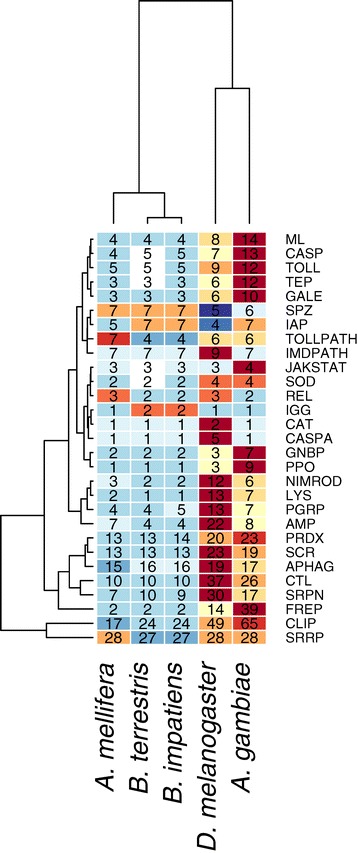
We report the high quality draft genome sequences of Bombus terrestris and Bombus impatiens, two ecologically dominant bumblebees and widely utilized study species. Comparing these new genomes to those of the highly eusocial honeybee Apis mellifera and other Hymenoptera, we identify deeply conserved similarities, as well as novelties key to the biology of these organisms. Some honeybee genome features thought to underpin advanced eusociality are also present in bumblebees, indicating an earlier evolution in the bee lineage. Xenobiotic detoxification and immune genes are similarly depauperate in bumblebees and honeybees, and multiple categories of genes linked to social organization, including development and behavior, show high conservation. Key differences identified include a bias in bumblebee chemoreception towards gustation from olfaction, and striking differences in microRNAs, potentially responsible for gene regulation underlying social and other traits.
These two bumblebee genomes provide a foundation for post-genomic research on these key pollinators and insect societies. Overall, gene repertoires suggest that the route to advanced eusociality in bees was mediated by many small changes in many genes and processes, and not by notable expansion or depauperation.
从独居行为向社会行为的转变是主要的进化转变之一。原始的真社会性熊蜂在阐明高度真社会性昆虫社会的进化方面具有独特地位。熊蜂也是非常重要的自然和农业传粉者,近期一些熊蜂物种的数量下降引发了广泛关注。高质量的基因组数据将为熊蜂生物学的关键方面提供信息,包括对相关种群生存能力威胁的易感性。
我们报告了地熊蜂和凤头熊蜂的高质量基因组草图序列,这两种熊蜂在生态上占主导地位且是广泛使用的研究物种。将这些新基因组与高度真社会性的蜜蜂以及其他膜翅目昆虫的基因组进行比较,我们识别出了深度保守的相似性以及这些生物生物学特性的关键新颖之处。一些被认为是高级真社会性基础的蜜蜂基因组特征在熊蜂中也存在,这表明这些特征在蜜蜂谱系中进化得更早。熊蜂和蜜蜂的异源生物解毒和免疫基因同样匮乏,并且与社会组织相关的多类基因,包括发育和行为相关基因,显示出高度保守性。识别出的关键差异包括熊蜂化学感受偏向味觉而非嗅觉,以及微小RNA的显著差异,这可能负责社会和其他性状背后的基因调控。
这两个熊蜂基因组为这些关键传粉者和昆虫社会的后基因组研究提供了基础。总体而言,基因库表明蜜蜂走向高级真社会性的途径是由许多基因和过程中的许多小变化介导的,而非通过显著的扩增或匮乏。