Gryseels Charlotte, Durnez Lies, Gerrets René, Uk Sambunny, Suon Sokha, Set Srun, Phoeuk Pisen, Sluydts Vincent, Heng Somony, Sochantha Tho, Coosemans Marc, Peeters Grietens Koen
Institute of Tropical Medicine, Antwerp, Belgium.
AISSR, University of Amsterdam, Amsterdam, The Netherlands.
Malar J. 2015 Apr 24;14:165. doi: 10.1186/s12936-015-0689-0.
In certain regions in Southeast Asia, where malaria is reduced to forested regions populated by ethnic minorities dependent on slash-and-burn agriculture, malaria vector populations have developed a propensity to feed early and outdoors, limiting the effectiveness of long-lasting insecticide-treated nets (LLIN) and indoor residual spraying (IRS). The interplay between heterogeneous human, as well as mosquito behaviour, radically challenges malaria control in such residual transmission contexts. This study examines human behavioural patterns in relation to the vector behaviour.
The anthropological research used a sequential mixed-methods study design in which quantitative survey research methods were used to complement findings from qualitative ethnographic research. The qualitative research existed of in-depth interviews and participant observation. For the entomological research, indoor and outdoor human landing collections were performed. All research was conducted in selected villages in Ratanakiri province, Cambodia.
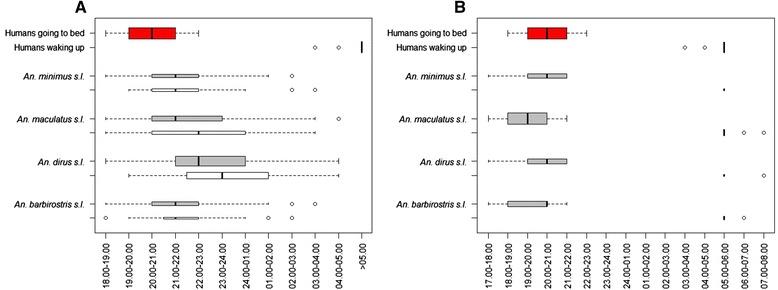
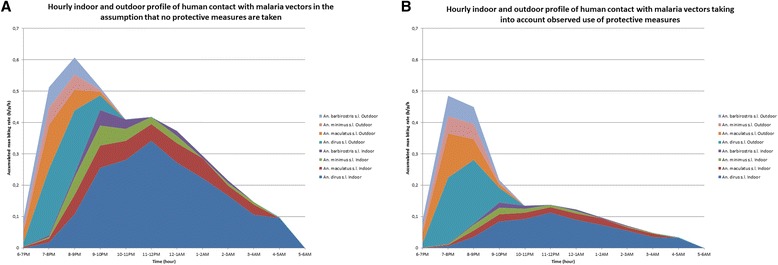
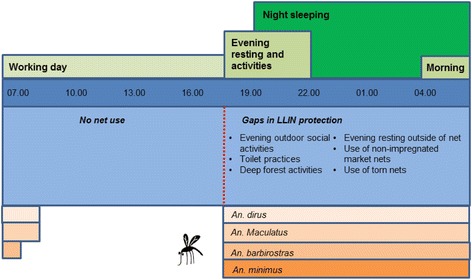
Variability in human behaviour resulted in variable exposure to outdoor and early biting vectors: (i) indigenous people were found to commute between farms in the forest, where malaria exposure is higher, and village homes; (ii) the indoor/outdoor biting distinction was less clear in forest housing often completely or partly open to the outside; (iii) reported sleeping times varied according to the context of economic activities, impacting on the proportion of infections that could be accounted for by early or nighttime biting; (iv) protection by LLINs may not be as high as self-reported survey data indicate, as observations showed around 40% (non-treated) market net use while (v) unprotected evening resting and deep forest activities impacted further on the suboptimal use of LLINs.
The heterogeneity of human behaviour and the variation of vector densities and biting behaviours may lead to a considerable proportion of exposure occurring during times that people are assumed to be protected by the distributed LLINs. Additional efforts in improving LLIN use during times when people are resting in the evening and during the night might still have an impact on further reducing malaria transmission in Cambodia.
在东南亚的某些地区,疟疾已减少至森林地区,这些地区居住着依赖刀耕火种农业的少数民族。疟疾媒介种群已形成了在早期和户外觅食的倾向,这限制了长效杀虫剂处理蚊帐(LLIN)和室内滞留喷洒(IRS)的效果。人类行为以及蚊子行为的异质性之间的相互作用,从根本上挑战了这种残留传播环境下的疟疾控制。本研究考察了与媒介行为相关的人类行为模式。
人类学研究采用了顺序混合方法研究设计,其中定量调查研究方法用于补充定性民族志研究的结果。定性研究包括深入访谈和参与观察。对于昆虫学研究,进行了室内和室外的人饵诱捕采集。所有研究均在柬埔寨腊塔纳基里省的选定村庄进行。
人类行为的差异导致了对室外和早期叮咬媒介的暴露程度不同:(i)发现原住民在疟疾暴露风险较高的森林农场和村庄住所之间往返;(ii)在通常完全或部分向外界开放的森林房屋中,室内/室外叮咬的区别不太明显;(iii)报告的睡眠时间因经济活动背景而异,影响了可归因于早期或夜间叮咬的感染比例;(iv)LLINs的保护效果可能不如自我报告的调查数据所示,因为观察显示约40%(未处理)的人使用市场蚊帐,而(v)未受保护的夜间休息和森林深处活动进一步影响了LLINs的使用效果不佳。
人类行为的异质性以及媒介密度和叮咬行为的变化,可能导致在人们被认为受分发的LLINs保护的时间段内,仍有相当一部分暴露发生。在人们晚上和夜间休息时,进一步努力提高LLINs的使用率,可能仍会对柬埔寨进一步减少疟疾传播产生影响。