Schneider Johannes, Klein Teresa, Mielich-Süss Benjamin, Koch Gudrun, Franke Christian, Kuipers Oscar P, Kovács Ákos T, Sauer Markus, Lopez Daniel
Research Center for Infectious Diseases ZINF, University of Würzburg, Würzburg, Germany.
Department of Biotechnology and Biophysics, University of Würzburg, Würzburg, Germany.
PLoS Genet. 2015 Apr 24;11(4):e1005140. doi: 10.1371/journal.pgen.1005140. eCollection 2015 Apr.
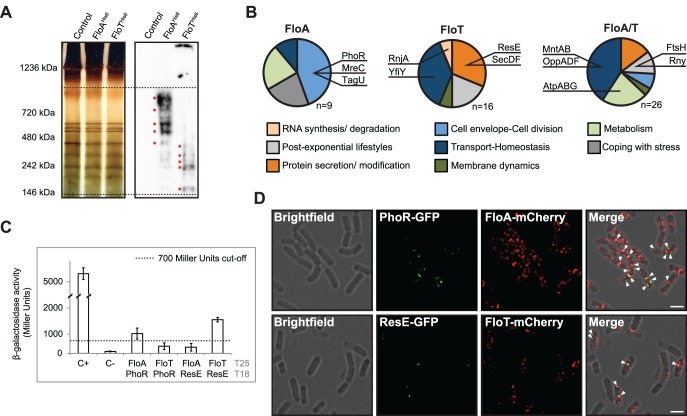
Lipid rafts are membrane microdomains specialized in the regulation of numerous cellular processes related to membrane organization, as diverse as signal transduction, protein sorting, membrane trafficking or pathogen invasion. It has been proposed that this functional diversity would require a heterogeneous population of raft domains with varying compositions. However, a mechanism for such diversification is not known. We recently discovered that bacterial membranes organize their signal transduction pathways in functional membrane microdomains (FMMs) that are structurally and functionally similar to the eukaryotic lipid rafts. In this report, we took advantage of the tractability of the prokaryotic model Bacillus subtilis to provide evidence for the coexistence of two distinct families of FMMs in bacterial membranes, displaying a distinctive distribution of proteins specialized in different biological processes. One family of microdomains harbors the scaffolding flotillin protein FloA that selectively tethers proteins specialized in regulating cell envelope turnover and primary metabolism. A second population of microdomains containing the two scaffolding flotillins, FloA and FloT, arises exclusively at later stages of cell growth and specializes in adaptation of cells to stationary phase. Importantly, the diversification of membrane microdomains does not occur arbitrarily. We discovered that bacterial cells control the spatio-temporal remodeling of microdomains by restricting the activation of FloT expression to stationary phase. This regulation ensures a sequential assembly of functionally specialized membrane microdomains to strategically organize signaling networks at the right time during the lifespan of a bacterium.
脂筏是膜微区,专门用于调节与膜组织相关的众多细胞过程,这些过程多种多样,如信号转导、蛋白质分选、膜运输或病原体入侵。有人提出,这种功能多样性需要具有不同组成的异质性脂筏结构域群体。然而,这种多样化的机制尚不清楚。我们最近发现,细菌膜在功能膜微区(FMMs)中组织其信号转导途径,这些微区在结构和功能上与真核生物脂筏相似。在本报告中,我们利用原核模型枯草芽孢杆菌的易处理性,为细菌膜中两种不同的FMM家族共存提供证据,这两种家族显示出专门参与不同生物过程的蛋白质的独特分布。一类微区含有支架类浮蛋白FloA,它选择性地连接专门调节细胞包膜周转和初级代谢的蛋白质。第二类微区含有两种支架类浮蛋白FloA和FloT,仅在细胞生长后期出现,专门负责细胞适应静止期。重要的是,膜微区的多样化并非随意发生。我们发现细菌细胞通过将FloT表达的激活限制在静止期来控制微区的时空重塑。这种调节确保了功能专门化的膜微区的顺序组装,以便在细菌生命周期的适当时间战略性地组织信号网络。