Jennum Poul, Tønnesen Philip, Ibsen Rikke, Kjellberg Jakob
Danish Center for Sleep Medicine, Department of Clinical Neurophysiology, Glostrup Hospital, Copenhagen, Denmark ; Faculty of Health Sciences, University of Copenhagen, Copenhagen, Denmark.
Danish Center for Sleep Medicine, Department of Clinical Neurophysiology, Glostrup Hospital, Copenhagen, Denmark.
Nat Sci Sleep. 2015 Apr 9;7:43-50. doi: 10.2147/NSS.S75166. eCollection 2015.
More information is needed about the effect on mortality of continuous positive airway pressure (CPAP) in patients with obstructive sleep apnea (OSA), especially in women.
We employed a historical cohort study design, using data from 25,389 patients with a diagnosis of OSA selected from the Danish National Patient Registry for the period 1999-2009. We used Cox proportional hazard function to evaluate the all-cause mortality from OSA in middle-aged and elderly males and females who were treated, or not, with CPAP.
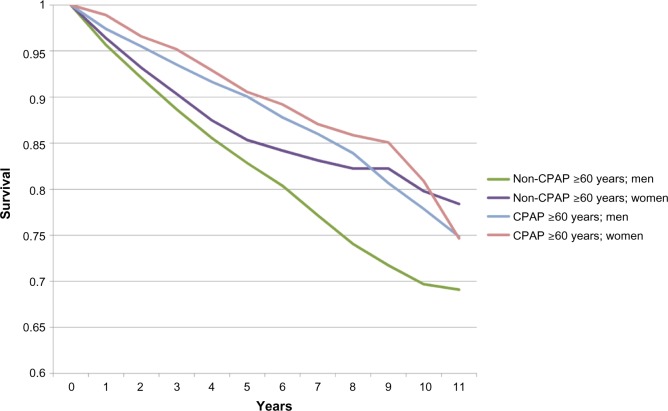
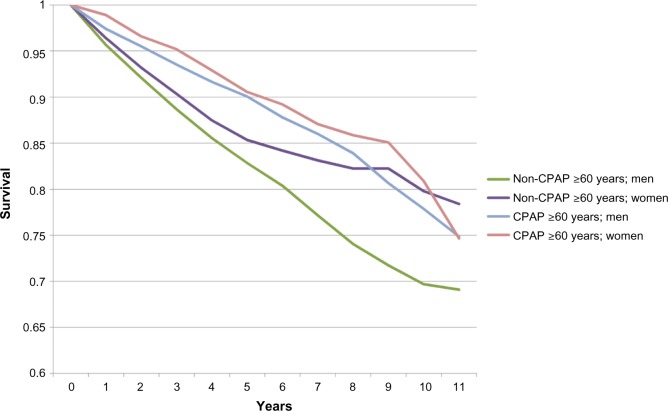
Female OSA patients had a lower mortality than males, irrespective of whether they received CPAP treatment. CPAP treatment improved survival, as illustrated by the hazard ratio of 0.62 (P<0.001). This effect was dependent on gender: CPAP had no significant effect on 20- to 39-year-old males and females, but the overall mortality in this age group was small. Survival was increased by CPAP in 40- to 59-year-old and ≥60-year-old males, but no such effect was observed in females. Positive predictors of survival were young age, female gender, higher educational level, and low 3-year prior comorbidity as estimated by the Charlson Comorbidity Index. Negative predictors for survival were male gender, age ≥60 years, no CPAP treatment, prior comorbidity, and low educational level.
CPAP therapy is associated with reduced all-cause mortality in middle-aged and elderly males, but no significant effect was found in females.
对于持续气道正压通气(CPAP)对阻塞性睡眠呼吸暂停(OSA)患者死亡率的影响,需要更多信息,尤其是在女性患者中。
我们采用历史队列研究设计,使用从丹麦国家患者登记处选取的1999 - 2009年期间诊断为OSA的25389例患者的数据。我们使用Cox比例风险函数来评估接受或未接受CPAP治疗的中年及老年男性和女性因OSA导致的全因死亡率。
女性OSA患者的死亡率低于男性,无论她们是否接受CPAP治疗。CPAP治疗改善了生存率,风险比为0.62(P<0.001)。这种效果取决于性别:CPAP对20至39岁的男性和女性没有显著影响,但该年龄组的总体死亡率较低。CPAP提高了40至59岁及≥60岁男性的生存率,但在女性中未观察到这种效果。生存的积极预测因素是年轻、女性、教育水平较高以及根据Charlson合并症指数估计的3年前合并症较低。生存的消极预测因素是男性、年龄≥60岁、未接受CPAP治疗、既往合并症以及教育水平较低。
CPAP治疗与中年及老年男性全因死亡率降低相关,但在女性中未发现显著效果。