Shovlin Claire L
NHLI Cardiovascular Sciences, Imperial Centre for Translational and Experimental Medicine, Imperial College London London, UK ; Respiratory Medicine, Hammersmith Hospital, Imperial College Healthcare NHS Trust London, UK.
Front Genet. 2015 Apr 9;6:101. doi: 10.3389/fgene.2015.00101. eCollection 2015.
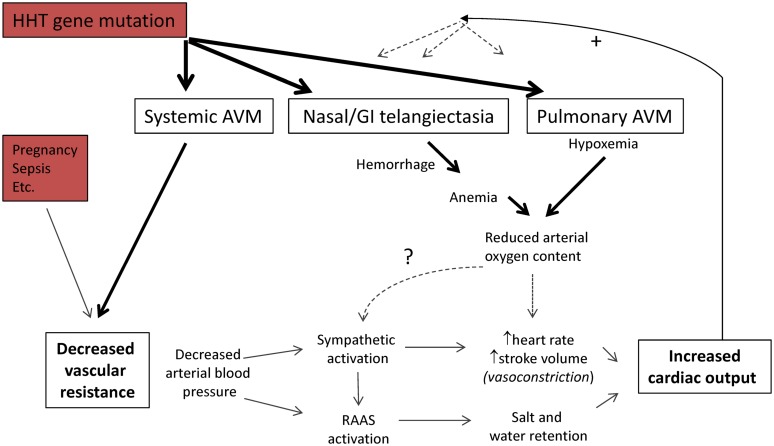
Hereditary hemorrhagic telangiectasia (HHT) is mechanistically and therapeutically challenging, not only because of the molecular and cellular perturbations that generate vascular abnormalities, but also the modifications to circulatory physiology that result, and are likely to exacerbate vascular injury. First, most HHT patients have visceral arteriovenous malformations (AVMs). Significant visceral AVMs reduce the systemic vascular resistance: supra-normal cardiac outputs are required to maintain arterial blood pressure, and may result in significant pulmonary venous hypertension. Secondly, bleeding from nasal and gastrointestinal telangiectasia leads to iron losses of such magnitude that in most cases, diet is insufficient to meet the 'hemorrhage adjusted iron requirement.' Resultant iron deficiency restricts erythropoiesis, leading to anemia and further increases in cardiac output. Low iron levels are also associated with venous and arterial thromboses, elevated Factor VIII, and increased platelet aggregation to circulating 5HT (serotonin). Third, recent data highlight that reduced oxygenation of blood due to pulmonary AVMs results in a graded erythrocytotic response to maintain arterial oxygen content, and higher stroke volumes and/or heart rates to maintain oxygen delivery. Finally, HHT-independent factors such as diet, pregnancy, sepsis, and other intercurrent illnesses also influence vascular structures, hemorrhage, and iron handling in HHT patients. These considerations emphasize the complexity of mechanisms that impact on vascular structures in HHT, and also offer opportunities for targeted therapeutic approaches.
遗传性出血性毛细血管扩张症(HHT)在发病机制和治疗方面都具有挑战性,这不仅是因为导致血管异常的分子和细胞紊乱,还因为由此引起的循环生理改变,而且这些改变可能会加剧血管损伤。首先,大多数HHT患者存在内脏动静脉畸形(AVM)。显著的内脏AVM会降低体循环血管阻力:需要超常的心输出量来维持动脉血压,这可能导致显著的肺静脉高压。其次,鼻腔和胃肠道毛细血管扩张引起的出血导致铁流失量很大,以至于在大多数情况下,饮食不足以满足“因出血而调整的铁需求量”。由此产生的缺铁会限制红细胞生成,导致贫血,并进一步增加心输出量。低铁水平还与静脉和动脉血栓形成、因子VIII升高以及血小板对循环5-羟色胺(血清素)的聚集增加有关。第三,最近的数据表明,由于肺AVM导致的血液氧合降低会引发分级红细胞增多反应以维持动脉血氧含量,并通过增加每搏输出量和/或心率来维持氧输送。最后,与HHT无关的因素,如饮食、妊娠、败血症和其他并发疾病,也会影响HHT患者的血管结构、出血和铁代谢。这些因素强调了影响HHT血管结构的机制的复杂性,同时也为靶向治疗方法提供了机会。