Jung Da Hyun, Kim Jie-Hyun, Chung Hyun Soo, Park Jun Chul, Shin Sung Kwan, Lee Sang Kil, Lee Yong Chan
Department of Internal Medicine, Yonsei University College of Medicine, Seoul, Korea.
Department of Internal Medicine, Gangnam Severance Hospital, Yonsei University College of Medicine, Seoul, Korea.
PLoS One. 2015 Apr 27;10(4):e0124725. doi: 10.1371/journal.pone.0124725. eCollection 2015.
There is controversy about the effect of Helicobacter pylori (H. pylori) eradication on the prevention of metachronous gastric cancer after endoscopic resection (ER).
The aim of this study was to systematically evaluate the effect of H. pylori eradication on the prevention of metachronous gastric lesions after ER of gastric neoplasms.
We performed a systematic search of PubMed, EMBASE, the Cochrane Library, and MEDLINE that encompassed studies through April 2014. Our meta-analysis consisted of 10 studies, which included 5881 patients who underwent ER of gastric neoplasms.
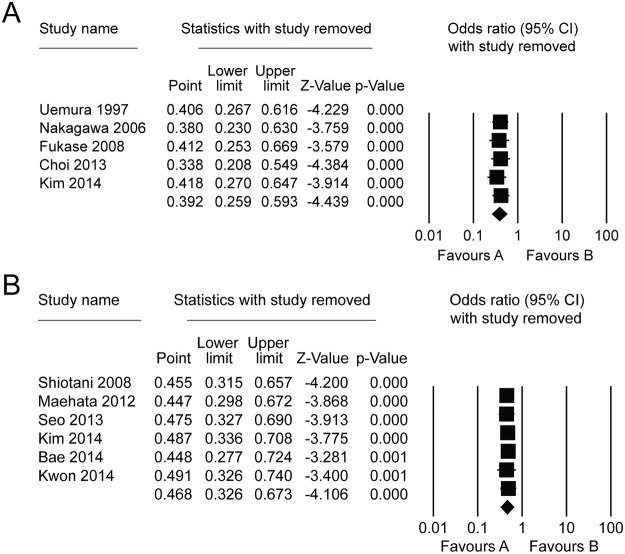
When we compared the incidence of metachronous lesions between H. pylori-eradicated and non-eradicated groups, H. pylori eradication significantly lowered the risk of metachronous lesions after ER of gastric neoplasms (five studies, OR = 0.392, 95% CI 0.259 - 0.593, P < 0.001). When we compared H. pylori-eradicated and persistent groups, again, H. pylori eradication significantly lowered the incidence of metachronous lesions after ER of gastric neoplasms (six studies, OR = 0.468, 95% CI 0.326 - 0.673, P < 0.001). There was no obvious heterogeneity across the analyzed studies.
This meta-analysis suggests a preventive role for H. pylori eradication for metachronous gastric lesions after ER of gastric neoplasms. Thus, H. pylori eradication should be considered if H. pylori infection is confirmed during ER.
关于幽门螺杆菌(H. pylori)根除对内镜切除(ER)后异时性胃癌预防的效果存在争议。
本研究旨在系统评价幽门螺杆菌根除对胃肿瘤内镜切除术后异时性胃病变预防的效果。
我们对PubMed、EMBASE、Cochrane图书馆和MEDLINE进行了系统检索,纳入截至2014年4月的研究。我们的荟萃分析包括10项研究,共5881例接受胃肿瘤内镜切除的患者。
当我们比较幽门螺杆菌根除组和未根除组异时性病变的发生率时,幽门螺杆菌根除显著降低了胃肿瘤内镜切除术后异时性病变的风险(5项研究,OR = 0.392,95% CI 0.259 - 0.593,P < 0.001)。当我们比较幽门螺杆菌根除组和持续感染组时,幽门螺杆菌根除再次显著降低了胃肿瘤内镜切除术后异时性病变的发生率(6项研究,OR = 0.468,95% CI 0.326 - 0.673,P < 0.001)。各分析研究之间无明显异质性。
这项荟萃分析表明,幽门螺杆菌根除对胃肿瘤内镜切除术后异时性胃病变具有预防作用。因此,如果在内镜切除过程中确诊幽门螺杆菌感染,应考虑进行根除治疗。