Shi Hongbin, Guo Xiaoyan, Zhang Qing, Wu Hongmei, Du Huanmin, Liu Li, Wang Chongjin, Xia Yang, Liu Xing, Li Chunlei, Sun Shaomei, Wang Xing, Zhou Ming, Jia Qiyu, Zhao Honglin, Song Kun, Wei Dianjun, Niu Kaijun
The Second Hospital of Tianjin Medical University, Tianjin, China; Health Management Centre, Tianjin Medical University General Hospital, Tianjin, China.
Nutritional Epidemiology Institute and School of Public Health, Tianjin Medical University, Tianjin, China.
PLoS One. 2015 Apr 27;10(4):e0124255. doi: 10.1371/journal.pone.0124255. eCollection 2015.
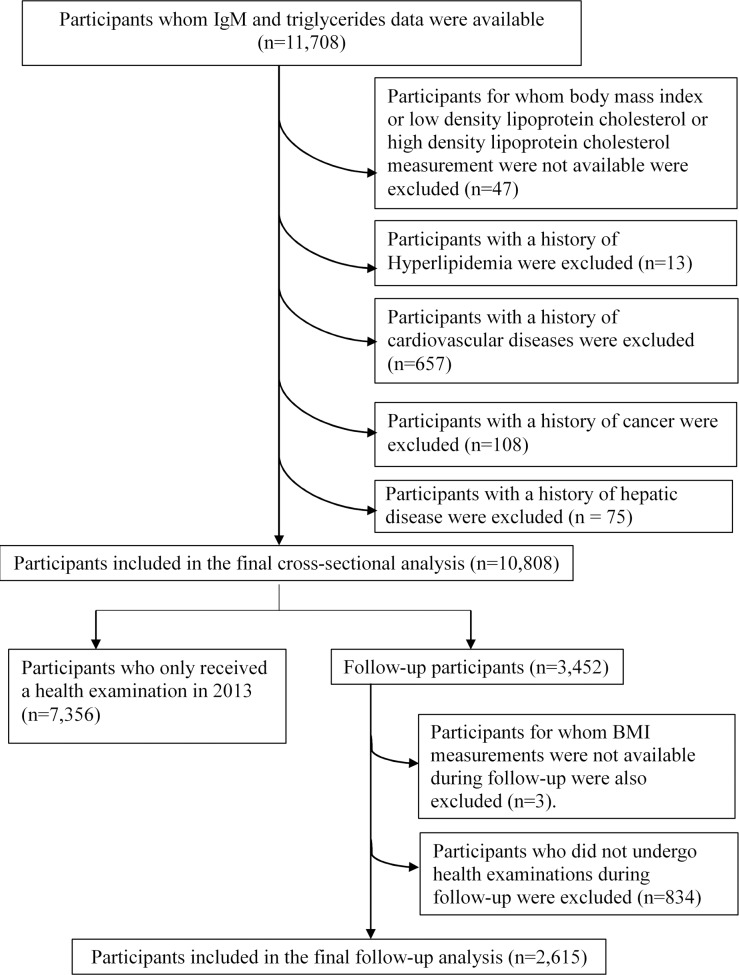
Persistent low-grade inflammation is thought to underlie the pathogenesis of many chronic diseases, such as cardiovascular diseases and metabolic syndrome. Autoimmunity is correlated with increased levels of chronic low-grade inflammation, and immunoglobulin M (IgM) is reactive to autoantigens and believed to be important for autoimmunity. Triglyceride (TG) is fatty acid carrier and initiator of oxidative stress, and it has been hypothesized that TG stimulates B cells to secrete IgM. However, few studies have investigated the relationship between TG and IgM in human populations. We designed a cross-sectional and prospective cohort study to evaluate how serum TG levels are related to IgM concentration. Participants were recruited from Tianjin Medical University General Hospital-Health Management Centre. Both a baseline cross-sectional (n = 10,808) and a prospective assessment (n = 2,615) were performed. Analysis of covariance was used in the cross-sectional analysis. After multiple adjustments for confounding factors, serum IgM level in the highest quartile of TG in males was significantly higher than levels in lower quartiles (P <0.05). There was no significant difference between the four quartiles in females (P = 0.91). In follow-up analysis, a multiple linear regression model showed a significant and positive correlation between changes in IgM levels and changes of TG concentration in males (P = 0.04, standard β coefficient = 0.882). This cross-sectional and cohort study is the first to show that serum concentration of IgM varies with TG levels in adult male populations. Further research is needed to explore the mechanism by which TG leads to increased IgM concentration.
持续性低度炎症被认为是许多慢性疾病(如心血管疾病和代谢综合征)发病机制的基础。自身免疫与慢性低度炎症水平升高相关,免疫球蛋白M(IgM)对自身抗原具有反应性,并且被认为对自身免疫很重要。甘油三酯(TG)是脂肪酸载体和氧化应激的引发剂,据推测TG会刺激B细胞分泌IgM。然而,很少有研究调查人群中TG与IgM之间的关系。我们设计了一项横断面和前瞻性队列研究,以评估血清TG水平与IgM浓度之间的关系。参与者来自天津医科大学总医院健康管理中心。进行了基线横断面研究(n = 10,808)和前瞻性评估(n = 2,615)。横断面分析采用协方差分析。在对混杂因素进行多次调整后,男性TG最高四分位数组的血清IgM水平显著高于较低四分位数组(P <0.05)。女性四分位数组之间无显著差异(P = 0.91)。在随访分析中,多元线性回归模型显示男性IgM水平变化与TG浓度变化之间存在显著正相关(P = 0.04,标准β系数 = 0.882)。这项横断面和队列研究首次表明,成年男性人群中IgM的血清浓度随TG水平而变化。需要进一步研究来探索TG导致IgM浓度升高的机制。