Skinner Michael K
Center for Reproductive Biology, School of Biological Sciences, Washington State University
Genome Biol Evol. 2015 Apr 26;7(5):1296-302. doi: 10.1093/gbe/evv073.
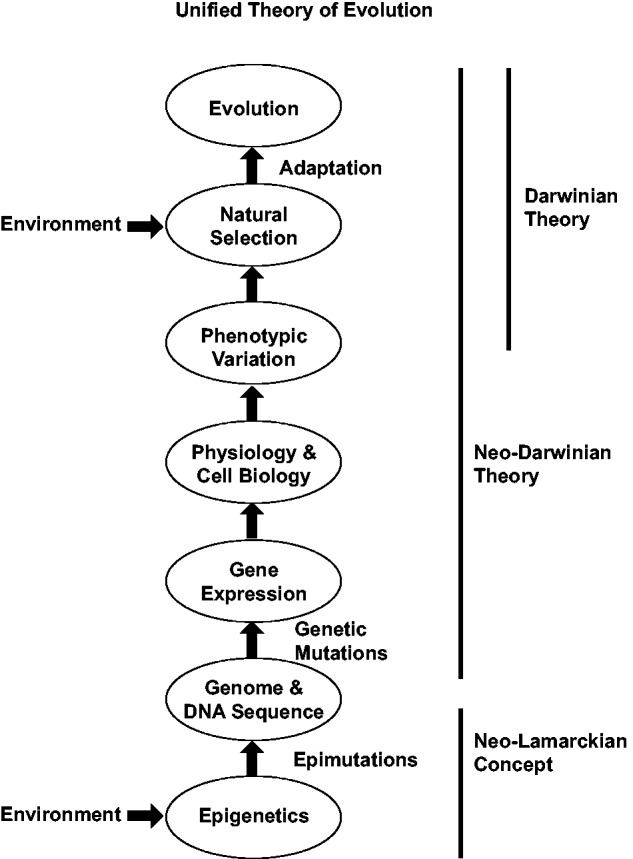
Environment has a critical role in the natural selection process for Darwinian evolution. The primary molecular component currently considered for neo-Darwinian evolution involves genetic alterations and random mutations that generate the phenotypic variation required for natural selection to act. The vast majority of environmental factors cannot directly alter DNA sequence. Epigenetic mechanisms directly regulate genetic processes and can be dramatically altered by environmental factors. Therefore, environmental epigenetics provides a molecular mechanism to directly alter phenotypic variation generationally. Lamarck proposed in 1802 the concept that environment can directly alter phenotype in a heritable manner. Environmental epigenetics and epigenetic transgenerational inheritance provide molecular mechanisms for this process. Therefore, environment can on a molecular level influence the phenotypic variation directly. The ability of environmental epigenetics to alter phenotypic and genotypic variation directly can significantly impact natural selection. Neo-Lamarckian concept can facilitate neo-Darwinian evolution. A unified theory of evolution is presented to describe the integration of environmental epigenetic and genetic aspects of evolution.
环境在达尔文进化论的自然选择过程中起着关键作用。当前新达尔文进化论所考虑的主要分子成分涉及基因改变和随机突变,这些会产生自然选择作用所需的表型变异。绝大多数环境因素无法直接改变DNA序列。表观遗传机制直接调控遗传过程,并且会被环境因素显著改变。因此,环境表观遗传学提供了一种分子机制,能够代际间直接改变表型变异。拉马克在1802年提出环境能够以可遗传的方式直接改变表型这一概念。环境表观遗传学和表观遗传的跨代遗传为这一过程提供了分子机制。因此,环境能够在分子水平上直接影响表型变异。环境表观遗传学直接改变表型和基因型变异的能力会对自然选择产生重大影响。新拉马克主义概念能够促进新达尔文进化论。本文提出了一个统一的进化理论,以描述进化过程中环境表观遗传学和遗传学方面的整合。