Rose Johann Christian, Paulus Stefan, Kuhlmann Heiner
Department of Geodesy, Institute of Geodesy and Geoinformation, University of Bonn, Nussallee 17, 53115 Bonn, Germany.
Sensors (Basel). 2015 Apr 24;15(5):9651-65. doi: 10.3390/s150509651.
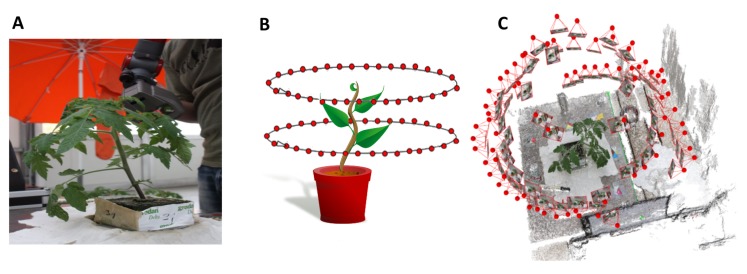
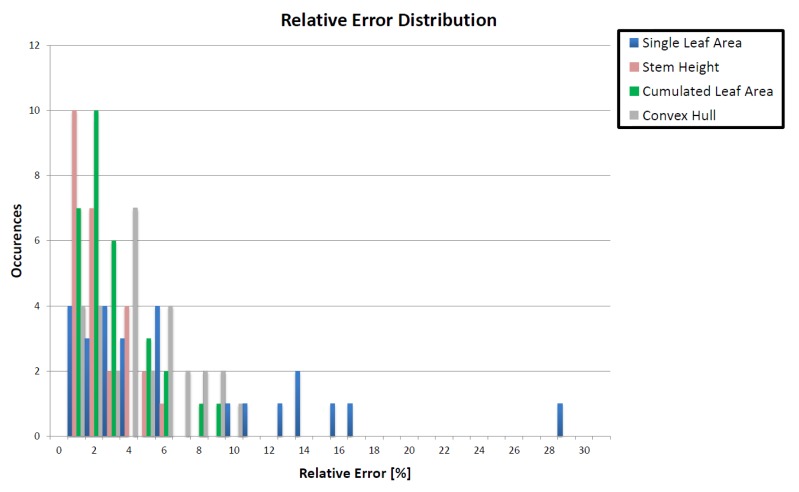
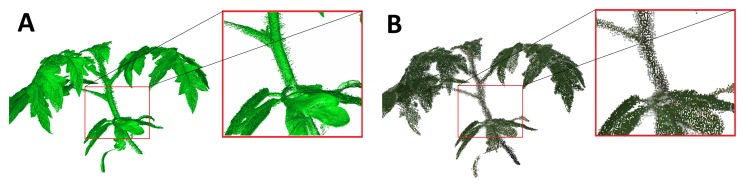
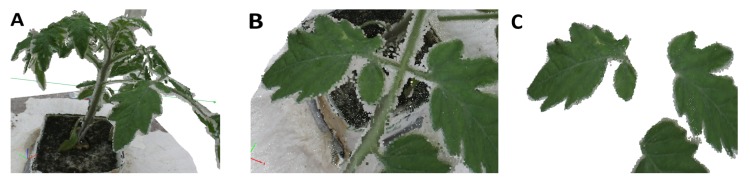
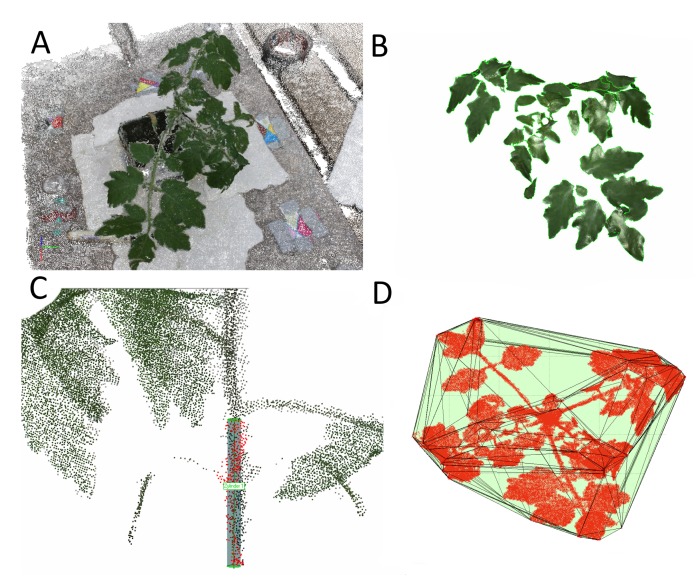
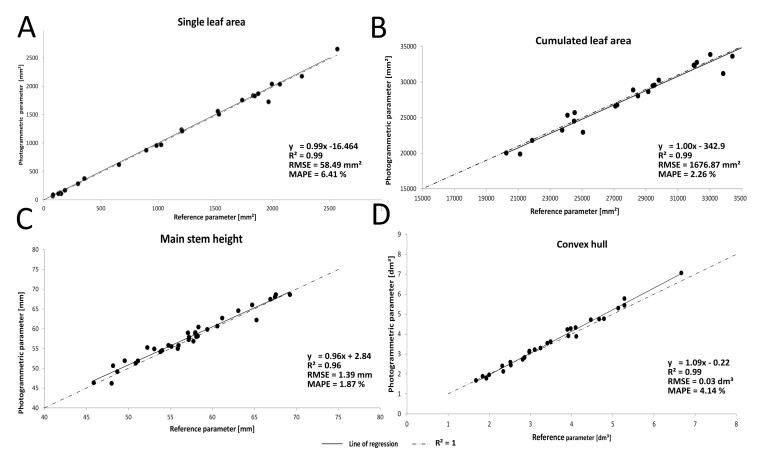
Accessing a plant's 3D geometry has become of significant importance for phenotyping during the last few years. Close-up laser scanning is an established method to acquire 3D plant shapes in real time with high detail, but it is stationary and has high investment costs. 3D reconstruction from images using structure from motion (SfM) and multi-view stereo (MVS) is a flexible cost-effective method, but requires post-processing procedures. The aim of this study is to evaluate the potential measuring accuracy of an SfM- and MVS-based photogrammetric method for the task of organ-level plant phenotyping. For this, reference data are provided by a high-accuracy close-up laser scanner. Using both methods, point clouds of several tomato plants were reconstructed at six following days. The parameters leaf area, main stem height and convex hull of the complete plant were extracted from the 3D point clouds and compared to the reference data regarding accuracy and correlation. These parameters were chosen regarding the demands of current phenotyping scenarios. The study shows that the photogrammetric approach is highly suitable for the presented monitoring scenario, yielding high correlations to the reference measurements. This cost-effective 3D reconstruction method depicts an alternative to an expensive laser scanner in the studied scenarios with potential for automated procedures.
在过去几年中,获取植物的三维几何形状对于表型分析变得极为重要。近距离激光扫描是一种成熟的方法,可实时获取高细节的三维植物形状,但它是固定的且投资成本高。使用运动结构(SfM)和多视图立体(MVS)从图像进行三维重建是一种灵活且经济高效的方法,但需要后处理程序。本研究的目的是评估基于SfM和MVS的摄影测量方法在器官水平植物表型分析任务中的潜在测量精度。为此,由高精度近距离激光扫描仪提供参考数据。使用这两种方法,在接下来的六天对几株番茄植株进行了点云重建。从三维点云中提取叶面积、主茎高度和整株植物凸包等参数,并与参考数据在准确性和相关性方面进行比较。这些参数是根据当前表型分析场景的需求选择的。研究表明,摄影测量方法非常适合所呈现的监测场景,与参考测量具有高度相关性。这种经济高效的三维重建方法在研究场景中是昂贵激光扫描仪的一种替代方案,具有自动化程序的潜力。