Nghiem V T, Davies K R, Beck J R, Follen M, MacAulay C, Guillaud M, Cantor S B
1] The University of Texas MD Anderson Cancer Center, Department of Health Services Research, 1515 Holcombe Blvd., Houston, TX 77030, USA [2] The University of Texas School of Public Health, Division of Management, Policy and Community Health, 1200 Pressler Street, Houston, TX 77030, USA.
The University of Texas MD Anderson Cancer Center, Department of Health Services Research, 1515 Holcombe Blvd., Houston, TX 77030, USA.
Br J Cancer. 2015 Jun 9;112(12):1951-7. doi: 10.1038/bjc.2015.95. Epub 2015 Apr 28.
DNA ploidy analysis involves automated quantification of chromosomal aneuploidy, a potential marker of progression toward cervical carcinoma. We evaluated the cost-effectiveness of this method for cervical screening, comparing five ploidy strategies (using different numbers of aneuploid cells as cut points) with liquid-based Papanicolaou smear and no screening.
A state-transition Markov model simulated the natural history of HPV infection and possible progression into cervical neoplasia in a cohort of 12-year-old females. The analysis evaluated cost in 2012 US$ and effectiveness in quality-adjusted life-years (QALYs) from a health-system perspective throughout a lifetime horizon in the US setting. We calculated incremental cost-effectiveness ratios (ICERs) to determine the best strategy. The robustness of optimal choices was examined in deterministic and probabilistic sensitivity analyses.
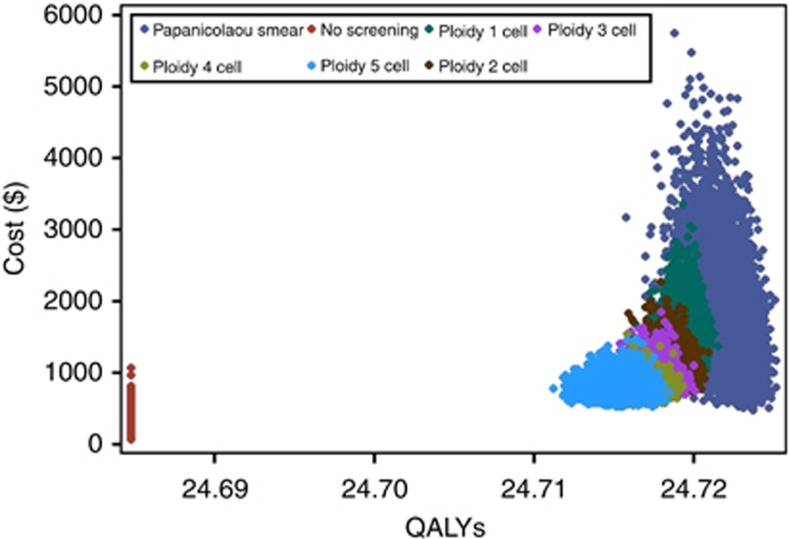
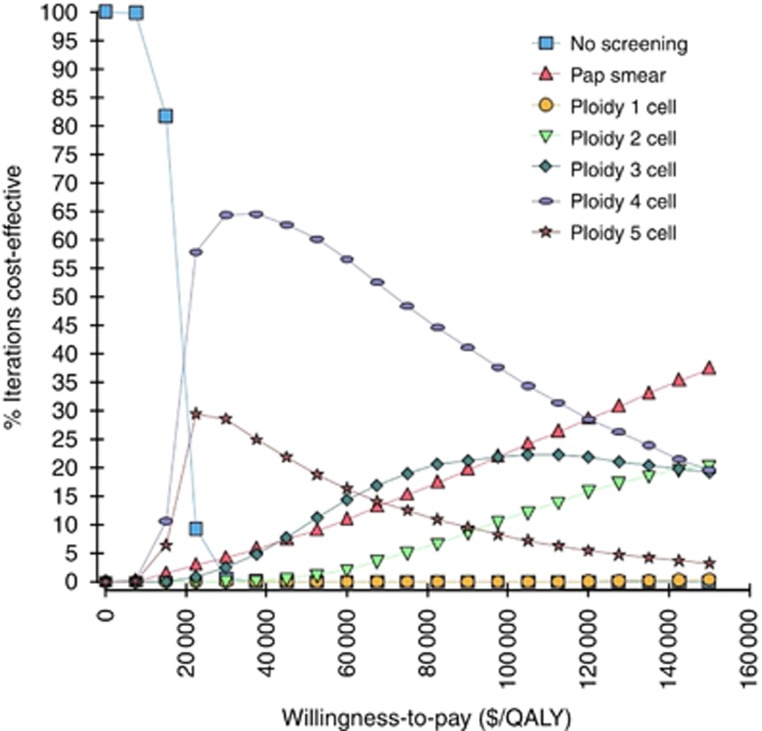
In the base-case analysis, the ploidy 4 cell strategy was cost-effective, yielding an increase of 0.032 QALY and an ICER of $18 264/QALY compared to no screening. For most scenarios in the deterministic sensitivity analysis, the ploidy 4 cell strategy was the only cost-effective strategy. Cost-effectiveness acceptability curves showed that this strategy was more likely to be cost-effective than the Papanicolaou smear.
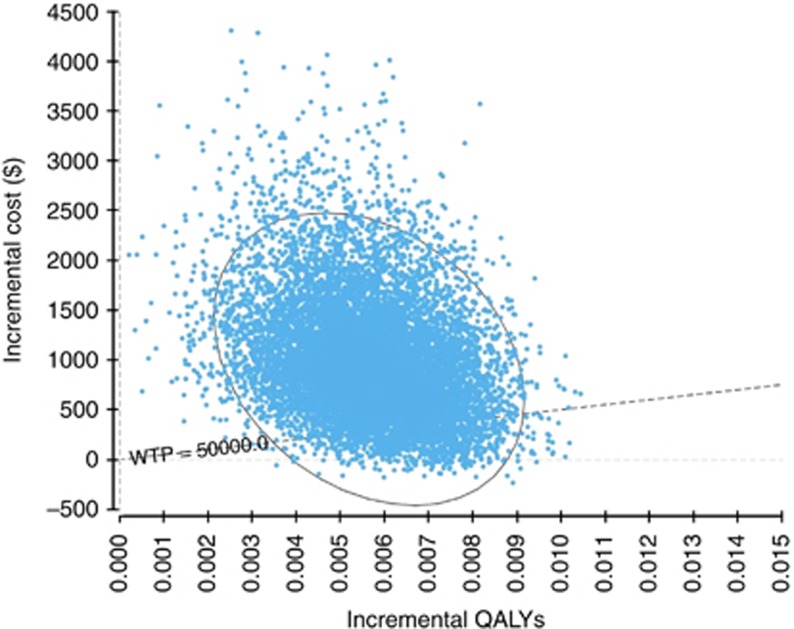
Compared to the liquid-based Papanicolaou smear, screening with a DNA ploidy strategy appeared less costly and comparably effective.
DNA倍体分析涉及对染色体非整倍体进行自动定量,这是宫颈癌进展的一个潜在标志物。我们评估了这种方法用于宫颈癌筛查的成本效益,将五种倍体策略(使用不同数量的非整倍体细胞作为切点)与液基巴氏涂片检查及不进行筛查进行了比较。
一个状态转换马尔可夫模型模拟了12岁女性队列中HPV感染的自然史以及可能进展为宫颈肿瘤的情况。该分析从美国卫生系统的角度,在整个生命周期内评估了以2012年美元计的成本以及以质量调整生命年(QALYs)计的有效性。我们计算了增量成本效益比(ICERs)以确定最佳策略。在确定性和概率敏感性分析中检验了最优选择的稳健性。
在基础病例分析中,倍体4细胞策略具有成本效益,与不进行筛查相比,可增加0.032个QALY,ICER为18264美元/QALY。在确定性敏感性分析的大多数情况下,倍体4细胞策略是唯一具有成本效益的策略。成本效益可接受性曲线表明,该策略比巴氏涂片检查更有可能具有成本效益。
与液基巴氏涂片检查相比,采用DNA倍体策略进行筛查似乎成本更低且效果相当。