Krishnasamy Vikram, Otte Joachim, Silbergeld Ellen
Johns Hopkins University Bloomberg School of Public Health, 615 N. Wolfe Street, Room WB602, Baltimore, MD 21205 USA.
Food and Agriculture Organization, Room C-510, Viale delle Terme di Caracalla, Rome, 00153 Italy.
Antimicrob Resist Infect Control. 2015 Apr 28;4:17. doi: 10.1186/s13756-015-0050-y. eCollection 2015.
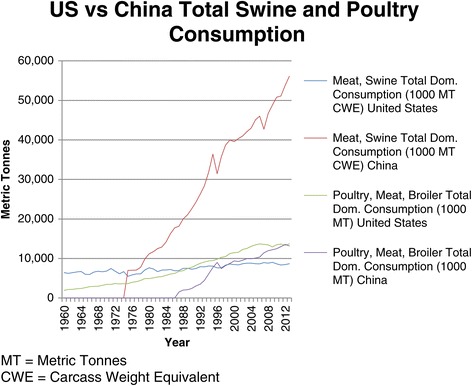
Antimicrobial use for growth promotion in food animal production is now widespread. A major concern is the rise of antimicrobial resistance and the subsequent impact on human health. The antimicrobials of concern are used in concentrated animal feeding operations (CAFOs) which are responsible for almost all meat production including swine and poultry in the US. With global meat consumption rising, the CAFO model has been adopted elsewhere to meet this demand. One such country where this has occurred is China, and evidence suggests 70% of poultry production now occurs outside of traditional small farms. Moreover, China is now the largest aggregate consumer of meat products in the world. With this rapid rise in consumption, the Chinese production model has changed along with the use of antimicrobials in feeds. However, the specific antibiotic use in the Chinese food animal production sector is unclear. Additionally, we are aware of high quantities of antimicrobial use because of reports of high concentrations of antimicrobials in animal waste and surface waters surrounding animal feeding operations.
In this report, we estimate the volume of antibiotics used for swine and poultry production as these are the two meat sources with the highest levels of production and consumption in China. We adopt a model developed by Mellon et al. in the US for estimating drug use in feed for poultry and swine production to estimate overall antimicrobial use as well as antimicrobial use by class.
We calculate that 38.5 million kg [84.9 million lbs] were used in 2012 in China's production of swine and poultry. By antibiotic class, the highest weights are tetracyclines in swine and coccidiostats in poultry.
The volume of antimicrobial use is alarming. Although there are limitations to these data, we hope our report will stimulate further analysis and a sense of urgency in assessing the consequences of such high levels of utilization in terms of antibiotic resistance in the food supply and the environment.
在食用动物生产中使用抗菌药物促进生长的现象如今十分普遍。一个主要担忧是抗菌药物耐药性的增加以及随之而来对人类健康的影响。令人担忧的抗菌药物被用于集约化动物饲养场(CAFOs),在美国,这些饲养场几乎负责所有肉类生产,包括猪和家禽。随着全球肉类消费的增加,CAFO模式已在其他地方被采用以满足这一需求。中国就是这样一个采用了该模式的国家,有证据表明现在70%的家禽生产是在传统小型农场之外进行的。此外,中国现在是世界上最大的肉类产品总消费国。随着消费的迅速增长,中国的生产模式以及饲料中抗菌药物的使用都发生了变化。然而,中国食用动物生产部门具体的抗生素使用情况尚不清楚。此外,由于有报道称动物粪便和动物饲养场周边地表水中抗菌药物浓度很高,我们知道抗菌药物的使用量很大。
在本报告中,我们估算了用于猪和家禽生产的抗生素用量,因为这两种肉类来源在中国的产量和消费量最高。我们采用了美国梅隆等人开发的一个模型来估算家禽和猪生产中饲料的药物使用量,以估算总体抗菌药物使用量以及按类别划分的抗菌药物使用量。
我们计算得出,2012年中国猪和家禽生产中使用了3850万千克[8490万磅]抗菌药物。按抗生素类别划分,猪用中使用量最大的是四环素类,家禽用中是抗球虫药。
抗菌药物的使用量令人担忧。尽管这些数据存在局限性,但我们希望我们的报告能激发进一步的分析,并在评估如此高的使用量对食品供应和环境中抗生素耐药性方面的后果时产生紧迫感。