Bonjour J-P, Benoit V, Atkin S, Walrand S
Jean-Philippe Bonjour, M.D. Division of Bone Diseases, Geneva University Hospitals and Faculty of Medicine, Rue Gabrielle Perret-Gentil 4, CH - 1211 Geneva 14, Switzerland, Phone:+4122 372 99 60, Fax:+4122 372 99 73, E-mail:
J Nutr Health Aging. 2015 May;19(5):563-9. doi: 10.1007/s12603-015-0498-8.
To evaluate whether fortification of yogurts with vitamin D and calcium exerts an additional lowering effect on serum parathyroid hormone (PTH) and bone resorption markers (BRM) as compared to iso-caloric and iso-protein dairy products in aged white women at risk of fragility fractures.
A randomized double-blind controlled trial.
A community dwelling home.
Forty-eight women over 60 years (mean age 73.4).
Consumption during 84 days of two 125 g servings of either vitamin D and calcium-fortified yogurts (FY) at supplemental levels of 10 µg vitamin D3/d and 520 mg/d of calcium (total=800 mg/d), or non fortified control yogurts (CY) providing 280 mg/d of calcium.
Serum changes from baseline (D0) to D28, D56 and D84 in 25OHD, PTH and in two BRM: Tartrate-resistant-acid-phosphatase-isoform-5b (TRAP5b) and carboxy-terminal-cross-linked-telopeptide of type-I-collagen (CTX).
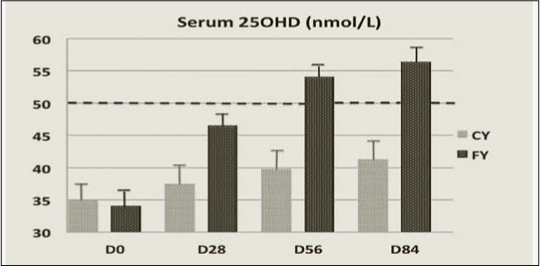
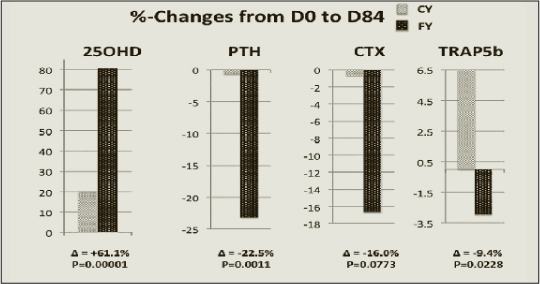
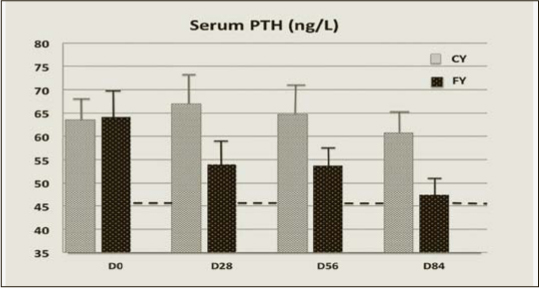
The 10 years risk of major and hip fractures were 13.1 and 5.0%, and 12.9 and 4.2 %, in FY and CY groups, respectively. From D0 to D84, serum 25OHD increased (mean±SE) from 34.3±2.4 to 56.3±2.4 nmol/L in FY (n=24) and from 35.0±2.5 to 41.3±3.0 nmol/L in CY (n=24), (P=0.00001). The corresponding changes in PTH were from 64.1±5.1 to 47.4±3.8 ng/L in FY and from 63.5±4.6 to 60.7±4.2 ng/L in CY (P=0.0011). After D84, TRAP5b was reduced significantly (P=0.0228) and CTX fell though not significantly (P=0.0773) in FY compared to CY.
This trial in aged white women living in a community dwelling home at risk for osteoporotic fractures confirms that fortification of dairy products with vitamin D3 and calcium should provide a greater prevention of secondary hyperparathyroidism and accelerated bone resorption as compared to non-fortified equivalent foods.
评估与等热量、等蛋白质的乳制品相比,添加维生素D和钙的酸奶是否对有脆性骨折风险的老年白人女性的血清甲状旁腺激素(PTH)和骨吸收标志物(BRM)有额外的降低作用。
一项随机双盲对照试验。
一个社区养老院。
48名60岁以上女性(平均年龄73.4岁)。
在84天内,每天食用两份125克的添加维生素D和钙的酸奶(FY),补充剂量为10μg维生素D3/天和520mg/天的钙(总计800mg/天),或食用提供280mg/天钙的未强化对照酸奶(CY)。
测量从基线(D0)到D28、D56和D84时血清中25OHD、PTH以及两种BRM(抗酒石酸酸性磷酸酶同工酶5b(TRAP5b)和I型胶原羧基末端交联肽(CTX))的变化。
FY组和CY组发生主要骨折和髋部骨折的10年风险分别为13.1%和5.0%,以及12.9%和4.2%。从D0到D84,FY组(n = 24)血清25OHD从34.3±2.4nmol/L增加到56.3±2.4nmol/L,CY组(n = 24)从35.0±2.5nmol/L增加到41.3±3.Ormol/L(P = 0.00001)。PTH的相应变化在FY组中从64.1±5.1ng/L降至47.4±3.8ng/L,在CY组中从63.5±4.6ng/L降至60.7±4.2ng/L(P = 0.0011)。D84后,与CY组相比,FY组的TRAP5b显著降低(P = 0.0228),CTX虽未显著下降(P = 0.0773)。
这项针对居住在社区养老院中有骨质疏松性骨折风险的老年白人女性的试验证实,与未强化的同类食品相比,用维生素D3和钙强化乳制品应能更好地预防继发性甲状旁腺功能亢进和加速骨吸收。