Markiewicz Ewa, Barnard Stephen, Haines Jackie, Coster Margaret, van Geel Orry, Wu Weiju, Richards Shane, Ainsbury Elizabeth, Rothkamm Kai, Bouffler Simon, Quinlan Roy A
School of Biological and Biomedical Sciences, University of Durham, Durham DH1 3LE, UK.
Public Health England, Centre for Radiation, Chemical & Environmental Hazards, Chilton, Didcot, Oxon OX11 0RQ, UK.
Open Biol. 2015 Apr;5(4):150011. doi: 10.1098/rsob.150011.
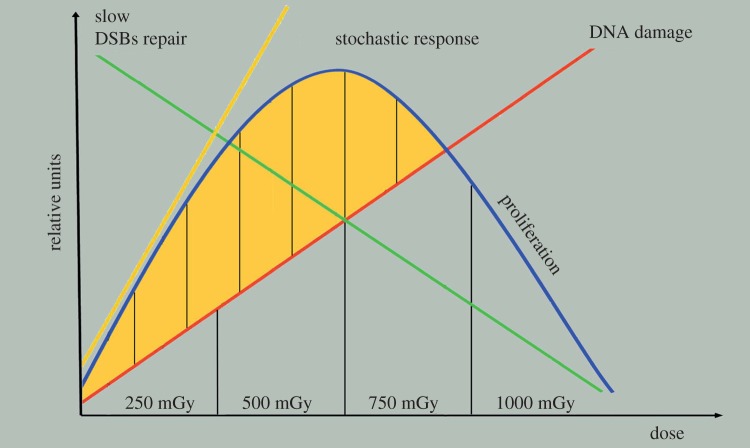
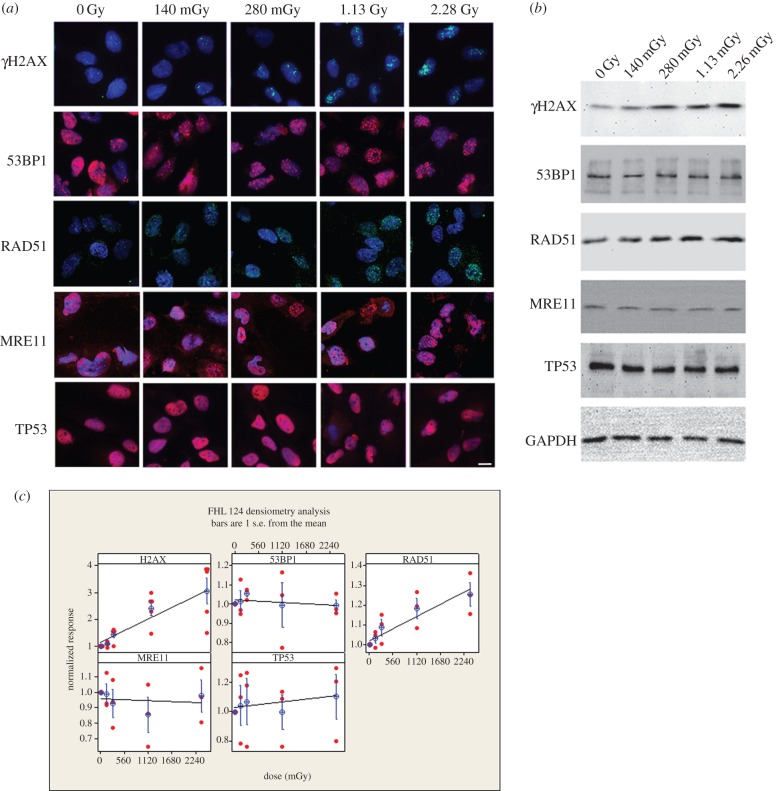
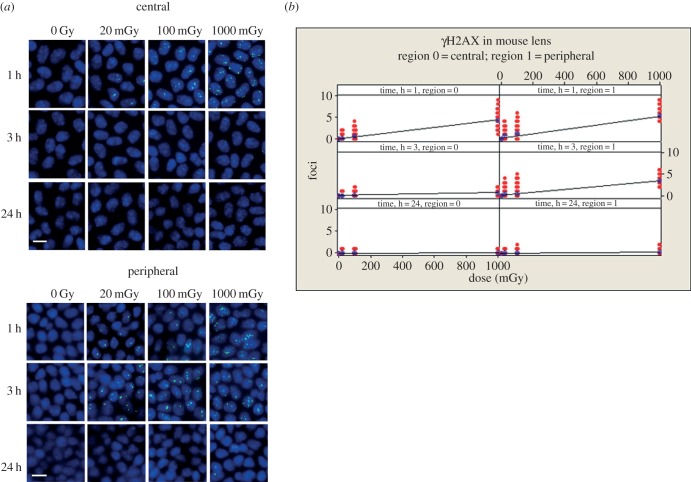
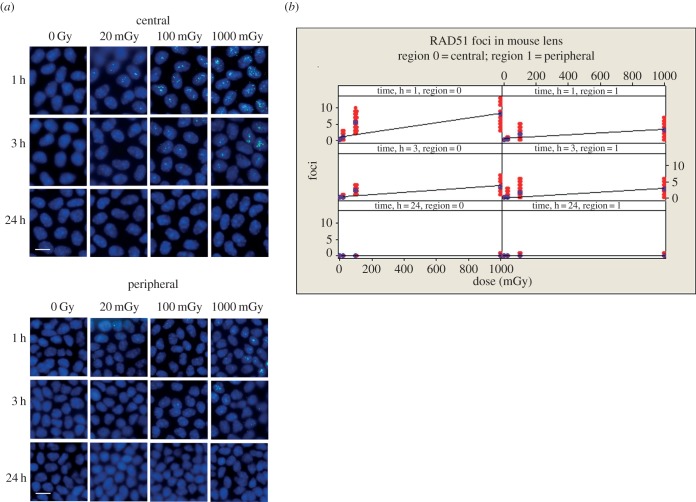
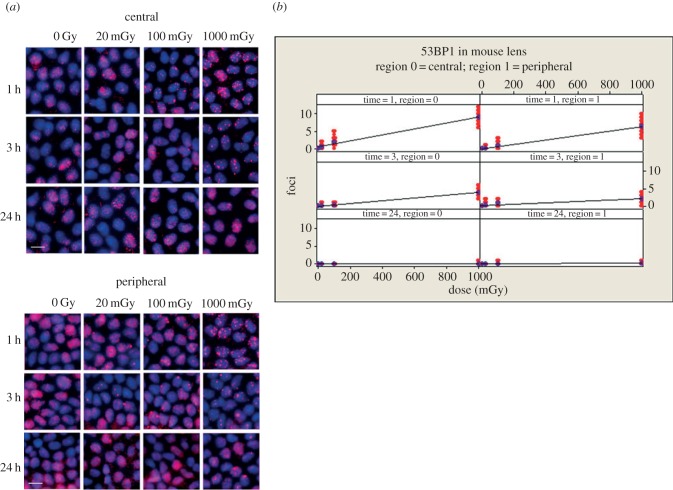
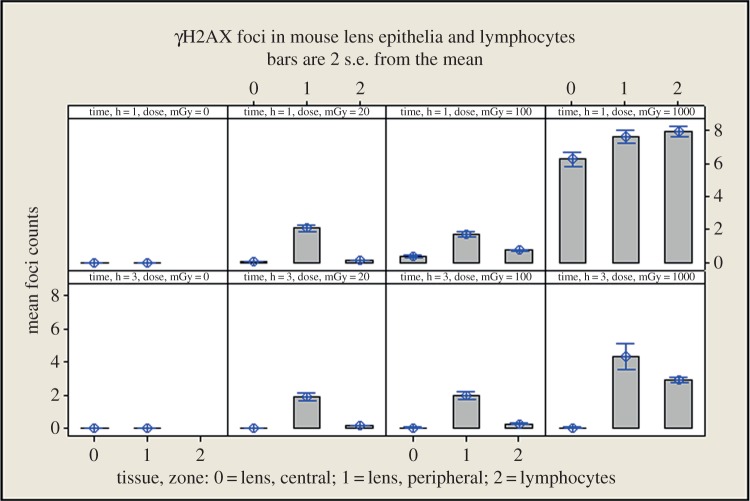
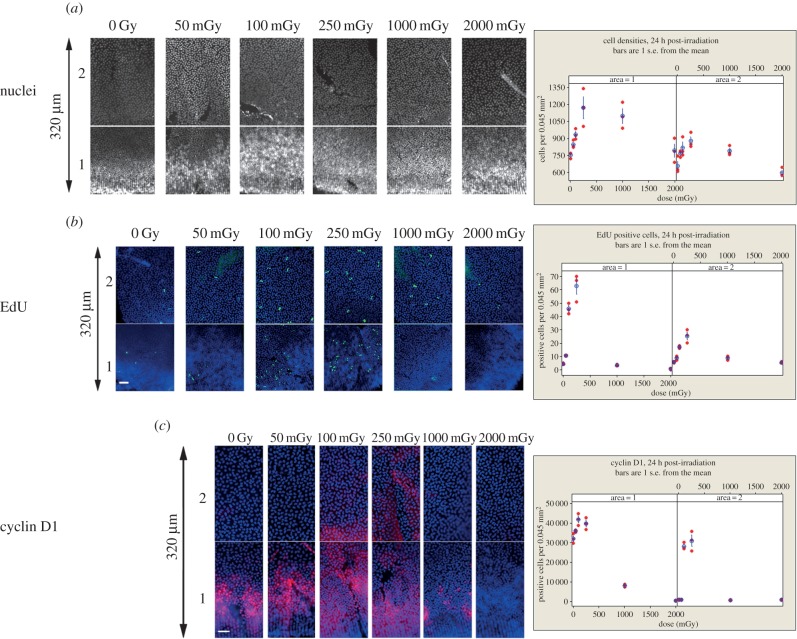
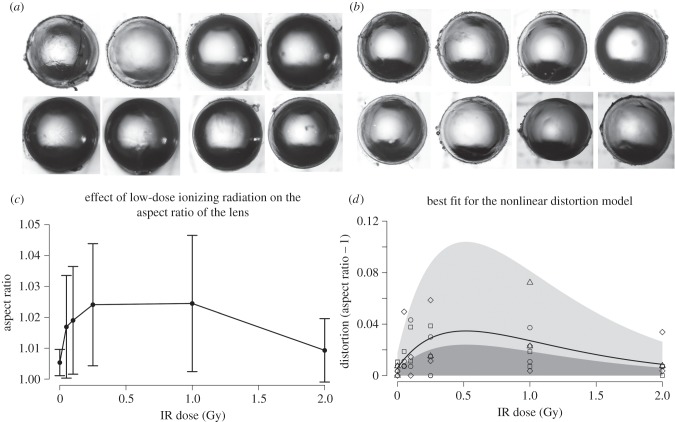
Elevated cataract risk after radiation exposure was established soon after the discovery of X-rays in 1895. Today, increased cataract incidence among medical imaging practitioners and after nuclear incidents has highlighted how little is still understood about the biological responses of the lens to low-dose ionizing radiation (IR). Here, we show for the first time that in mice, lens epithelial cells (LECs) in the peripheral region repair DNA double strand breaks (DSB) after exposure to 20 and 100 mGy more slowly compared with circulating blood lymphocytes, as demonstrated by counts of γH2AX foci in cell nuclei. LECs in the central region repaired DSBs faster than either LECs in the lens periphery or lymphocytes. Although DSB markers (γH2AX, 53BP1 and RAD51) in both lens regions showed linear dose responses at the 1 h timepoint, nonlinear responses were observed in lenses for EdU (5-ethynyl-2'-deoxy-uridine) incorporation, cyclin D1 staining and cell density after 24 h at 100 and 250 mGy. After 10 months, the lens aspect ratio was also altered, an indicator of the consequences of the altered cell proliferation and cell density changes. A best-fit model demonstrated a dose-response peak at 500 mGy. These data identify specific nonlinear biological responses to low (less than 1000 mGy) dose IR-induced DNA damage in the lens epithelium.
1895年X射线发现后不久,就确定了辐射暴露后白内障风险升高。如今,医学影像从业者以及核事故后白内障发病率的增加凸显了人们对晶状体对低剂量电离辐射(IR)的生物学反应仍知之甚少。在此,我们首次表明,在小鼠中,与循环血液淋巴细胞相比,外周区域的晶状体上皮细胞(LEC)在受到20和100毫戈瑞辐射后修复DNA双链断裂(DSB)的速度更慢,这通过细胞核中γH2AX焦点计数得以证明。中央区域的LEC修复DSB的速度比晶状体周边的LEC或淋巴细胞都要快。尽管两个晶状体区域的DSB标记物(γH2AX、53BP1和RAD51)在1小时时间点显示出线性剂量反应,但在100和250毫戈瑞照射24小时后,晶状体中EdU(5-乙炔基-2'-脱氧尿苷)掺入、细胞周期蛋白D1染色和细胞密度出现非线性反应。10个月后,晶状体纵横比也发生了变化,这是细胞增殖改变和细胞密度变化后果的一个指标。一个最佳拟合模型显示在500毫戈瑞处有剂量反应峰值。这些数据确定了晶状体上皮细胞对低(小于1000毫戈瑞)剂量IR诱导的DNA损伤的特定非线性生物学反应。