Schaller Benoit, Clarke William T, Neubauer Stefan, Robson Matthew D, Rodgers Christopher T
University of Oxford Centre for Clinical Magnetic Resonance Research (OCMR), University of Oxford, Level 0, John Radcliffe Hospital, Oxford, United Kingdom.
Magn Reson Med. 2016 Mar;75(3):962-72. doi: 10.1002/mrm.25755. Epub 2015 Apr 28.
The translation of sophisticated phosphorus MR spectroscopy ((31)P-MRS) protocols to 7 Tesla (T) is particularly challenged by the issue of radiofrequency (RF) heating. Legal limits on RF heating make it hard to reliably suppress signals from skeletal muscle that can contaminate human cardiac (31)P spectra at 7T. We introduce the first surface-spoiling crusher coil for human cardiac (31)P-MRS at 7T.
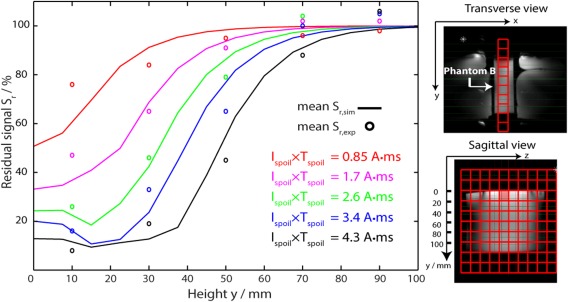
A planar crusher coil design was optimized with simulations and its performance was validated in phantoms. Crusher gradient pulses (100 μs) were then applied during human cardiac (31)P-MRS at 7T.
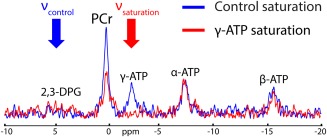
In a phantom, residual signals were 50 ± 10% with BISTRO (B1 -insensitive train to obliterate signal), and 34 ± 8% with the crusher coil. In vivo, residual signals in skeletal muscle were 49 ± 4% using BISTRO, and 24 ± 5% using the crusher coil. Meanwhile, in the interventricular septum, spectral quality and metabolite quantification did not differ significantly between BISTRO (phosphocreatine/adenosine triphosphate [PCr/ATP] = 2.1 ± 0.4) and the crusher coil (PCr/ATP = 1.8 ± 0.4). However, the specific absorption rate (SAR) decreased from 96 ± 1% of the limit (BISTRO) to 16 ± 1% (crusher coil).
A crusher coil is an SAR-efficient alternative for selectively suppressing skeletal muscle during cardiac (31)P-MRS at 7T. A crusher coil allows the use of sequence modules that would have been SAR-prohibitive, without compromising skeletal muscle suppression.
将复杂的磷磁共振波谱((31)P-MRS)协议转换到7特斯拉(T)时,射频(RF)加热问题带来了特别的挑战。RF加热的法定限制使得难以可靠地抑制骨骼肌信号,而这些信号在7T时会污染人体心脏(31)P谱。我们介绍了首款用于7T人体心脏(31)P-MRS的表面破坏式粉碎线圈。
通过模拟优化了平面粉碎线圈设计,并在体模中验证了其性能。然后在7T人体心脏(31)P-MRS期间施加粉碎梯度脉冲(100微秒)。
在体模中,使用BISTRO(对B1不敏感的信号消除序列)时残留信号为50±10%,使用粉碎线圈时为34±8%。在体内,使用BISTRO时骨骼肌中的残留信号为49±4%,使用粉碎线圈时为24±5%。同时,在室间隔中,BISTRO(磷酸肌酸/三磷酸腺苷[PCr/ATP]=2.1±0.4)和粉碎线圈(PCr/ATP = 1.8±0.4)之间的光谱质量和代谢物定量没有显著差异。然而,比吸收率(SAR)从极限值的96±1%(BISTRO)降至16±1%(粉碎线圈)。
粉碎线圈是在7T心脏(31)P-MRS期间选择性抑制骨骼肌的一种SAR高效替代方案。粉碎线圈允许使用原本因SAR限制而无法使用的序列模块,同时不影响骨骼肌抑制效果。