Huber Erika O, Roos Ewa M, Meichtry André, de Bie Rob A, Bischoff-Ferrari Heike A
Centre of Aging and Mobility, University Hospital Zurich and Waid City Hospital Zurich, Rämistrasse 100, Zurich, Switzerland.
School of Health Professions, Institute of Physiotherapy, Zurich University of Applied Sciences, Technikumstrasse 71, 8401, Winterthur, Switzerland.
BMC Musculoskelet Disord. 2015 Apr 25;16:101. doi: 10.1186/s12891-015-0556-8.
Improving functional status preoperatively through exercise may improve postoperative outcome. Previous knowledge on preoperative exercise in knee osteoarthritis is insufficient. The aim of the study was to compare the difference in change between groups in lower extremity function from baseline to 3 months after Total Knee Replacement (TKR) following a neuromuscular exercise programme (NEMEX-TJR) plus a knee school educational package (KS) or KS alone.
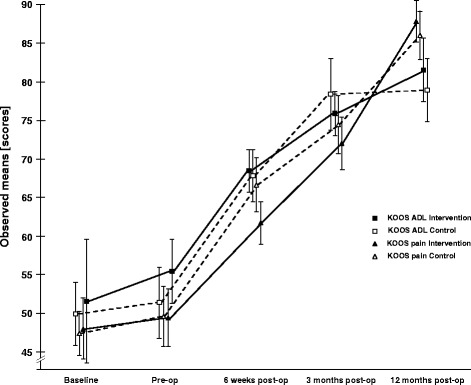
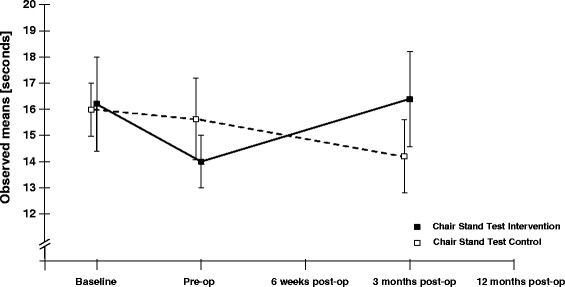
45 patients (55-83 years, 53% male, waiting for TKR) were randomized to receive a minimum of 8 sessions of NEMEXTJR plus 3 sessions of KS or 3 sessions of KS alone. Function was assessed with the Chair Stand Test (CST, primary endpoint) and the Knee Injury and Osteoarthritis Outcome Score (KOOS) subscales focusing on daily living function (ADL) and pain (secondary endpoints). Assessments were performed immediately before and after the intervention, and at 6 weeks, 3 months and 12 months after surgery by a physiotherapist, blinded to group allocation.
After intervention before surgery we observed a small improvement for primary and secondary endpoints in both groups, which did not differ significantly between groups: comparing the exercise to the control group the treatment effect for the CST was -1.5 seconds (95% CI: -5.3, 2.2), for KOOS ADL and KOOS pain the treatment effect was 1.3 points (-10.1, 12.8) and -2.3 (-12.4, 7.9) respectively. At 3 months after surgery we observed a small improvement in the primary endpoint in the control group and a significant improvement in the secondary endpoints in both exercise and control groups, which did not differ significantly between groups: comparing the exercise group to the control group the treatment effect in the CST was 2.0 seconds (-1.8, 5.8), for KOOS ADL and KOOS pain the treatment effect was -4.9 points (-16.3, 6.5) and -3.3 points (-13.5, 6.8) respectively.
A median (IQR) of 10 (8, 14) exercise sessions before surgery showed an additional small but non-significant improvement in all functional assessments compared to patient education alone. These benefits were not sustained after TKR. Our trial doesn't give a conclusive answer to whether additional preoperative exercise on postoperative functional outcomes is beneficial.
通过运动改善术前功能状态可能会改善术后结果。此前关于膝关节骨关节炎术前运动的知识并不充分。本研究的目的是比较在全膝关节置换术(TKR)后,接受神经肌肉运动计划(NEMEX-TJR)加膝关节康复教育套餐(KS)或仅接受KS的两组患者,从基线到术后3个月下肢功能变化的差异。
45例患者(年龄55 - 83岁,男性占53%,等待TKR手术)被随机分为两组,一组接受至少8次NEMEXTJR加3次KS,另一组仅接受3次KS。通过椅子站立试验(CST,主要终点)以及膝关节损伤和骨关节炎疗效评分(KOOS)中侧重于日常生活功能(ADL)和疼痛(次要终点)的子量表来评估功能。评估由一名对分组情况不知情的物理治疗师在干预前后、术后6周、3个月和12个月进行。
术前干预后,我们观察到两组的主要和次要终点均有小幅改善,两组间差异不显著:运动组与对照组相比,CST的治疗效果为 -1.5秒(95%置信区间:-5.3,2.2),KOOS ADL和KOOS疼痛的治疗效果分别为1.3分(-10.1,12.8)和 -2.3分(-12.4,7.9)。术后3个月,我们观察到对照组的主要终点有小幅改善,运动组和对照组的次要终点均有显著改善,两组间差异不显著:运动组与对照组相比,CST的治疗效果为2.0秒(-1.8,5.8),KOOS ADL和KOOS疼痛的治疗效果分别为 -4.9分(-16.3,6.5)和 -3.3分(-13.5,6.8)。
术前平均(四分位间距)进行10次(8,14)运动训练与单纯患者教育相比,在所有功能评估中显示出额外的小幅但不显著的改善。这些益处术后未持续存在。我们的试验并未对术前额外运动对术后功能结果是否有益给出确凿答案。