Ageberg Eva, Nilsdotter Anna, Kosek Eva, Roos Ewa M
BMC Musculoskelet Disord. 2013 Aug 8;14:232. doi: 10.1186/1471-2474-14-232.
The benefits of exercise in mild and moderate knee or hip osteoarthritis (OA) are apparent, but the evidence in severe OA is less clear. We recently reported that neuromuscular training was well tolerated and feasible in patients with severe primary hip or knee OA. The aims of this controlled before-and-after study were to compare baseline status to an age-matched population-based reference group and to examine the effects of neuromuscular training on patient-reported outcomes and physical function in patients with severe primary OA of the hip or knee.
87 patients (60-77 years) with severe primary OA of the hip (n = 38, 55% women) or knee (n = 49, 59% women) awaiting total joint replacement (TJR) had supervised, neuromuscular training (NEMEX-TJR) in groups with individualized level and progression of training. A reference group (n = 43, 53% women) was included for comparison with patients' data. Assessments included self-reported outcomes (HOOS/KOOS) and measures of physical function (chair stands, number of knee bends/30 sec, knee extensor strength, 20-meter walk test) at baseline and at follow-up before TJR. Analysis of covariance (ANCOVA) was used for comparing patients and references and elucidating influence of demographic factors on change. The paired t-test was used for comparisons within groups.
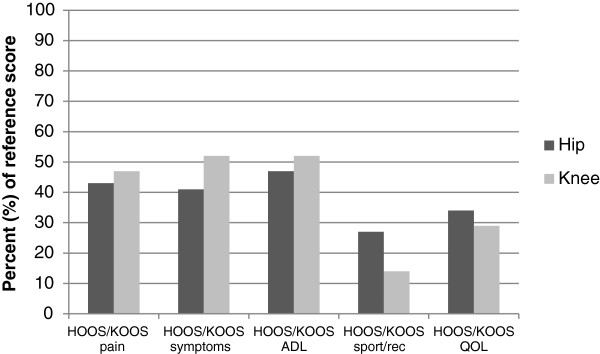
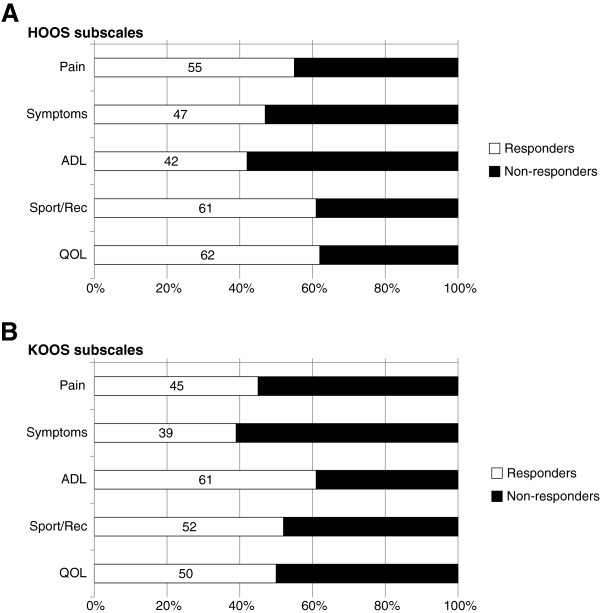
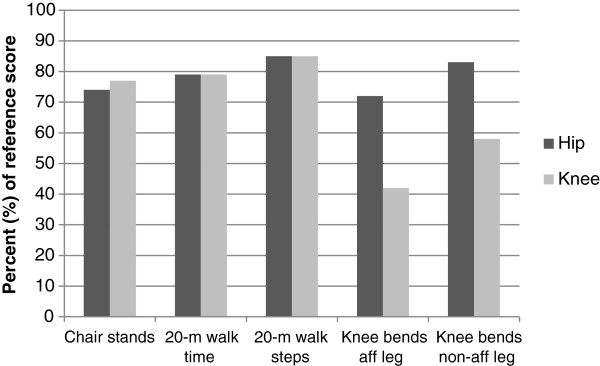
At baseline, patients reported worse scores than the references in all HOOS/KOOS subscales (hip 27-47%, knee 14-52%, of reference scores, respectively) and had functional limitations (hip 72-85%, knee 42-85%, of references scores, respectively). NEMEX-TJR (mean 12 weeks (SD 5.6) of training) improved self-reported outcomes (hip 9-29%, knee 7-20%) and physical function (hip 3-18%, knee 5-19%) (p < 0.005). Between 42% and 62% of hip OA patients, and 39% and 61% of knee OA patients, displayed a clinically meaningful improvement (≥15%) in HOOS/KOOS subscales by training. The improvement in HOOS/KOOS subscale ADL was greater for patients with knee OA than hip OA, while the improvement in subscale Sport/Rec was greater for patients with hip OA than knee OA.
Both self-reported outcomes and physical function were clearly worse compared with the reference group. Neuromuscular training with an individualized approach and gradual progression showed promise for improving patient-reported outcomes and physical function even in older patients with severe primary OA of the hip or knee.
运动对轻中度膝或髋骨关节炎(OA)有益已很明显,但对重度OA的证据尚不太明确。我们最近报告称,神经肌肉训练在重度原发性髋或膝OA患者中耐受性良好且可行。这项前后对照研究的目的是将基线状态与年龄匹配的基于人群的参考组进行比较,并研究神经肌肉训练对重度原发性髋或膝OA患者报告的结局和身体功能的影响。
87例(60 - 77岁)等待全关节置换(TJR)的重度原发性髋(n = 38,55%为女性)或膝(n = 49,59%为女性)OA患者接受了有监督的神经肌肉训练(NEMEX - TJR),训练分组具有个体化的水平和进展。纳入一个参考组(n = 43,53%为女性)以与患者数据进行比较。评估包括基线时以及TJR前随访时的自我报告结局(HOOS/KOOS)和身体功能测量(从椅子上站起、30秒内屈膝次数、伸膝力量、20米步行测试)。协方差分析(ANCOVA)用于比较患者和参考组,并阐明人口统计学因素对变化的影响。配对t检验用于组内比较。
在基线时,患者在所有HOOS/KOOS子量表中的得分均低于参考组(髋分别为参考得分的27 - 47%,膝为14 - 52%),并且存在功能受限(髋分别为参考得分的72 - 85%,膝为42 - 85%)。NEMEX - TJR(平均训练12周(标准差5.6))改善了自我报告结局(髋提高9 - 29%,膝提高7 - 20%)和身体功能(髋提高3 - 18%,膝提高5 - 19%)(p < 0.005)。通过训练,42%至62%的髋OA患者和39%至61%的膝OA患者在HOOS/KOOS子量表中显示出具有临床意义的改善(≥15%)。HOOS/KOOS子量表ADL方面,膝OA患者的改善大于髋OA患者,而子量表Sport/Rec方面,髋OA患者的改善大于膝OA患者。
与参考组相比,患者报告的结局和身体功能均明显更差。采用个体化方法和逐步进展的神经肌肉训练显示出有望改善患者报告的结局和身体功能,即使是患有重度原发性髋或膝OA的老年患者。