Deng Yunping, Lanciego Jose, Kerkerian-Le-Goff Lydia, Coulon Patrice, Salin Pascal, Kachidian Philippe, Lei Wanlong, Del Mar Nobel, Reiner Anton
Department of Anatomy and Neurobiology, The University of Tennessee Health Science Center Memphis, TN, USA.
Neurosciences Division, Center for Applied Medical Research (CIMA), Centro de Investigación Biomédica en Red sobre Enfermedades Neurosdegenerativas (CIBERNED), and Instituto de Investigación Sanitaria de Navarra (IdiSNA), University of Navarra Medical College Pamplona, Spain.
Front Syst Neurosci. 2015 Apr 14;9:51. doi: 10.3389/fnsys.2015.00051. eCollection 2015.
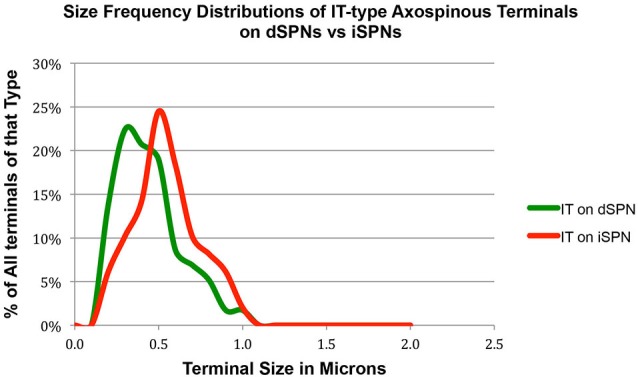
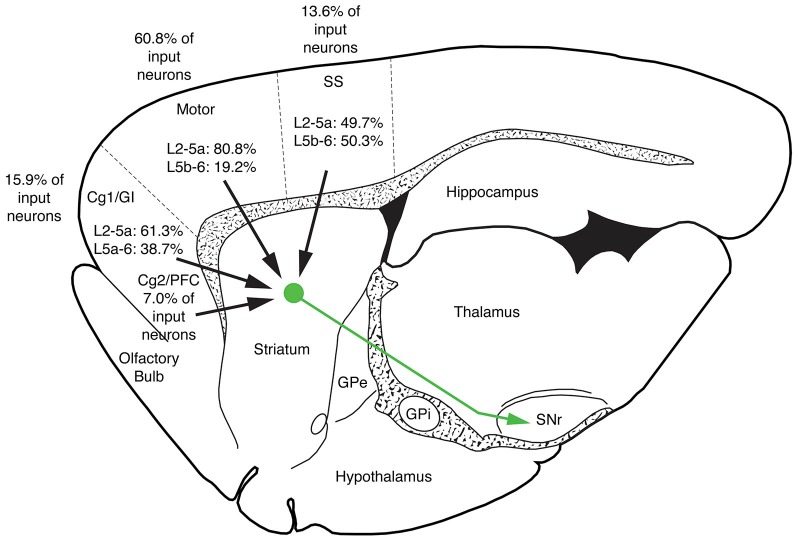
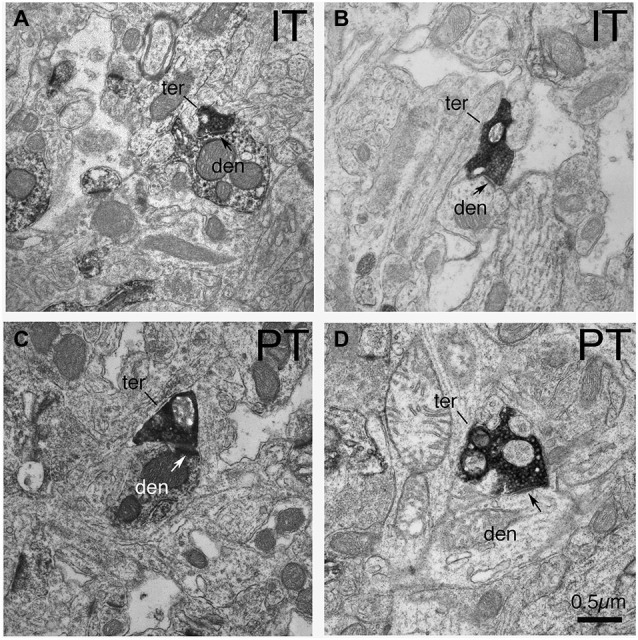
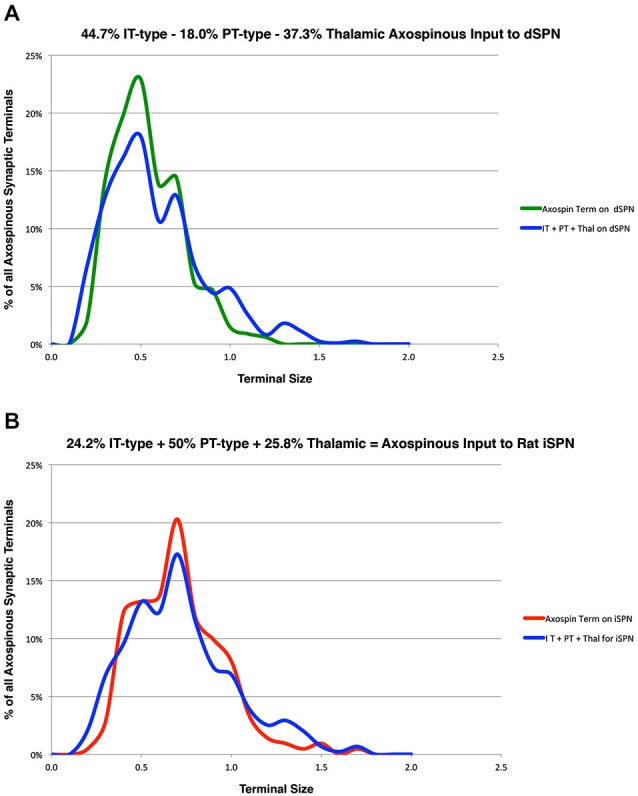
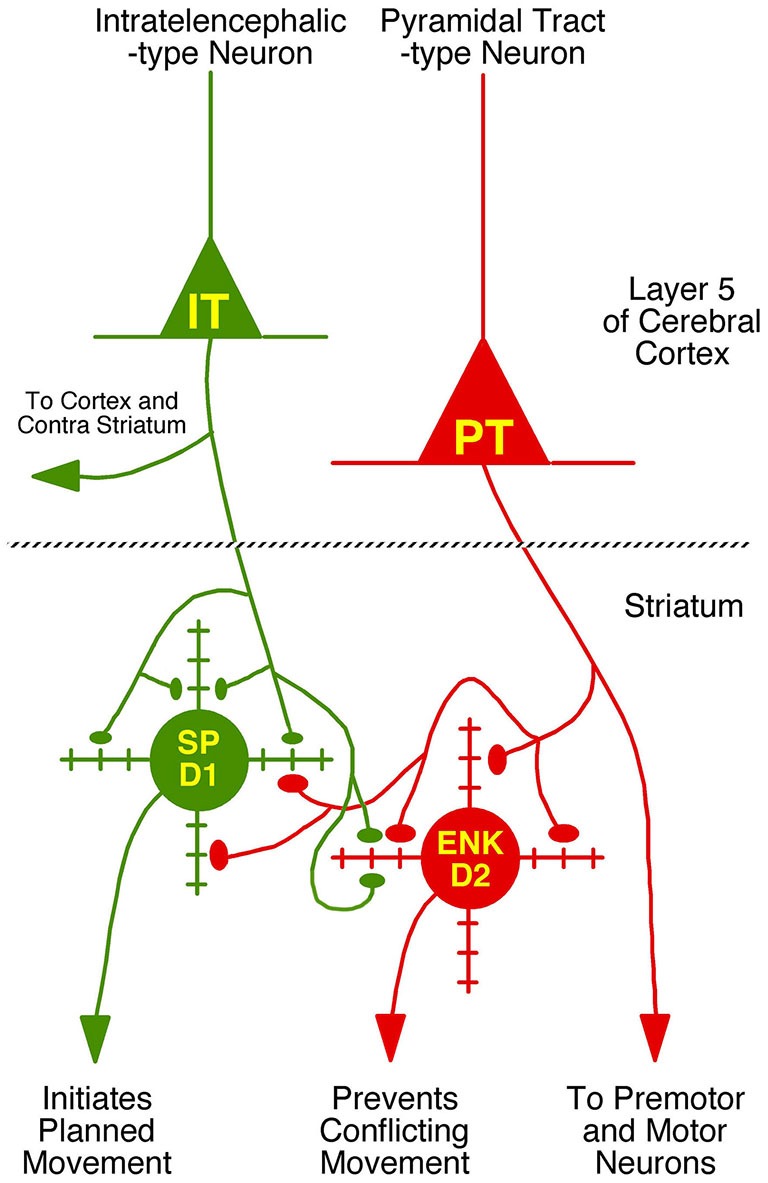
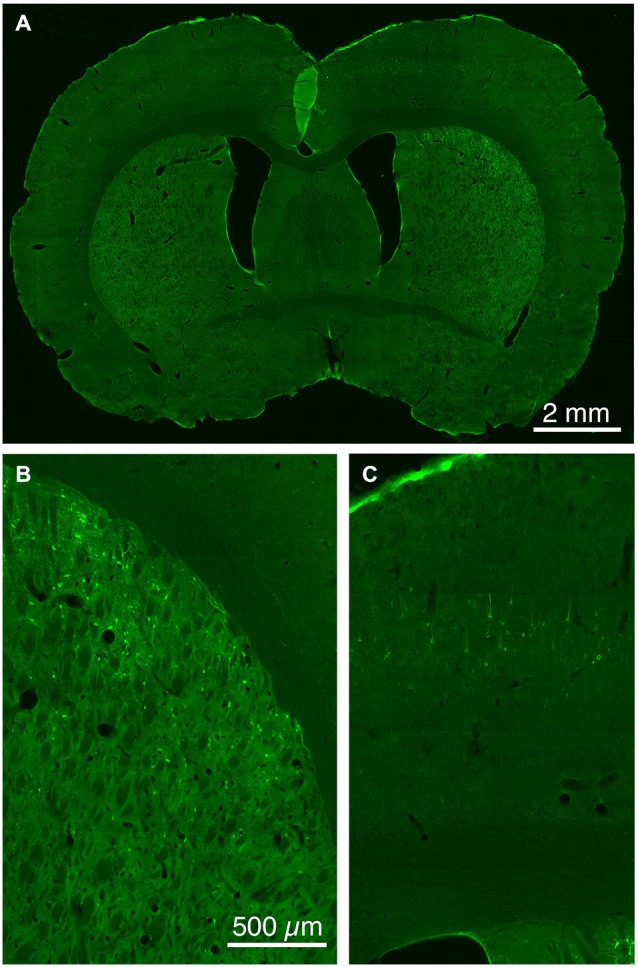
In prior studies, we described the differential organization of corticostriatal and thalamostriatal inputs to the spines of direct pathway (dSPNs) and indirect pathway striatal projection neurons (iSPNs) of the matrix compartment. In the present electron microscopic (EM) analysis, we have refined understanding of the relative amounts of cortical axospinous vs. axodendritic input to the two types of SPNs. Of note, we found that individual dSPNs receive about twice as many axospinous synaptic terminals from IT-type (intratelencephalically projecting) cortical neurons as they do from PT-type (pyramidal tract projecting) cortical neurons. We also found that PT-type axospinous synaptic terminals were about 1.5 times as common on individual iSPNs as IT-type axospinous synaptic terminals. Overall, a higher percentage of IT-type terminals contacted dSPN than iSPN spines, while a higher percentage of PT-type terminals contacted iSPN than dSPN spines. Notably, IT-type axospinous synaptic terminals were significantly larger on iSPN spines than on dSPN spines. By contrast to axospinous input, the axodendritic PT-type input to dSPNs was more substantial than that to iSPNs, and the axodendritic IT-type input appeared to be meager and comparable for both SPN types. The prominent axodendritic PT-type input to dSPNs may accentuate their PT-type responsiveness, and the large size of axospinous IT-type terminals on iSPNs may accentuate their IT-type responsiveness. Using transneuronal labeling with rabies virus to selectively label the cortical neurons with direct input to the dSPNs projecting to the substantia nigra pars reticulata, we found that the input predominantly arose from neurons in the upper layers of motor cortices, in which IT-type perikarya predominate. The differential cortical input to SPNs is likely to play key roles in motor control and motor learning.
在先前的研究中,我们描述了皮质纹状体和丘脑纹状体输入到基质区直接通路(dSPNs)和间接通路纹状体投射神经元(iSPNs)棘突的差异组织。在目前的电子显微镜(EM)分析中,我们对两种类型的SPNs的皮质轴棘突输入与轴树突输入的相对量有了更精确的理解。值得注意的是,我们发现单个dSPNs从IT型(脑内投射)皮质神经元接收的轴棘突突触终末数量大约是从PT型(锥体束投射)皮质神经元接收的两倍。我们还发现,PT型轴棘突突触终末在单个iSPNs上的数量大约是IT型轴棘突突触终末的1.5倍。总体而言,与iSPN棘突相比,接触dSPN的IT型终末百分比更高,而与dSPN棘突相比,接触iSPN的PT型终末百分比更高。值得注意的是,IT型轴棘突突触终末在iSPN棘突上比在dSPN棘突上显著更大。与轴棘突输入相反,dSPNs的轴树突PT型输入比iSPNs的更丰富,并且轴树突IT型输入似乎很少,且在两种类型的SPNs中相当。dSPNs突出的轴树突PT型输入可能会增强它们的PT型反应性,而iSPNs上轴棘突IT型终末的大尺寸可能会增强它们的IT型反应性。使用狂犬病病毒进行跨神经元标记,以选择性标记直接输入到投射到黑质网状部的dSPNs的皮质神经元,我们发现输入主要来自运动皮质上层的神经元,其中IT型胞体占主导。SPNs的皮质输入差异可能在运动控制和运动学习中起关键作用。