Tsanas Athanasios, Clifford Gari D
Department of Engineering Science, Institute of Biomedical Engineering, University of Oxford Oxford, UK ; Wolfson Centre for Mathematical Biology, Mathematical Institute, University of Oxford Oxford, UK ; Nuffield Department of Medicine, Sleep and Circadian Neuroscience Institute, University of Oxford UK.
Nuffield Department of Medicine, Sleep and Circadian Neuroscience Institute, University of Oxford UK ; Department of Biomedical Informatics, Emory University Atlanta, GA, USA ; Department of Biomedical Engineering, Georgia Institute of Technology Atlanta, GA, USA.
Front Hum Neurosci. 2015 Apr 8;9:181. doi: 10.3389/fnhum.2015.00181. eCollection 2015.
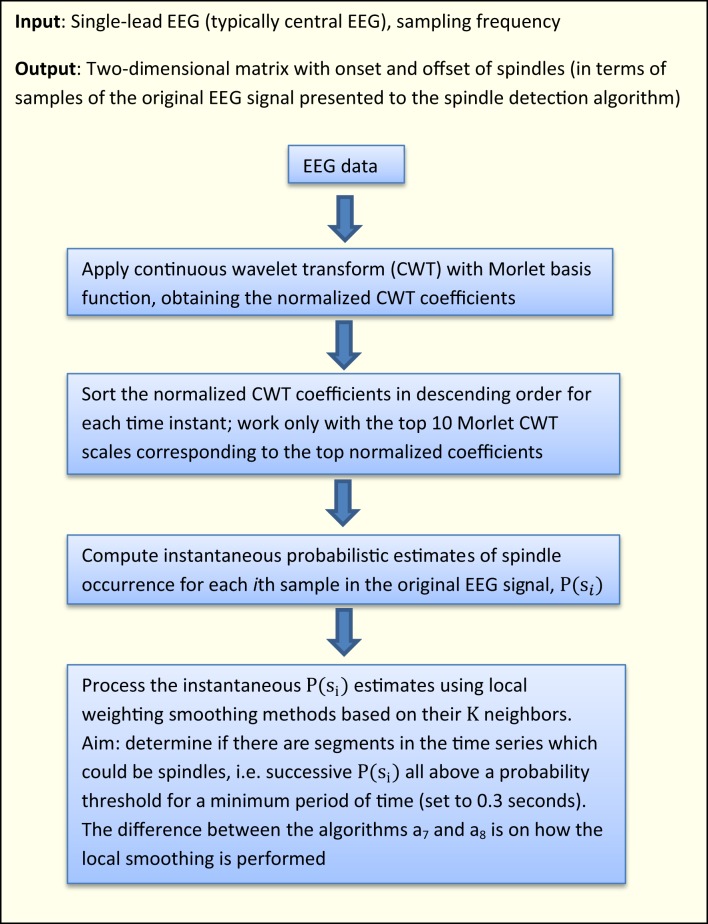
Sleep spindles are critical in characterizing sleep and have been associated with cognitive function and pathophysiological assessment. Typically, their detection relies on the subjective and time-consuming visual examination of electroencephalogram (EEG) signal(s) by experts, and has led to large inter-rater variability as a result of poor definition of sleep spindle characteristics. Hitherto, many algorithmic spindle detectors inherently make signal stationarity assumptions (e.g., Fourier transform-based approaches) which are inappropriate for EEG signals, and frequently rely on additional information which may not be readily available in many practical settings (e.g., more than one EEG channels, or prior hypnogram assessment). This study proposes a novel signal processing methodology relying solely on a single EEG channel, and provides objective, accurate means toward probabilistically assessing the presence of sleep spindles in EEG signals. We use the intuitively appealing continuous wavelet transform (CWT) with a Morlet basis function, identifying regions of interest where the power of the CWT coefficients corresponding to the frequencies of spindles (11-16 Hz) is large. The potential for assessing the signal segment as a spindle is refined using local weighted smoothing techniques. We evaluate our findings on two databases: the MASS database comprising 19 healthy controls and the DREAMS sleep spindle database comprising eight participants diagnosed with various sleep pathologies. We demonstrate that we can replicate the experts' sleep spindles assessment accurately in both databases (MASS database: sensitivity: 84%, specificity: 90%, false discovery rate 83%, DREAMS database: sensitivity: 76%, specificity: 92%, false discovery rate: 67%), outperforming six competing automatic sleep spindle detection algorithms in terms of correctly replicating the experts' assessment of detected spindles.
睡眠纺锤波对于睡眠特征的刻画至关重要,并且与认知功能和病理生理评估相关。通常,它们的检测依赖于专家对脑电图(EEG)信号进行主观且耗时的视觉检查,由于睡眠纺锤波特征定义不明确,导致不同评分者之间存在很大差异。迄今为止,许多算法性纺锤波检测器本质上都对信号平稳性做出了假设(例如基于傅里叶变换的方法),而这对于EEG信号并不适用,并且常常依赖于在许多实际场景中可能无法轻易获得的额外信息(例如多个EEG通道,或先前的睡眠图评估)。本研究提出了一种仅依赖单个EEG通道的新颖信号处理方法,并提供了客观、准确的手段来概率性地评估EEG信号中睡眠纺锤波的存在。我们使用具有Morlet基函数的直观且有吸引力的连续小波变换(CWT),识别出与纺锤波频率(11 - 16Hz)相对应的CWT系数功率较大的感兴趣区域。使用局部加权平滑技术来完善将信号段评估为纺锤波的可能性。我们在两个数据库上评估我们的发现:包含19名健康对照者的MASS数据库和包含8名被诊断患有各种睡眠疾病参与者的DREAMS睡眠纺锤波数据库。我们证明,我们能够在两个数据库中准确地复制专家对睡眠纺锤波的评估(MASS数据库:灵敏度:84%,特异性:90%,错误发现率83%;DREAMS数据库:灵敏度:76%,特异性:92%,错误发现率:67%),在正确复制专家对检测到的纺锤波评估方面优于六种竞争的自动睡眠纺锤波检测算法。