Huq Nafisa Lira, Ahmed Anisuddin, Haque Nafis Al, Hossaine Moyazzam, Uddin Jamal, Ahmed Faisal, Quaiyum M A
International Centre for Diarrheal Disease Research, Bangladesh (icddr,b). 68, Shaheed Tajuddin Ahmed Sarani, Mohakhali, Dhaka, 1212, Bangladesh.
Department of Microbiology, Child Health Research Foundation (CHRF), Dhaka Shishu (Children) Hospital, Dhaka, Bangladesh.
BMC Pregnancy Childbirth. 2015 Apr 28;15:104. doi: 10.1186/s12884-015-0520-5.
An integrated maternal health intervention in a rural sub district of Bangladesh focused on the training and deployment of a required number of Community Based Skilled Birth Attendants (CSBAs). The aim of the study was to assess the effect of the intervention on use of skilled provider care during pregnancy, delivery and after delivery.
The effect compared the skilled providers care in low performing areas with high and medium performing areas through pre-and post-intervention surveys. The post-intervention survey was conducted two years after the completion of the intervention. Village clusters, with populations of approximately 3000, were randomly assigned to the surveys. Mothers who had delivered within the 6 months prior to the surveys, were recruited for the structured interviews. Logistic regression was conducted to compare the effect.
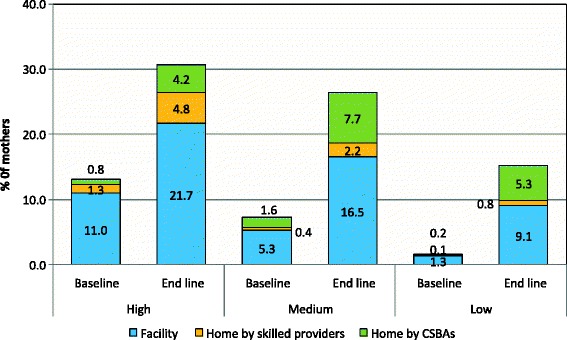
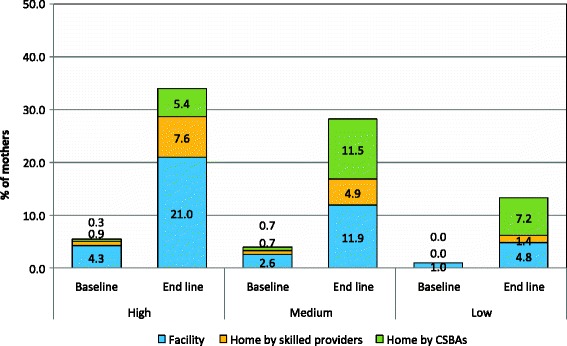
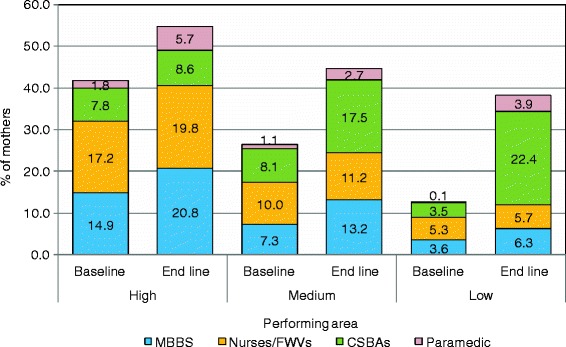
Majority of mothers in the low performing areas belonged to a poor economic quintile. The level of skilled attendance for 4+ Antenatal Care (ANC) and delivery increased sharply from baseline to endline survey in low performing areas (ANC: 1.6% to 15.3%, p < 0.0001; skilled birth attendant at delivery: 12.6% to 38.3%, p < 0.0001). Less than 1% of the women received Post Natal Care (PNC) from a skilled provider prior to the intervention, and this proportion increased to 20% at the end of the intervention. Adjusted odds showed that the intervention had an effect on the individual performing area on use of skilled provider care during ANC, delivery and PNC. The increase of 4+ ANC from skilled providers and skilled birth attendants during delivery in the low performing areas due to the integrated maternal health intervention was significant relative to the increase in the high performing areas [4+ ANC from skilled providers - OR: 3.8 (1.9-7.6); skilled birth attendants - OR: 2.8 (2.1-3.8)].
An integrated maternal health care intervention focused on deployment of a required number of CSBAs increased the opportunity for underprivileged women to benefit from skilled providers care during their pregnancy. This integrated intervention might improve the maternal health in developing countries where home delivery with unskilled attendants is common.
在孟加拉国一个农村分区开展的一项综合孕产妇保健干预措施,重点是培训和部署所需数量的社区熟练接生员(CSBA)。本研究的目的是评估该干预措施对孕期、分娩期及产后获得熟练医护人员护理的影响。
通过干预前后的调查,比较了表现较差地区与表现中等和较好地区获得熟练医护人员护理的情况。干预后调查在干预结束两年后进行。将约3000人的村庄集群随机分配到调查中。招募在调查前6个月内分娩的母亲进行结构化访谈。进行逻辑回归以比较效果。
表现较差地区的大多数母亲属于经济最贫困的五分之一人群。在表现较差地区,从基线调查到终期调查,4次及以上产前检查(ANC)和分娩时的熟练医护人员护理水平大幅提高(ANC:1.6%至15.3%,p<0.0001;分娩时熟练接生员:12.6%至38.3%,p<0.0001)。干预前,不到1%的妇女从熟练医护人员处获得产后护理(PNC),干预结束时这一比例增至20%。调整后的比值显示,该干预措施对各表现地区在ANC、分娩和PNC期间获得熟练医护人员护理有影响。由于综合孕产妇保健干预措施,表现较差地区分娩时熟练医护人员进行的4次及以上ANC和熟练接生员的增加相对于表现较好地区的增加具有显著性[熟练医护人员进行的4次及以上ANC - 比值比:3.8(1.9 - 7.6);熟练接生员 - 比值比:2.8(2.1 - 3.8)]。
一项侧重于部署所需数量CSBA的综合孕产妇保健干预措施,增加了贫困妇女在孕期从熟练医护人员护理中受益的机会。这种综合干预措施可能会改善发展中国家的孕产妇健康状况,在这些国家,由非熟练人员在家接生的情况很常见。