Wang Shaoshuai, Sun Haiying, Jia Yao, Tang Fangxu, Zhou Hang, Li Xiong, Zhou Jin, Huang Kecheng, Zhang Qinghua, Hu Ting, Yang Ru, Wang Changyu, Xi Ling, Deng Dongrui, Wang Hui, Wang Shixuan, Ma Ding, Li Shuang
Department of Obstetrics and Gynecology, Tongji Hospital, Tongji Medical College, Huazhong University of Science and Technology, 1095 jiefang road, Wuhan, 430030, P.R. China.
Department of Gynecology & Obstetrics, the Central Hospital of Wuhan, Wuhan, 430032, P.R. China.
BMC Med Genet. 2015 Apr 15;16:25. doi: 10.1186/s12881-015-0168-z.
A large number of single nucleotide polymorphisms (SNPs) associated with cervical cancer have been identified through candidate gene association studies and genome-wide association studies (GWAs). However, some studies have yielded different results for the same SNP. To obtain a more comprehensive understanding, we performed a meta-analysis on previously published case-control studies involving the SNPs associated with cervical cancer.
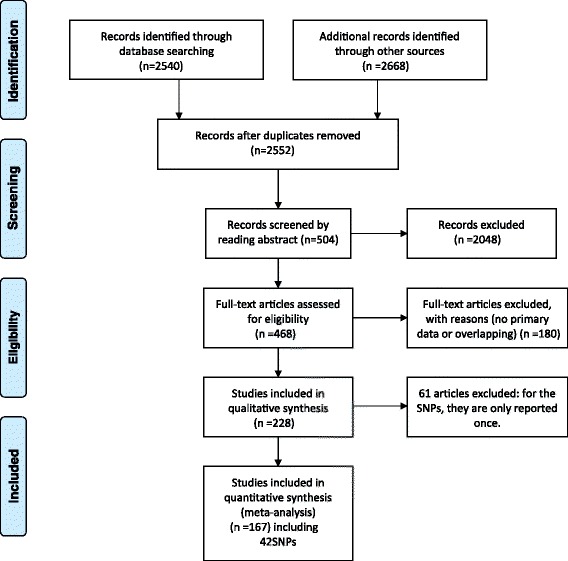
Electronic searches of PubMed and Embase were conducted for all publications about the association between gene polymorphisms and cervical cancer. One-hundred and sixty-seven association studies were included in our research. For each SNP, three models (the allele, dominant and recessive effect models) were adopted in the meta-analysis. For each model, the effect summary odds ratio (OR) and 95% CI were calculated. Heterogeneity between studies was evaluated by Cochran's Q test. If the p value of Q test was less than 0.01, a random effect model was used; otherwise, a fixed effect model was used.
The results of our meta-analysis showed that: (1) There were 8, 2 and 8 SNPs that were significantly associated with cervical cancer (P < 0.01) in the allele, dominant and recessive effect models, respectively. (2) rs1048943 (CYP1A1 A4889G) showed the strongest association with cervical cancer in the allele effect model (1.83[1.57, 2.13]); in addition, rs1048943 (CYP1A1 A4889G) had a very strong association in the dominant and recessive effect model. (3) 15, 11 and 10 SNPs had high heterogeneity (P < 0.01) in the three models, respectively. (4) There was no published bias for most of the SNPs according to Egger's test (P < 0.01) and Funnel plot analysis. For some SNPs, their association with cervical cancer was only tested in a few studies and, therefore, might have been subjected to published bias. More studies on these loci are required.
Our meta-analysis provides a comprehensive evaluation of cervical cancer association studies.
通过候选基因关联研究和全基因组关联研究(GWAs),已经鉴定出大量与宫颈癌相关的单核苷酸多态性(SNP)。然而,一些研究对同一SNP得出了不同的结果。为了获得更全面的认识,我们对先前发表的涉及与宫颈癌相关SNP的病例对照研究进行了荟萃分析。
对PubMed和Embase进行电子检索,以查找所有关于基因多态性与宫颈癌关联的出版物。我们的研究纳入了167项关联研究。对于每个SNP,荟萃分析采用三种模型(等位基因、显性和隐性效应模型)。对于每个模型,计算效应汇总比值比(OR)和95%可信区间(CI)。采用Cochran's Q检验评估研究间的异质性。如果Q检验的p值小于0.01,则使用随机效应模型;否则,使用固定效应模型。
我们的荟萃分析结果显示:(1)在等位基因、显性和隐性效应模型中,分别有8个、2个和8个SNP与宫颈癌显著相关(P < 0.01)。(2)rs1048943(CYP1A1 A4889G)在等位基因效应模型中与宫颈癌的关联最强(1.83[1.57, 2.13]);此外,rs1048943(CYP1A1 A4889G)在显性和隐性效应模型中也有很强的关联。(3)分别有15个、11个和10个SNP在三种模型中具有高度异质性(P < 0.01)。(4)根据Egger检验(P < 0.01)和漏斗图分析,大多数SNP没有发表偏倚。对于一些SNP,它们与宫颈癌的关联仅在少数研究中进行了检验,因此可能存在发表偏倚。需要对这些位点进行更多研究。
我们的荟萃分析对宫颈癌关联研究提供了全面评估。