Yu Yingjie, Nangia-Makker Pratima, Farhana Lulu, G Rajendra Sindhu, Levi Edi, Majumdar Adhip P N
Department of Veterans Affairs Medical Center, 4646 John R, Detroit, MI, 48201, USA.
Departments of Internal Medicine, Wayne State University, Detroit, MI, 48201, USA.
Mol Cancer. 2015 May 1;14:98. doi: 10.1186/s12943-015-0372-7.
Acquired drug resistance is one of the major reasons for failing cancer therapies. Although the reasons are not fully understood, they may be related to the presence of cancer stem cells (CSCs). We have reported that chemo-resistant (CR) colon cancer cells, highly enriched in CSCs, exhibit a marked up-regulation of miR-21 and that down-regulation of this miR renders the CR cells more susceptible to therapeutic regimens. However, the underlying molecular mechanism is poorly understood. The aim of this investigation is to unravel this mechanism.
The levels of miR-145 and miR-21 were manipulated by transfection of mature, antago-miRs or pCMV/miR-145 expression plasmid. Quantitative RT-PCR or/and Western blots were performed to examine the expression of CD44, β-catenin, Sox-2, PDCD4, CK-20 and k-Ras. Colonosphere formation and SCID mice xenograft studies were performed to evaluate the tumorigenic properties of CSC-enriched colon CR cells.
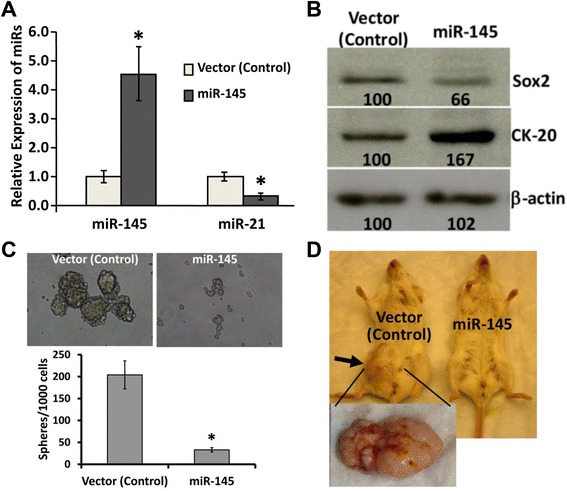
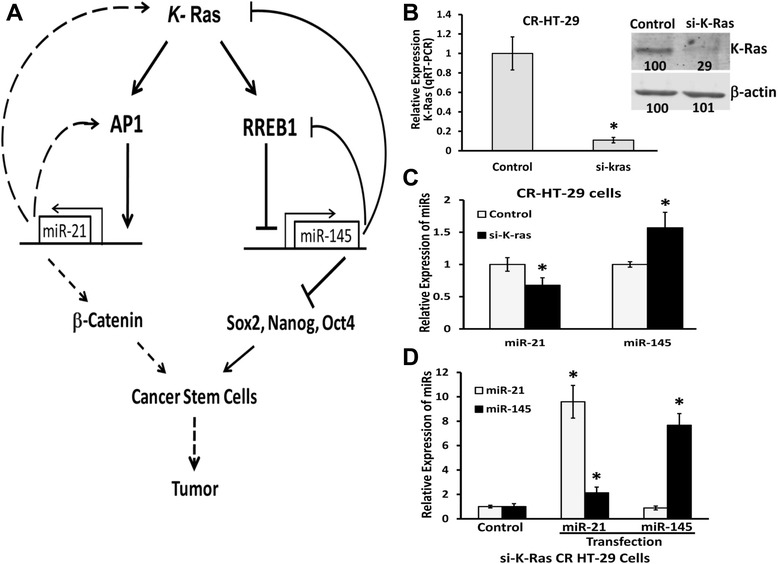
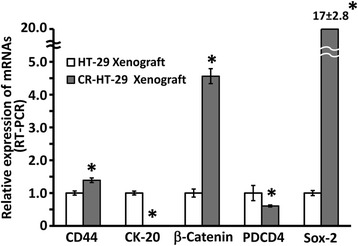
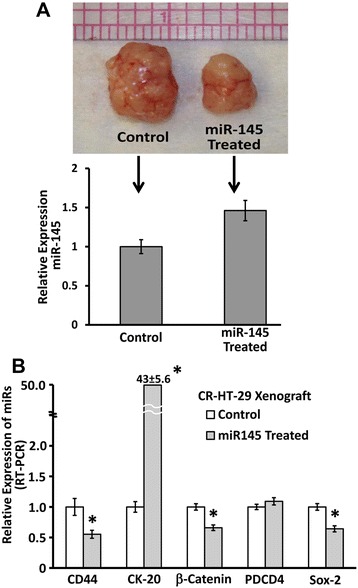
We investigated the role that microRNAs (miRs), specifically miR-21 and miR-145 play in regulating colon CSCs. We found the expression of miR-21 to be greatly increased and miR-145 decreased in CR colon cancer cells that are highly enriched in CSC, indicating a role for these miRNAs in regulating CSCs. In support of this, we found that whereas forced expression of miR-145 in colon cancer cells greatly inhibits CSCs and tumor growth, up-regulation of miR-21 causes an opposite phenomenon. In addition, administration of mature miR-145 or antagomir-21 (anti-sense miR-21) greatly suppresses the growth of colon cancer cell xenografts in SCID mice. This was associated with decreased expression of CD44, β-catenin, Sox-2 and induction of CK-20 indicating that administration of miR-145 or antagomir-21 decreases CSC proliferation and induces differentiation. In vitro studies further demonstrate that miR-21 negatively regulates miR-145 and vice versa. k-Ras appears to play critical role in regulation of this process, as evidenced by the fact that the absence of k-Ras in CR colon cancer cells increases miR-145 expression, suppresses miR-21, and interrupts the negative cooperation between miR-21 and miR-145.
Our current observations suggest that miR-21, miR-145, and their networks play critical roles in regulating CSCs growth and/or differentiation in the colon cancer and progression of chemo-resistance.
获得性耐药是癌症治疗失败的主要原因之一。尽管其原因尚未完全明确,但可能与癌症干细胞(CSCs)的存在有关。我们曾报道,高度富集CSCs的化疗耐药(CR)结肠癌细胞中miR-21显著上调,而该miR的下调使CR细胞对治疗方案更敏感。然而,其潜在分子机制仍知之甚少。本研究旨在揭示这一机制。
通过转染成熟miR、抗miR或pCMV/miR-145表达质粒来调控miR-145和miR-21的水平。采用定量RT-PCR或/和蛋白质免疫印迹法检测CD44、β-连环蛋白、Sox-2、PDCD4、CK-20和k-Ras的表达。进行结肠球形成和SCID小鼠异种移植研究以评估富含CSC的结肠CR细胞的致瘤特性。
我们研究了微小RNA(miRs),特别是miR-21和miR-145在调控结肠CSCs中的作用。我们发现,在高度富集CSC的CR结肠癌细胞中,miR-21表达大幅增加而miR-145表达降低,表明这些miRs在调控CSCs中发挥作用。支持这一观点的是,我们发现,在结肠癌细胞中强制表达miR-145可显著抑制CSCs和肿瘤生长,而miR-21的上调则导致相反现象。此外,给予成熟miR-145或抗miR-21(反义miR-21)可显著抑制SCID小鼠中结肠癌细胞异种移植瘤的生长。这与CD44、β-连环蛋白、Sox-2表达降低及CK-20的诱导有关,表明给予miR-145或抗miR-21可降低CSC增殖并诱导分化。体外研究进一步表明,miR-21负向调控miR-145,反之亦然。k-Ras似乎在这一过程的调控中起关键作用,CR结肠癌细胞中k-Ras的缺失增加miR-145表达、抑制miR-21并中断miR-21与miR-145之间的负向协同作用即证明了这一点。
我们目前的观察结果表明,miR-21、miR-145及其网络在调控结肠癌中CSCs的生长和/或分化以及化疗耐药进展中起关键作用。