Brolan Claire E, Hussain Sameera, Friedman Eric A, Ruano Ana Lorena, Mulumba Moses, Rusike Itai, Beiersmann Claudia, Hill Peter S
School of Population Health, Faculty of Medicine and Biomedical Sciences, The University of Queensland, Brisbane, Australia.
James P Grant School of Public Health, BRAC University, Dhaka, Bangladesh.
Int J Equity Health. 2014 Oct 10;13:66. doi: 10.1186/s12939-014-0066-6.
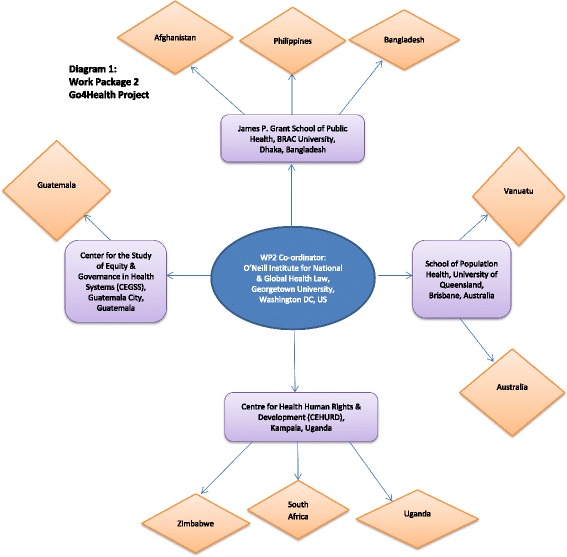
Global discussion on the post-2015 development goals, to replace the Millennium Development Goals when they expire on 31 December 2015, is well underway. While the Millennium Development Goals focused on redressing extreme poverty and its antecedents for people living in developing countries, the post-2015 agenda seeks to redress inequity worldwide, regardless of a country's development status. Furthermore, to rectify the UN's top-down approach toward the Millennium Development Goals' formulation, widespread negotiations are underway that seek to include the voices of people and communities from around the globe to ground each post-2015 development goal. This reflexive commentary, therefore, reports on the early methodological challenges the Go4Health research project experienced in its engagement with communities in nine countries in 2013. Led by four research hubs in Uganda, Bangladesh, Australia and Guatemala, the purpose of this engagement has been to ascertain a 'snapshot' of the health needs and priorities of socially excluded populations particularly from the Global South. This is to inform Go4Health's advice to the European Commission on the post-2015 global goals for health and new governance frameworks. Five methodological challenges were subsequently identified from reflecting on the multidisciplinary, multiregional team's research practices so far: meanings and parameters around qualitative participatory research; representation of marginalization; generalizability of research findings; ethical research in project time frames; and issues related to informed consent. Strategies to overcome these methodological hurdles are also examined. The findings from the consultations represent the extraordinary diversity of marginal human experience requiring contextual analysis for universal framing of the post-2015 agenda. Unsurprisingly, methodological challenges will, and did, arise. We conclude by advocating for a discourse to emerge not only critically examining how and whose voices are being obtained at the community-level to inform the post-2015 health and development goal agenda, but also how these voices are being translated and integrated into post-2015 decision-making at national and global levels.
关于2015年后发展目标的全球讨论正在热烈进行中,这些目标将于2015年12月31日千年发展目标到期时取而代之。千年发展目标侧重于解决发展中国家人民的极端贫困及其根源问题,而2015年后议程旨在解决全球范围内的不平等问题,无论一个国家的发展状况如何。此外,为纠正联合国制定千年发展目标时采用的自上而下的方法,目前正在进行广泛的谈判,力求纳入全球各地人民和社区的声音,以使每一项2015年后发展目标都有坚实基础。因此,本反思性评论报告了Go4Health研究项目在2013年与九个国家的社区接触过程中早期遇到的方法学挑战。该项目由乌干达、孟加拉国、澳大利亚和危地马拉的四个研究中心牵头,此次接触的目的是确定社会排斥群体,特别是来自全球南方的社会排斥群体的健康需求和优先事项 “快照”。这将为Go4Health向欧盟委员会提供的关于2015年后全球健康目标和新治理框架的建议提供参考。通过反思多学科、多区域团队迄今为止的研究实践,随后确定了五个方法学挑战:定性参与式研究的意义和参数;边缘化的呈现;研究结果的可推广性;项目时间框架内的伦理研究;以及与知情同意相关的问题。还研究了克服这些方法学障碍的策略。磋商结果表明,边缘人群体的经历极为多样,需要进行背景分析,以便为2015年后议程的普遍框架提供依据。不出所料,方法学挑战已经出现,而且还会继续出现。我们最后倡导开展一场讨论,不仅要批判性地审视在社区层面如何获取以及获取哪些人的声音,以为2015年后健康与发展目标议程提供信息,还要审视这些声音如何在国家和全球层面转化并纳入2015年后的决策过程。