Yu Haixiang, Littlewood Trevor, Bennett Martin
Division of Cardiovascular Medicine, University of Cambridge, Box 110, Addenbrooke's Centre for Clinical Investigation, Addenbrooke's Hospital, Hills Road, Cambridge CB2 0QQ, UK.
Department of Biochemistry, University of Cambridge, 80 Tennis Court Road, Cambridge CB2 1GA, UK.
Vascul Pharmacol. 2015 Aug;71:57-64. doi: 10.1016/j.vph.2015.03.003. Epub 2015 Apr 28.
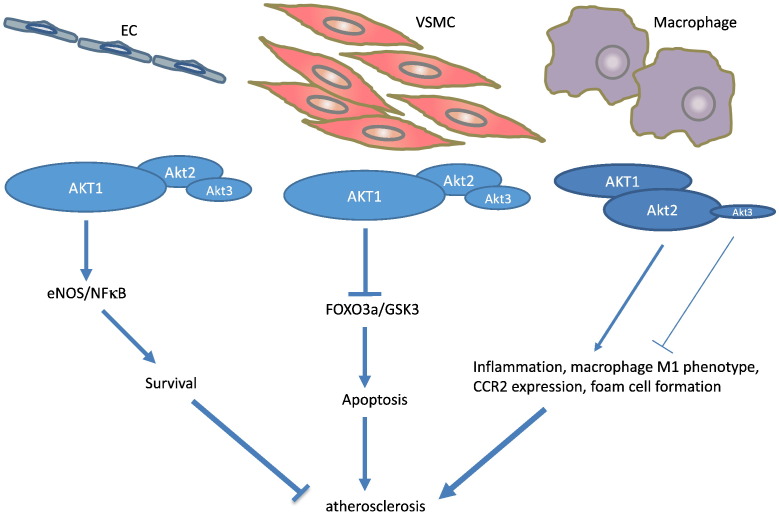
The mammalian serine/threonine Akt kinases comprise three closely related isoforms: Akt1, Akt2 and Akt3. Akt activation has been implicated in both normal and disease processes, including in development and metabolism, as well as cancer and cardiovascular disease. Although Akt signalling has been identified as a promising therapeutic target in cancer, its role in cardiovascular disease is less clear. Importantly, accumulating evidence suggests that the three Akt isoforms exhibit distinct tissue expression profiles, localise to different subcellular compartments, and have unique modes of activation. Consistent with in vitro findings, genetic studies in mice show distinct effects of individual Akt isoforms on the pathophysiology of cardiovascular disease. This review summarises recent studies of individual Akt isoforms in atherosclerosis, vascular remodelling and aneurysm formation, to provide a comprehensive overview of Akt function in vascular disease.
哺乳动物的丝氨酸/苏氨酸蛋白激酶Akt由三种密切相关的亚型组成:Akt1、Akt2和Akt3。Akt激活与正常和疾病过程均有关联,包括发育和代谢,以及癌症和心血管疾病。尽管Akt信号通路已被确定为癌症中一个有前景的治疗靶点,但其在心血管疾病中的作用尚不清楚。重要的是,越来越多的证据表明,三种Akt亚型表现出不同的组织表达谱,定位于不同的亚细胞区室,并且具有独特的激活模式。与体外研究结果一致,小鼠的基因研究表明,单个Akt亚型对心血管疾病的病理生理学有不同的影响。本综述总结了最近关于单个Akt亚型在动脉粥样硬化、血管重塑和动脉瘤形成方面的研究,以全面概述Akt在血管疾病中的功能。