Panouillères Muriel T N, Joundi Raed A, Brittain John-Stuart, Jenkinson Ned
Nuffield Department of Clinical Neurosciences, University of Oxford, John Radcliffe Hospital, Oxford, OX3 9DU, UK.
Department of Physiology, Anatomy and Genetics, University of Oxford, South Parks Road, Oxford, OX1 3QX, UK.
J Physiol. 2015 Aug 15;593(16):3645-55. doi: 10.1113/JP270484. Epub 2015 Jun 23.
Healthy ageing in man is associated with a decline in motor adaptation. Transcranial direct current stimulation (TDCS) over the primary motor cortex (M1) or the lateral cerebellum can improve motor adaptation in young and older adults, but as yet no direct comparisons of TDCS effects exist between the two age groups and the two stimulation sites. TDCS over M1 enhanced the motor adaptation in both age groups by ∼30% relative to their respective non-stimulated groups and improved the performance of older adults to the extent that it compared with that of young adults without stimulation. The study suggests that the plastic mechanisms activated by TDCS that underpin improvements in motor behaviour in young adults remain available in older adults. The results indicate that TDCS may be a useful tool to help combat the normal decline in motor performance seen in normal healthy ageing.
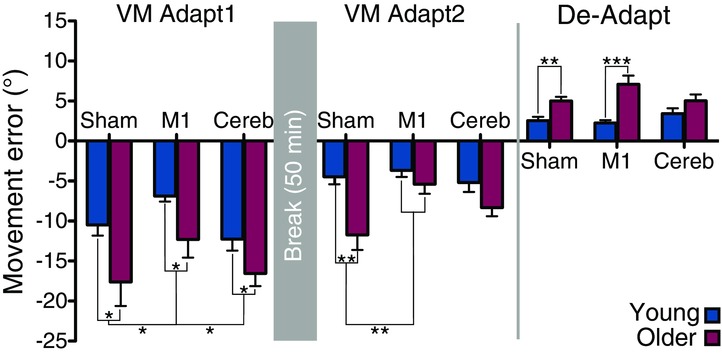
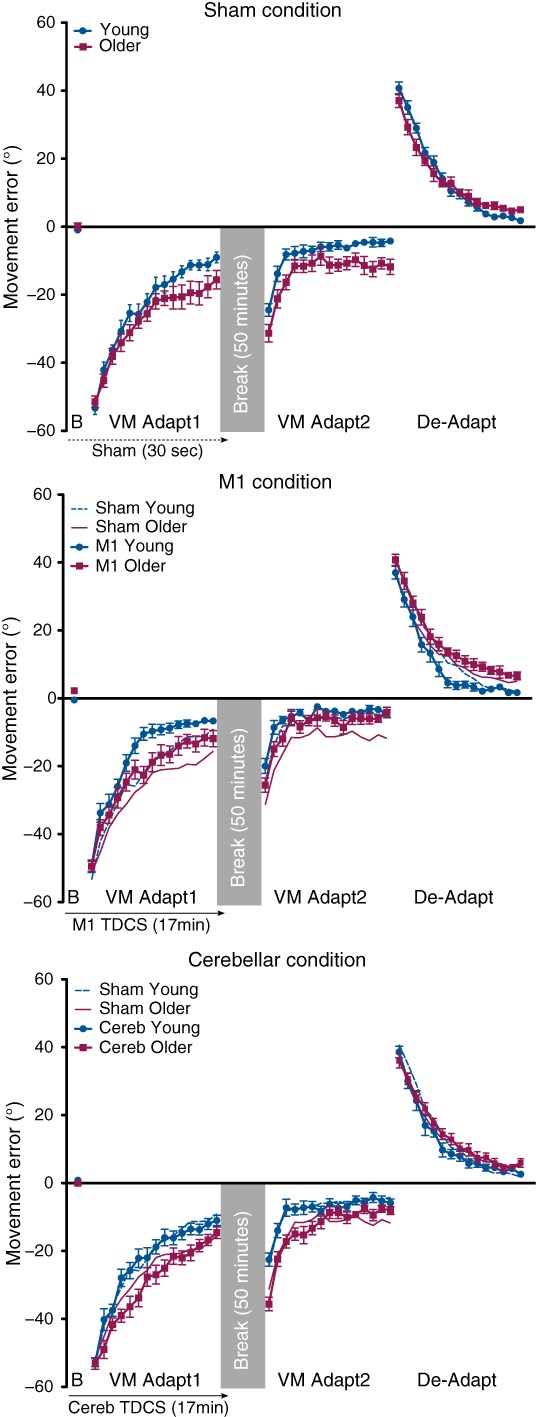
Healthy ageing is characterised by deterioration of motor performance. In normal circumstances motor adaptation corrects for movements' inaccuracies and as such, it is critical in maintaining optimal motor control. However, motor adaptation performance is also known to decline with age. Anodal transcranial direct current stimulation (TDCS) of the cerebellum and the primary motor cortex (M1) have been found to improve visuomotor adaptation in healthy young and older adults. However, no study has directly compared the effect of TDCS on motor adaptation between the two age populations. The aim of our study was to investigate whether the application of anodal TDCS over the lateral cerebellum and M1 affected motor adaptation in young and older adults similarly. Young and older participants performed a visuomotor rotation task and concurrently received TDCS over the left M1, the right cerebellum or received sham stimulation. Our results replicated the finding that older adults are impaired compared to the young adults in visuomotor adaptation. At the end of the adaptation session, older adults displayed a larger error (-17 deg) than the young adults (-10 deg). The stimulation of the lateral cerebellum did not change the adaptation in both age groups. In contrast, anodal TDCS over M1 improved initial adaptation in both age groups by around 30% compared to sham and this improvement lasted up to 40 min after the end of the stimulation. These results demonstrate that TDCS of M1 can enhance visuomotor adaptation, via mechanisms that remain available in the ageing population.
男性的健康衰老与运动适应性下降有关。对初级运动皮层(M1)或外侧小脑进行经颅直流电刺激(TDCS)可改善年轻人和老年人的运动适应性,但目前尚无关于两个年龄组和两个刺激部位TDCS效果的直接比较。相对于各自的未刺激组,对M1进行TDCS可使两个年龄组的运动适应性提高约30%,并将老年人的表现提高到与未受刺激的年轻人相当的程度。该研究表明,TDCS激活的、支撑年轻人运动行为改善的可塑性机制在老年人中仍然存在。结果表明,TDCS可能是一种有用的工具,有助于对抗正常健康衰老过程中出现的运动表现正常下降。
健康衰老的特征是运动表现恶化。在正常情况下,运动适应性可纠正运动的不准确之处,因此对于维持最佳运动控制至关重要。然而,运动适应性表现也会随着年龄的增长而下降。已发现对小脑和初级运动皮层(M1)进行阳极经颅直流电刺激(TDCS)可改善健康年轻人和老年人的视觉运动适应性。然而,尚无研究直接比较TDCS对两个年龄人群运动适应性的影响。我们研究的目的是调查在外侧小脑和M1上施加阳极TDCS是否对年轻人和老年人的运动适应性有类似影响。年轻和年长的参与者执行视觉运动旋转任务,并同时接受左侧M1、右侧小脑的TDCS或假刺激。我们的结果重复了这一发现,即与年轻人相比,老年人在视觉运动适应性方面受损。在适应阶段结束时,老年人的误差(-17度)比年轻人(-10度)更大。外侧小脑的刺激在两个年龄组中均未改变适应性。相比之下,与假刺激相比,对M1进行阳极TDCS可使两个年龄组的初始适应性提高约30%,并且这种改善在刺激结束后持续长达40分钟。这些结果表明,M1的TDCS可通过在老年人群中仍然存在的机制增强视觉运动适应性。