Ramalho Juciany R O, Mambrini Juliana V M, César Cibele C, de Oliveira César M, Firmo Josélia O A, Lima-Costa Maria Fernanda, Peixoto Sérgio V
Rene Rachou Research Center, Oswaldo Cruz Foundation, Belo Horizonte, Brazil.
Rene Rachou Research Center, Oswaldo Cruz Foundation, Belo Horizonte, Brazil ; Department of Statistics, Federal University of Minas Gerais, Belo Horizonte, Brazil.
Clin Interv Aging. 2015 Apr 16;10:751-8. doi: 10.2147/CIA.S74569. eCollection 2015.
To investigate the association between physical activity (eg, energy expenditure) and survival over 11 years of follow-up in a large representative community sample of older Brazilian adults with a low level of education. Furthermore, we assessed sex as a potential effect modifier of this association.
A population-based prospective cohort study was conducted on all the ≥60-year-old residents in Bambuí city (Brazil). A total of 1,606 subjects (92.2% of the population) enrolled, and 1,378 (85.8%) were included in this study. Type, frequency, and duration of physical activity were assessed in the baseline survey questionnaire, and the metabolic equivalent task tertiles were estimated. The follow-up time was 11 years (1997-2007), and the end point was mortality. Deaths were reported by next of kin during the annual follow-up interview and ascertained through the Brazilian System of Information on Mortality, Brazilian Ministry of Health. Hazard ratios (95% confidence intervals [CIs]) were estimated by Cox proportional-hazard models, and potential confounders were considered.
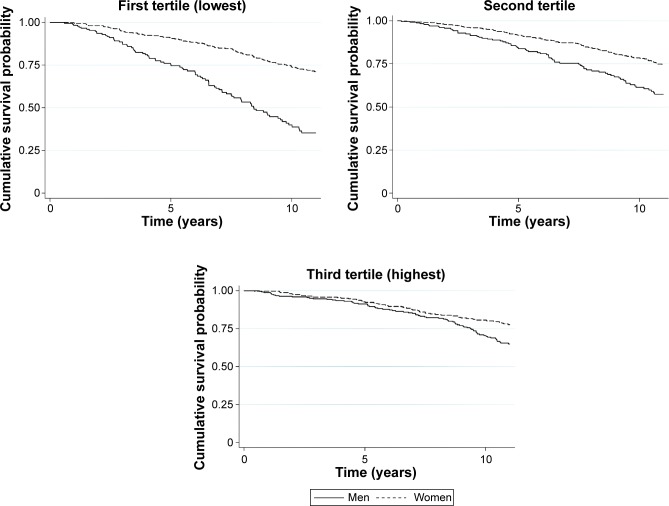
A statistically significant interaction (P<0.03) was found between sex and energy expenditure. Among older men, increases in levels of physical activity were associated with reduced mortality risk. The hazard ratios were 0.59 (95% CI 0.43-0.81) and 0.47 (95% CI 0.34-0.66) for the second and third tertiles, respectively. Among older women, there was no significant association between physical activity and mortality.
It was possible to observe the effect of physical activity in reducing mortality risk, and there was a significant interaction between sex and energy expenditure, which should be considered in the analysis of this association in different populations.
在一个具有代表性的低教育水平巴西老年成年人社区大样本中,调查身体活动(如能量消耗)与11年随访期内生存率之间的关联。此外,我们评估了性别作为该关联潜在效应修饰因素的作用。
对巴西班布伊市所有60岁及以上居民进行了一项基于人群的前瞻性队列研究。共有1606名受试者(占总人口的92.2%)登记入组,其中1378名(85.8%)被纳入本研究。在基线调查问卷中评估身体活动的类型、频率和持续时间,并估算代谢当量任务三分位数。随访时间为11年(1997 - 2007年),终点为死亡率。在年度随访访谈中,由近亲报告死亡情况,并通过巴西卫生部的巴西死亡率信息系统进行确认。通过Cox比例风险模型估计风险比(95%置信区间[CI]),并考虑潜在混杂因素。
发现性别与能量消耗之间存在统计学显著交互作用(P<0.03)。在老年男性中,身体活动水平的增加与死亡风险降低相关。第二和第三三分位数的风险比分别为0.59(95%CI 0.43 - 0.81)和0.47(95%CI 0.34 - 0.66)。在老年女性中,身体活动与死亡率之间无显著关联。
可以观察到身体活动对降低死亡风险的作用,并且性别与能量消耗之间存在显著交互作用,在分析不同人群的这种关联时应予以考虑。