Integrated Research Group in Biomarkers, Rene Rachou Institute, Oswaldo Cruz Foundation, Avenida Augusto de Lima, 1715 - Barro Preto -, Belo Horizonte, Minas Gerais, 30190-002, Brazil.
José do Rosário Vellano University, UNIFENAS/BH, Belo Horizonte, Brazil.
Infect Dis Poverty. 2020 May 11;9(1):51. doi: 10.1186/s40249-020-00663-w.
Chagas disease is endemic in Latin America and still represents an important public health problem in the region. Chronic cardiomyopathy is the most significant chronic form due to its association with morbidity and mortality. The last decade has seen increasing evidence that inflammatory cytokines and chemokines are responsible for the generation of inflammatory infiltrate and tissue damage, with chronic chagasic cardiomyopathy patients presenting a pro-inflammatory immune response. Although studies have evaluated the role of chemokines in experimental T. cruzi infection, few have addressed their systemic profile, especially for human infection and in aging populations. The present work aimed to use the data from a large population based study of older adults, conducted in an endemic area for Chagas disease, to examine the association between serum levels of cytokines and chemokines, T. cruzi infection and electrocardiogram (ECG) abnormality.
The present work evaluated serum levels of CCL2, CXCL9, CXCL10, CCL5, CXCL8, IL-1β, IL-6, TNF, IL-12 and IL-10 by Flow Cytometric Bead Array assay (CBA) and the results expressed in pg/ml. The baseline survey started in January 1st 1997, with 1284 participants of an aged population-based cohort. Participants signed an informed consent at baseline and at each subsequent visit and authorized death certificate and medical records verification.
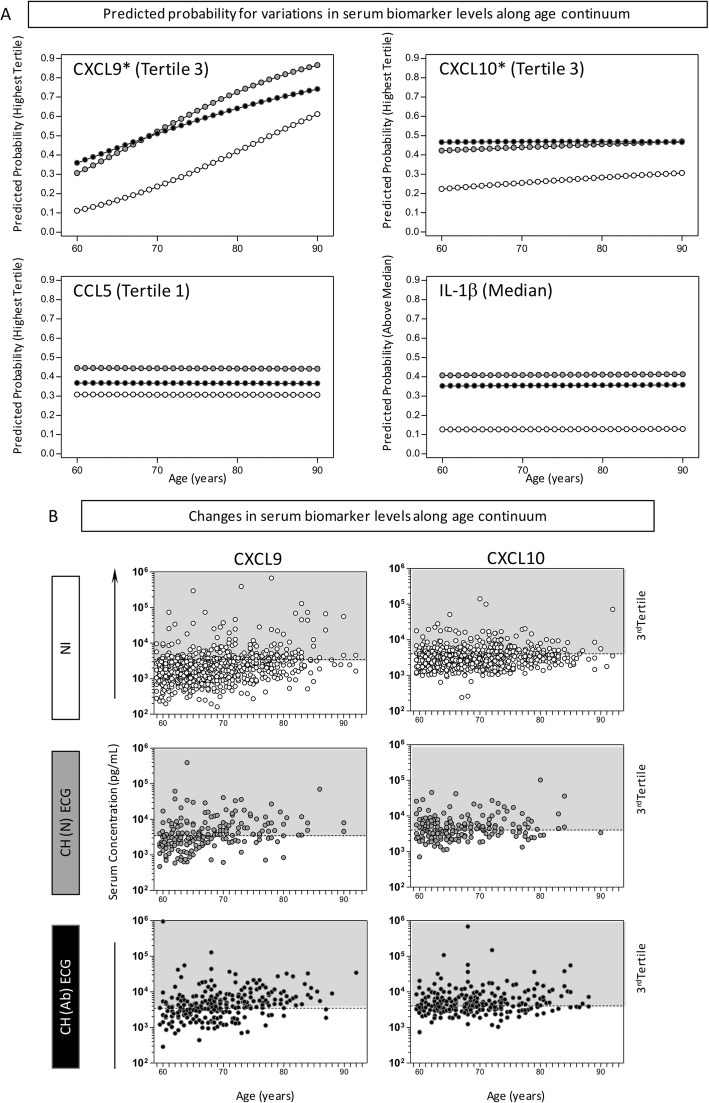
Our results demonstrated that Chagas disease patients had higher serum levels of CXCL9, CXCL10 and IL-1β and lower serum levels of CCL5 than non-infected subjects. Moreover, our data demonstrated that CXCL9 and CXCL10 increased in an age-dependent profile in Chagas disease patients.
Together, this study provided evidences that serum biomarkers increase along the age continuum and may have potential implications for establishing clinical management protocols and therapeutic intervention in Chagas disease patients.
恰加斯病在拉丁美洲流行,仍是该地区一个重要的公共卫生问题。慢性心肌病是最严重的慢性形式,因为它与发病率和死亡率有关。过去十年的证据越来越多表明,炎症细胞因子和趋化因子是导致炎症浸润和组织损伤的原因,慢性恰加斯病患者表现出促炎免疫反应。尽管已经有研究评估了趋化因子在实验性 T. cruzi 感染中的作用,但很少有研究涉及它们的系统特征,特别是针对人类感染和老年人群。本研究旨在利用在恰加斯病流行地区进行的一项大型老年人群基础研究的数据,研究细胞因子和趋化因子的血清水平与 T. cruzi 感染和心电图(ECG)异常之间的关联。
本研究通过流式细胞术珠阵列分析(CBA)评估了血清中 CCL2、CXCL9、CXCL10、CCL5、CXCL8、IL-1β、IL-6、TNF、IL-12 和 IL-10 的水平,并以 pg/ml 表示。基线调查于 1997 年 1 月 1 日开始,参与者为一个基于年龄的队列中的 1284 名老年人。参与者在基线时和每次后续访问时都签署了知情同意书,并授权死亡证明和医疗记录验证。
我们的结果表明,与未感染的受试者相比,恰加斯病患者的血清 CXCL9、CXCL10 和 IL-1β水平较高,而 CCL5 水平较低。此外,我们的数据表明,恰加斯病患者的 CXCL9 和 CXCL10 水平随年龄呈依赖性增加。
综上所述,这项研究提供了证据表明,血清生物标志物随年龄增长而增加,这可能对恰加斯病患者建立临床管理方案和治疗干预具有潜在意义。